1-855-QUOTEMR

Table of Contents [hide]
Who This Is For
This strategic resource is built for single-family homeowners planning to upgrade their properties with energy-efficient windows. If you want to understand Section 25C tax qualifications, calculate your precise material versus labor cost splits, and maximize your federal tax write-offs before strict deadlines expire, this guide is for you.
Key Takeaways
- The Single Window Baseline: Because the federal tax credit caps at $600 annually, purchasing just one premium qualifying window mathematically maximizes your entire yearly deduction.
- Strict Cost Exclusions: The Section 25C credit applies solely to 30% of the raw product material costs, meaning all installation labor fees are completely excluded from the calculation.
- Accelerated Deadlines: Due to recent legislative changes, homeowners must ensure all energy-efficient windows are fully installed and placed in service by December 31, 2025.
- Tax Form Verification: Claiming your credit on early 2026 tax filings strictly requires inputting a unique four-digit Qualified Manufacturer Identification Number on IRS Form 5695.
- Climate Certification Standards: To qualify for any financial incentive, all upgraded units must achieve the prestigious ENERGY STAR Most Efficient designation for your specific climate zone.
Are you looking to lower your winter heating bills and reduce your summer cooling costs? Upgrading old, drafty glass packages is one of the most effective ways to stabilize your indoor climate and protect your home investment.
According to official data from the Internal Revenue Service (IRS Guidelines), the federal government incentivizes these structural improvements by offering a substantial tax credit. Homeowners can reclaim 30% of their eligible product expenses under the Section 25C tax code.
However, navigating these regulatory definitions can be difficult without a clear financial context. At Mr. Remodel, we analyze thousands of active window projects to translate dense government rules into actionable project economics.
See Related: How Much Do New Windows Save on Cooling Bills | $16k Cost vs. ROI
Decoding Section 25C Limits and Project Economics
The primary mistake property owners make is assuming the federal energy incentive covers their entire contractor invoice. The Section 25C framework features explicit boundaries regarding what qualifies for a financial write-off.
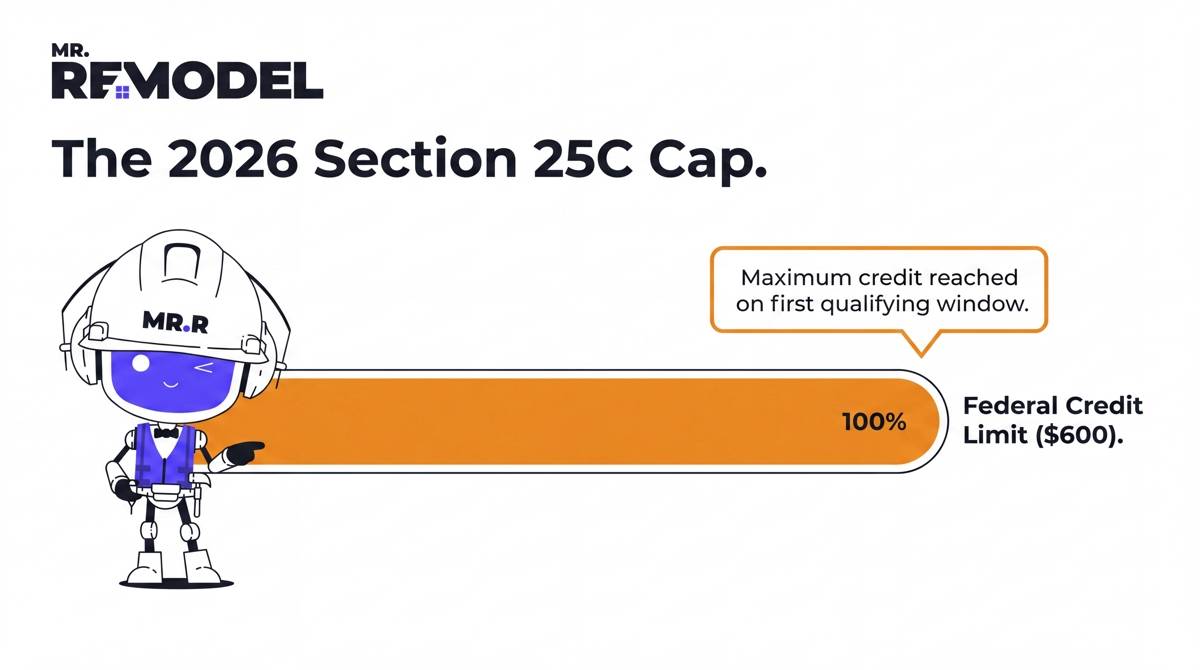
The federal credit features a hard cap of $600 annually for windows and skylights. Furthermore, documentation from ENERGY STAR Federal Tax Credits confirms that the credit applies strictly to product costs, completely omitting construction labor.
Our proprietary project metrics highlight the absolute reality of this cost split. Our internal database indicates that the average cost of a closed-sale residential window is $2,896.70.
The Material vs. Labor Calculation
When preparing your financial layout, you must isolate the raw product value from the contractor's assembly fees. Installation and removal labor generally accounts for about 30% of your total window replacement invoice.
Removing that 30% labor allocation from our $2,896.70 average project unit leaves a raw material cost of roughly $2,027. This mathematical breakdown carries massive tax implications for your household budget.
Because 30% of that $2,027 material baseline equals $608, upgrading just one single premium window hits the maximum allowable federal cap. You do not need a whole-house overhaul to claim the full $600 incentive.
Project Scaling Realities
While a single window maximizes your annual credit, most residential properties require a larger initial scope. Homeowners usually replace multiple compromised frames at once to optimize regional shipping and local permitting costs.
Our closed-sales tracking shows that a typical client project consists of six windows. This volume results in an average total project expenditure of $17,187.54 when factoring in custom sizing.
To see how individual window sizes scale across different residential layouts, consult our replacing 5 windows cost guide. This tool helps you map out baseline structural expenses before planning your tax deductions.
The Accelerated 2025 Deadline and Legislative Urgency
Homeowners planning these exterior renovations cannot afford to delay their projects. Recent legislative updates have injected immense urgency into the residential home improvement market.
The passage of the One Big Beautiful Bill Act of 2025 dramatically accelerated the sunset timelines for these federal incentives. Property owners must alter their scheduling expectations to avoid missing out on these savings.
To claim the Section 25C credit on your early 2026 tax returns, your windows must be fully installed and placed in service by December 31, 2025. Missing this strict calendar cutoff eliminates your deduction eligibility.
See Related: Window Replacement Timeline | Custom Lead Times vs. In-Stock Speed
Strict Efficiency Standards and Regional Cost Volatility
You cannot simply buy standard retail windows off the shelf and expect an IRS deduction. The federal government enforces rigorous performance benchmarks to ensure products provide true environmental optimization.
Every upgraded unit must achieve the ENERGY STAR Most Efficient designation. As outlined by the Department of Energy (ENERGY STAR Climate Zones), windows must meet specific U-factor and Solar Heat Gain Coefficient values tailored to your geographical region.
Cold-Market Thermal Requirements
Homeowners living in freezing northern environments face the highest efficiency barriers. Colder target markets require advanced thermal engineering to stop interior heat from escaping through the glass.
Our market analysis indicates that average window projects reach $25,831.00 in Colorado and settle around $24,333.00 in Oregon. These premium prices reflect the necessity of multi-pane structural configurations.
These advanced product requirements instantly trigger the maximum federal tax threshold due to elevated baseline manufacturing costs. Investing in superior insulation ensures your property complies with strict local energy mandates.
See Related: Are Triple Pane Windows Worth It? | 2026 ROI & V7 Tax Credits
Warm-Climate Solar Defense
Conversely, southern properties require specialized glass layers designed to deflect intense solar radiation. Blocking ultraviolet rays keeps your air conditioning system from working too hard during intense summer heatwaves.
If you are renovating a home in the southern half of the country, selecting efficient windows for hot climates is critical. These systems provide excellent cooling relief while protecting your interior flooring from sun fade.
See Related: Energy Efficient Windows | 2026 Ratings, Costs & Savings Guide
Tax Filing Compliance and Fraud Prevention
The Internal Revenue Service has significantly tightened its reporting protocols to eliminate fraudulent deduction claims. Homeowners must secure exact manufacturing data from their installation crews to file successfully.
When submitting your early 2026 tax documentation, you must utilize IRS Form 5695. This form now mandates the inclusion of a unique four-digit Qualified Manufacturer Identification Number for every product line claimed.
Failing to provide this verified code results in an immediate automated rejection of your energy credit. Working with certified, transparent suppliers ensures you possess all required tax tracking codes.
See Related: Low-E Glass Explained | Low-E 366 vs. Passive Solar (2026)
Vetting Specialists for Certified Installations
Because a single measurement error can compromise the thermal seal of an entire window assembly, choosing your installation partner requires careful evaluation. Poorly fitted frames allow air leakage that negates your expensive material upgrades.
Homeowners trying to navigate tight budgets often look at the DIY vs professional contractor limits to see where they can save money. However, self-installation risks voiding both your manufacturer's warranty and your federal tax credit eligibility.
To guarantee compliance with the latest IRS definitions, you should always choose to hire a window company that provides certified product codes. Vetted firms handle the heavy structural engineering while securing your long-term return on investment.
Do not miss out on the 2025 calendar deadline. Let Mr. Remodel connect you with fully licensed regional specialists who provide verified manufacturing codes. Request a free quote for professional window installation services to lock in your federal energy deductions.
Frequently Asked Questions
What is the maximum Section 25C tax credit for windows in 2026?
The federal credit caps at a hard limit of $600 per year for windows and skylights. This deduction represents a maximum of 30% of your eligible raw material expenses.
Does the federal energy tax credit cover installation labor costs?
No. The Section 25C incentive applies exclusively to product material costs. All contractor fees for removal, framing labor, and disposal are completely excluded from the tax calculation.
What is a QMID number on IRS Form 5695?
The Qualified Manufacturer Identification Number is a mandatory four-digit tracking code. It proves your upgraded windows meet strict federal efficiency rules and prevents tax deduction rejections.
Why do window replacement costs vary so much between Colorado and Ohio?
Colorado requires advanced, multi-pane insulation packages to meet strict cold-weather climate rules, driving project averages to $25,831.00. Warmer, stable supply chains in other areas keep baselines lower.
Can a handyman installation qualify for the energy tax credit?
The credit relies entirely on the window product achieving specific ENERGY STAR standards, not on who sets the glass. However, professional services like Mr. Remodel ensure code-compliant placement to prevent warranty and seal failures.
Capitalize on Energy Savings and Federal Credits
Maximizing your upcoming home renovation requires balancing premium material selections with strict federal timeline requirements. Because purchasing just one qualifying window hits the $600 Section 25C cap, strategic project timing delivers massive financial advantages.
By securing your four-digit tracking numbers and finishing your installation before the December 2025 cutoff, you prevent costly filing rejections. Investing in high-performance glass safeguards your home envelope and lowers your monthly utility costs.
Ready to launch your project before deadlines expire? Get started with Mr. Remodel to finalize your energy-efficient upgrades and secure your federal tax credits with complete peace of mind. Get your free, no-obligation quote to start your project soon.