1-855-QUOTEMR

Table of Contents [hide]
Who This Is For
This guide is for homeowners who know they need better windows but feel overwhelmed by technical jargon like U-Factor and SHGC. If you are trying to decide between triple-pane and double-pane options or wondering if the extra cost for Energy Star Most Efficient products is worth it for your specific zip code, then this article is your roadmap.
Key Takeaways
- Location Dictates Specs: The best window for Minnesota is the wrong choice for Florida. You must buy for your climate zone rather than using a generic national standard.
- The Rules Changed in 2026: Under the new Energy Star Version 7.0 guidelines, Northern homeowners likely need triple-pane glass to qualify for tax credits.
- Solar Heat Gain Matters: In Southern climates, the U-Factor is secondary. Your primary focus must be on a low Solar Heat Gain Coefficient to stop the sun from baking your interiors.
- ROI is Long-Term: While energy savings are real, the immediate financial benefit comes from the 25C Tax Credit and increased home value.
- Installation is Critical: Even the highest-rated glass package will fail if the installation seal is compromised or the flashing is skipped.
Finding truly energy-efficient windows in 2026 is about more than just picking a brand you recognize or looking for a generic blue sticker. The technology has advanced rapidly over the last few years, and government standards have shifted to keep pace. What used to be considered a premium window five years ago might barely meet the minimum building code requirements today.
This guide serves as your comprehensive resource for navigating these changes. We will help you look past the marketing brochures to understand the physics of how windows actually save you money. Whether you are looking to lower your heating bills in the North or reduce the strain on your AC in the South, we have the data you need to make the right choice.
The New Reality of Window Buying in 2026
For years, buying energy-efficient windows was relatively simple. You looked for the Energy Star logo, and you bought the product. That advice is now outdated. With the full implementation of Energy Star Version 7.0, the bar has been raised significantly. The windows that passed inspection just a few years ago might no longer qualify for tax credits or Most Efficient status today.
This shift is not just about environmental goals. It is about passing modern building codes and qualifying for financial incentives. According to the Energy Star Residential Windows, Doors, and Skylights Version 7, the criteria have split sharply based on geography. A window that is considered efficient in Phoenix is now fundamentally different from one that is considered efficient in Duluth.
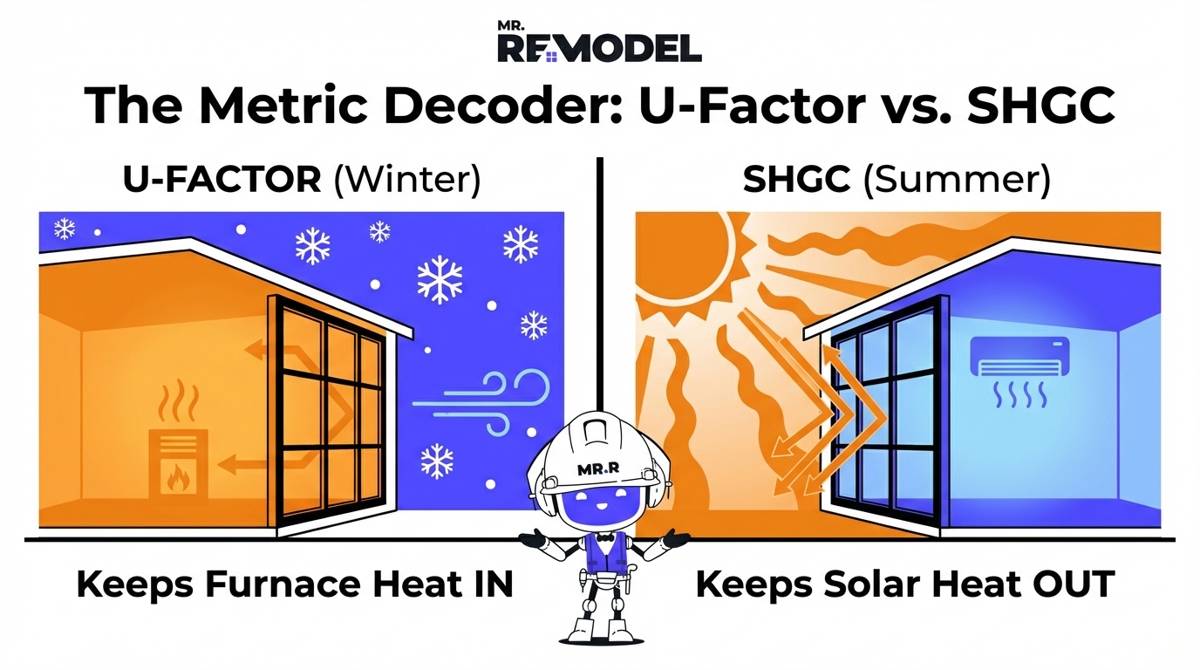
The market is flooded with conflicting advice because many contractors are still quoting based on older Version 6.0 standards. To make a smart investment, you need to understand two main metrics. You must know how well a window keeps heat inside, which is the U-Factor. You also must know how well it keeps heat outside, which is the SHGC.
See Related: U-Factor and SHGC Explained Simply
Why National Advice Fails You
Most general guides fail because they ignore your zip code. Data from Mr. Remodel shows a clear divergence in homeowner behavior depending on where they live. In Northern regions, the median project cost hovers around $16,000. This is driven by the need for heavy insulation against freezing winters.
In the South, volume peaks in late summer as homeowners scramble to lower air conditioning bills. If you apply Northern logic to a Southern home, you might trap unwanted heat inside your house. Conversely, using Southern glass in the North will leave you freezing in January.
The Climate Zone Strategy: What You Need to Buy
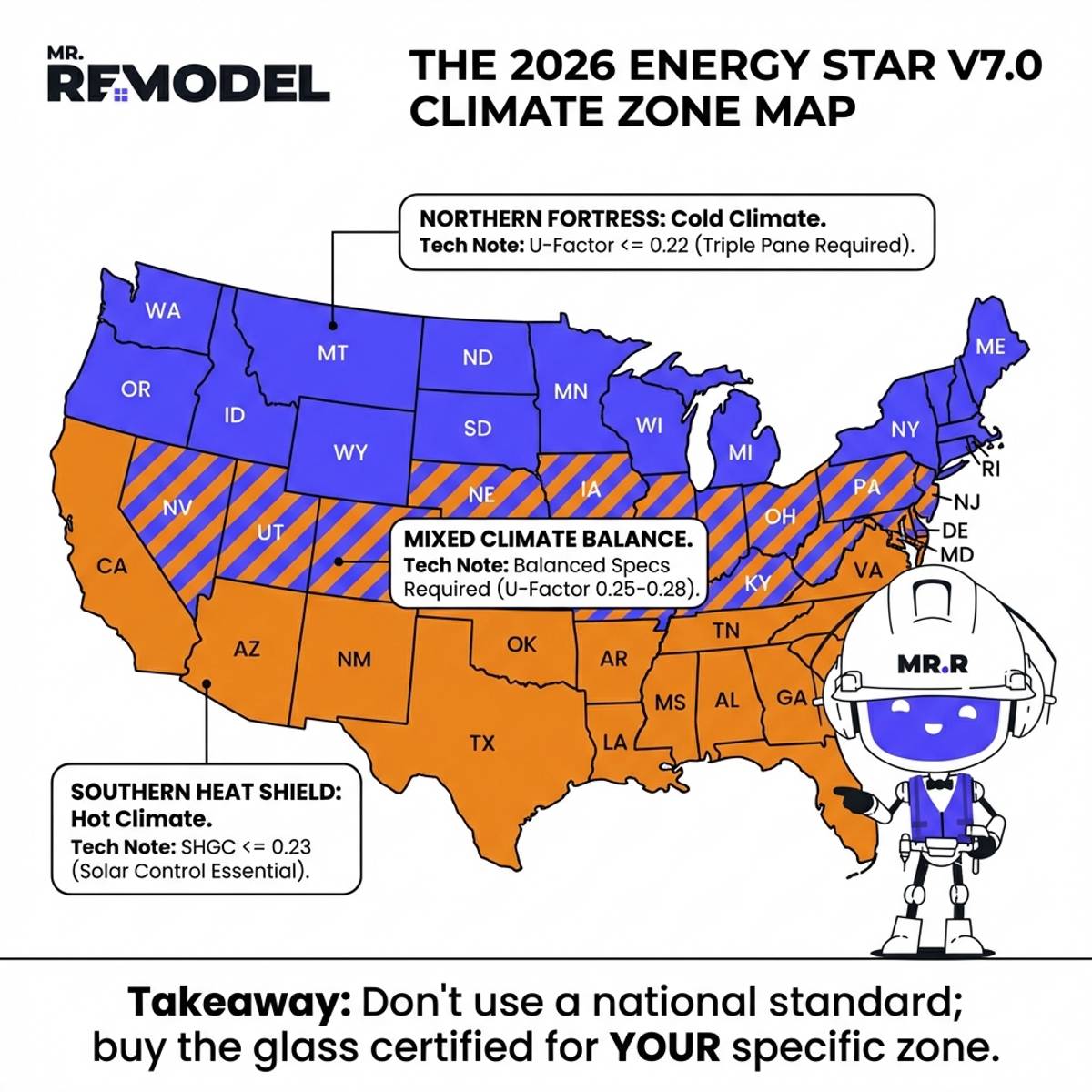
To get the right windows, you first need to identify your climate zone strategy. The Efficient Windows Collaborative provides an excellent breakdown, but we have simplified the buying criteria below based on the new 2026 standards.
The Northern Strategy: Fortress Against the Cold
If you live in the Northern Climate Zone, your primary enemy is conductive heat loss. This includes the Midwest, Northeast, and Mountain regions. You lose heat from the inside of your home to the freezing outdoors through the glass pane.
The Metric That Matters: U-Factor.
The lower the U-Factor, the better the window insulates. Under Energy Star V7.0, Northern windows must now meet a U-Factor of 0.22 or lower.
The Hard Truth About Triple-Pane Windows
Reaching a U-Factor of 0.22 with standard double-pane glass is incredibly difficult. It is bordering on impossible for many manufacturers. This means that for Northern homeowners, triple-pane windows are becoming the new standard.
According to Mr. Remodel's internal data, the Cold Climate Investor demographic is seeing project costs rise as they shift toward these higher-performance units. While the upfront cost is higher, the comfort difference is palpable. A triple-pane window creates a warmer interior glass surface. This eliminates that drafty feeling you get when sitting near a window in winter.
See Related: Are Triple-Pane Windows Worth the Extra Cost?
The Southern Strategy: The Heat Shield
If you live in the Southern or South-Central zones, your enemy is heat. This includes Florida, Texas, and Arizona. You are not trying to keep heat in. You are frantically trying to keep it out.
The Metric That Matters: SHGC (Solar Heat Gain Coefficient).
This number measures how much solar heat passes through the glass. A lower number means less heat. For the South, you want an SHGC of 0.23 or lower.
The Solar Pumping Risk
In hot climates, windows undergo immense thermal stress. As the sun beats down, the space between the panes heats up and expands. At night, it cools and contracts. This cycle is known as solar pumping.
It can cause seal failure in cheaper windows. This is why Southern homeowners need to prioritize robust sealants and spacers alongside their glass coatings. The focus here is not on the number of panes. Double-pane is usually sufficient. The focus is on the quality of the Low-E coating designed to reflect the sun.
See Related: Best Energy Efficient Windows for Hot Climates
The Mixed Climate Strategy: The Balancing Act
For the 51% of homeowners living in mixed climates, the choice is nuanced. This includes places like Virginia, North Carolina, or parts of California. You have cold winters and hot summers.
The goal here is a moderate U-Factor around 0.28 to 0.30. You also want a moderate SHGC. You want to retain furnace heat in the winter without turning your home into a greenhouse in July. Often this is achieved with a Low-E 272 or similar glass package that offers a middle-ground performance.
Quick Reference: 2026 Energy Star Criteria
Use this table to check the quotes you receive from contractors. If the numbers do not match these requirements, you might be buying outdated technology.
Deep Dive: The Technology Behind the Rating
Understanding why a window is efficient helps you spot marketing fluff. It comes down to three components. You must evaluate the glass, the gas, and the coating.
1. The Glass Packages
Double Pane
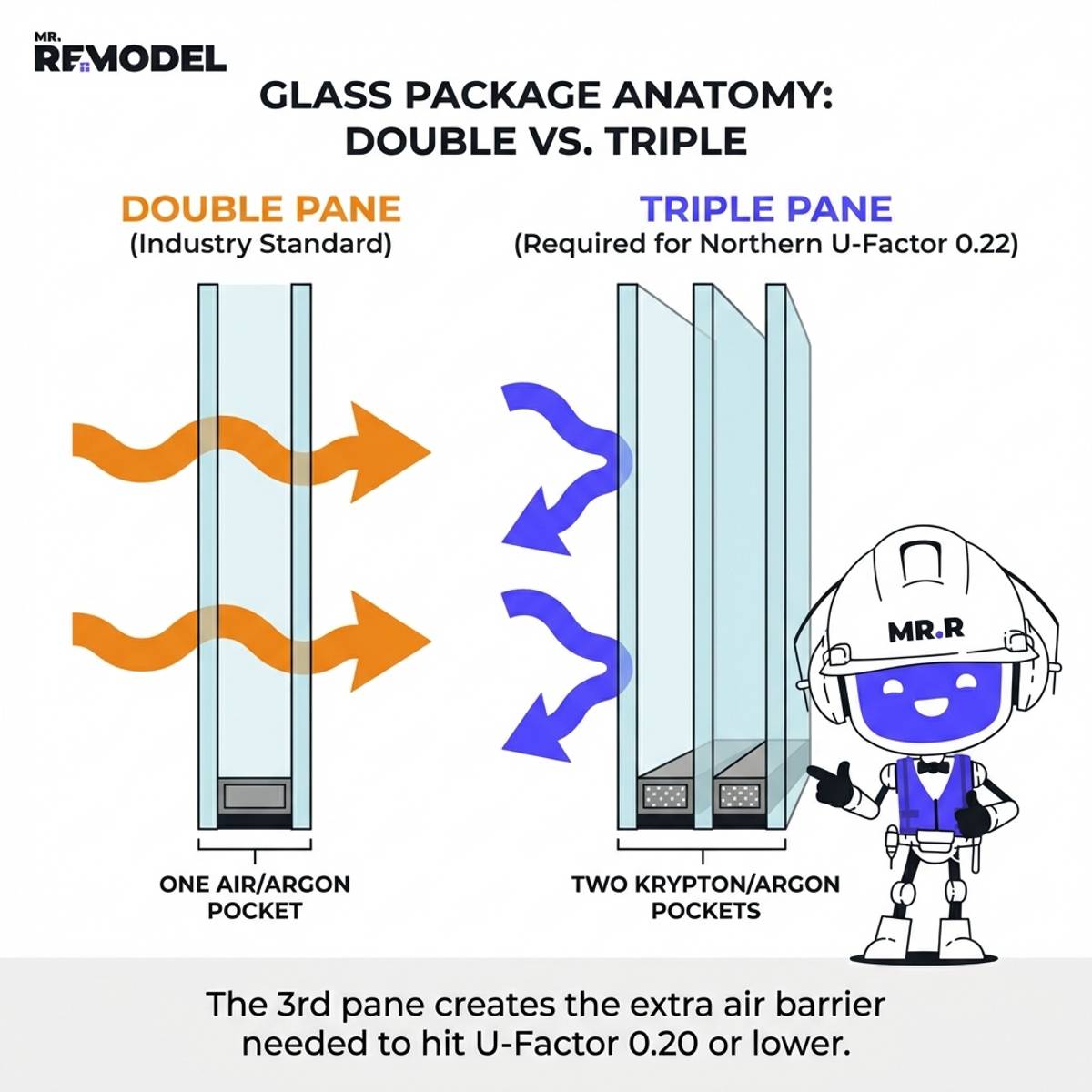
This consists of two sheets of glass with a spacer in between. This is the industry standard and creates a single insulating pocket. It is lighter and cheaper than triple-pane.
Triple Pane
This uses three sheets of glass to create two insulating pockets. This is significantly heavier and more expensive. However, it offers superior sound dampening and insulation. It is the only reliable way to hit a U-Factor of 0.20 or lower.
2. Gas Fills: Argon vs. Krypton
Air is a decent insulator, but heavy gases are better.
- Argon: This is the industry standard. It is inexpensive and non-toxic. It is denser than air, which slows down the transfer of heat.
- Krypton: This is much denser than Argon. It works best in thinner spaces typically found in triple-pane windows. It is more expensive but necessary for achieving those ultra-low U-Factors required in the North.
3. Low-E Coatings (The Invisible Shield)
Low-emissivity glass has a microscopically thin layer of metal sprayed onto one of the glass surfaces. This is usually silver. This layer reflects infrared light while letting visible light pass through.
- Passive Solar Low-E (Hard Coat): This allows some solar heat in to help warm the home. It is great for very cold climates where free heat from the sun is a bonus.
- Solar Control Low-E (Soft Coat): This reflects the sun's heat back outside. It is essential for hot climates to keep AC bills down.
- Low-E 366: This is a common triple-layer silver coating that blocks 95% of solar heat. This is often the default premium option. Be aware that it can sometimes make rooms feel slightly darker due to lower Visible Transmittance.
See Related: Low-E Glass Explained
4. Warm Edge Spacers
The spacer is the strip of material that holds the two pieces of glass apart. Old windows used aluminum spacers. Metal conducts heat. This meant the edge of the glass was always cold in winter, leading to condensation.
Modern energy-efficient windows use Warm Edge Spacers. These are made of silicone, foam, or reinforced thermoplastics. They do not conduct heat. This keeps the edge of the glass warmer and reduces the risk of seal failure.
Analyzing the Financials: Costs vs. Savings
We see many homeowners hesitate at the price tag of energy-efficient windows. It is a significant investment. However, you need to view the cost through the lens of Total Cost of Ownership. This includes purchase price, energy savings, and tax incentives.
The Real Cost of Replacement
According to Mr. Remodel’s market data, median project costs are shifting.
- Standard Replacement: Vinyl frames with double-pane glass typically range from $600 to $900 per opening installed.
- High-Performance: Composite or fiberglass frames with triple-pane glass can range from $1,200 to $1,800 per opening.
This price difference is substantial. However, the performance gap is equally large.
Energy Bill Reduction
Do new windows actually pay for themselves? Yes, but it is a long game. The Pacific Northwest National Laboratory conducted rigorous testing using Lab Homes. These are identical houses subjected to the same weather conditions.
Their findings were compelling. High-performance windows saved an average of 12% on heating and 28% on cooling compared to standard double-pane windows. In a hot climate, a 28% reduction in cooling costs is massive over the lifespan of a 20-year window.
See Related: How Much Do New Windows Save on Cooling Bills
The 25C Tax Credit
The most immediate financial relief comes from the federal government. The Energy Efficient Home Improvement Credit offers a tax credit of 30% of the project cost. This is capped at $600 per year for windows.
To qualify, the windows must meet the Energy Star Most Efficient criteria. This is a critical distinction. Simply being Energy Star Certified is not enough. They must be Most Efficient.
This is why checking the specific ratings on the NFRC Label is mandatory before you sign a contract. For exact details, always refer to the IRS Instructions for Form 5695.
Pro Tip: The $600 cap resets annually. If you have a large project, some homeowners choose to replace windows in stages. You could do half the house in 2026 and half in 2027 to claim the credit twice. |
Resale Value
Beyond the monthly savings, there is the asset value. National real estate data consistently shows that buyers value efficiency. A home with new, high-performance windows sells faster and for a higher price than a home with original single-pane units. You are not just buying lower bills. You are buying equity.
Upgrading your windows is more than just buying glass. It is about improving your home and increasing its value. Whether you are battling the Minnesota freeze or the Texas sun, getting the specs right is the first step.
Mr. Remodel connects you with top-rated local professionals who understand the specific energy codes in your area. Stop guessing at U-Factors and start planning your renovation today by getting a free, no-obligation quote from us.
Frame Material: The Unsung Hero of Efficiency
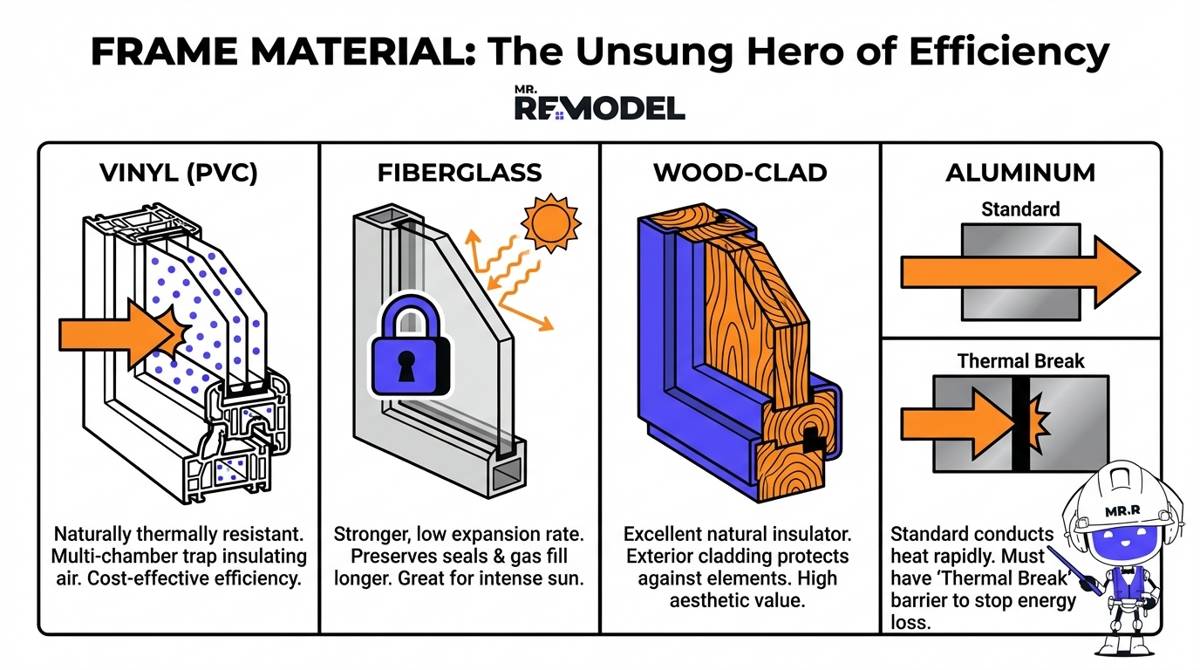
While glass gets all the attention, the frame material plays a huge role in the overall efficiency of the window unit. Heat can flow through the frame just as easily as it flows through the glass.
Vinyl (PVC)
Vinyl is the most popular choice for a reason. It is naturally thermally resistant because it does not conduct heat like metal. It is filled with multi-chambered pockets that trap air for insulation.
High-quality vinyl windows are often the most cost-effective way to hit Energy Star V7.0 numbers. However, cheap vinyl can warp in extreme heat, so ensure you are buying a premium grade.
Fiberglass
Fiberglass is stronger than vinyl. It has a lower expansion and contraction rate. This means the seals are less likely to fail over time, which preserves the Argon gas fill for longer.
For homeowners in the Southern Shield looking for longevity against intense su,n fiberglass is often worth the premium. It can also be painted, which gives you more design flexibility than vinyl.
Wood-Clad
Wood is an excellent natural insulator. It has been used for centuries for a reason. However, wood windows require maintenance. They can rot if moisture gets in.
Most modern wood windows are clad in aluminum or vinyl on the exterior to protect against the elements. These are typically the most expensive option. They are chosen more for aesthetics and historical accuracy than for pure efficiency ROI.
Aluminum
Standard aluminum frames are terrible for energy efficiency because metal conducts heat rapidly. Unless the frame has a very sophisticated thermal break, aluminum should be avoided in climates with extreme temperatures.
A thermal break is a rubber or plastic barrier separating the inside metal from the outside metal. Without it, your frame will feel like an ice cube in winter and a frying pan in summer.
Installation: Where Efficiency Goes to Die
You can buy the most expensive, triple-pane, krypton-filled window on the market. But if the installer does a poor job, you have wasted your money. A drafty window is often not the fault of the glass. It is the fault of the integration between the window frame and the rough opening of your house.
Pocket vs. Full Frame Replacement
There are two ways to install a window. The method you choose affects your energy efficiency.
Pocket Replacement (Insert)
This involves removing the old sashes but leaving the old frame in place. The new window slides into the old frame.
- Pros: It is cheaper and faster. It preserves existing interior trim.
- Cons: You lose some glass area. More importantly, you cannot insulate the gap between the old frame and the house studs. If that gap is uninsulated, it will remain uninsulated.
Full Frame Replacement
This involves ripping everything out down to the studs. The old frame, sashes, and trim are removed.
- Pros: The installer can inspect for rot and water damage. They can fill the gap between the window and the studs with new expanding foam. This provides the best possible airtight seal.
- Cons: It is more expensive and requires new interior trim.
The Importance of Spray Foam
Ensure your installer uses low-expanding spray foam around the perimeter of the window. Old-school fiberglass batt insulation stuffed into the gaps is not enough. Air can pass right through fiberglass. Spray foam creates an air barrier that stops drafts dead in their tracks.
Flashing Tape
Proper flashing is required to prevent water infiltration. Water can rot out the insulation and framing, rendering the energy efficiency moot. When interviewing contractors, ask them specifically about their flashing practices. If they skip this step, do not hire them.
Troubleshooting Common Issues
Even with new windows, homeowners sometimes see things that worry them. Understanding the physics can set your mind at ease.
Exterior Condensation
You wake up in the morning, and the outside of your new window is covered in dew. Is the seal broken? No. This is actually a sign of a very efficient window. It means the outer pane is staying cold while the inner pane stays warm. The heat from your house is not escaping to warm up the outside glass. This condensation will burn off as the sun comes up.
Interior Condensation
This is when water forms on the glass inside your home. This is usually a humidity issue within the house, not a window failure. New windows are so airtight that they trap moisture from cooking, showering, and breathing inside. You may need to run exhaust fans or a dehumidifier to lower your indoor humidity.
Between-Glass Condensation
If you see fog or water droplets between the two panes of glass that you cannot wipe off, this is a failure. It means the seal has broken and the Argon gas has escaped. The window is no longer insulating properly and likely needs to be replaced under warranty.
Frequently Asked Questions
Can I just replace the glass to get better energy efficiency?
Technically, yes, this is called glass pack replacement. However, it is rarely recommended for efficiency upgrades. If your frames are old, they likely lack the multi-chambered insulation of modern vinyl or fiberglass.
Putting high-tech glass in a low-tech frame is like putting a Ferrari engine in a go-kart. Our partner contractors at Mr. Remodel usually recommend full-frame or insert replacements to ensure the entire unit performs to 2026 standards.
How do I know if a window is Energy Star Version 7.0 certified?
Do not just take the salesperson's word for it. Look for the physical Energy Star label adhered to the window. It will list the Climate Zone it is certified for. Furthermore, check the NFRC label for the specific U-Factor and SHGC numbers.
Is the extra cost for triple-pane really necessary?
In the past, the answer was often no. But with the new Version 7.0 standards and the rising cost of energy, the math has changed for Northern climates. The comfort factor alone is worth it for many. Eliminating cold drafts near the glass makes the whole room usable in winter. Plus, if you want the tax credit, you might not have a choice. Mr. Remodel data indicates a sharp rise in triple-pane orders in states like Michigan and New York for this very reason.
What is the difference between U-Factor and R-Value?
You might be used to R-Values when buying wall insulation. Windows use U-Factor. They are essentially opposites. R-Value measures resistance to heat flow, while U-Factor measures the rate of heat flow. A high R-Value is good. A low U-Factor is good. To convert roughly, you can divide 1 by the U-Factor. So a 0.25 U-Factor window has an R-Value of roughly 4.
Your 2026 Window Installation Action Plan
The era of guessing is over. To buy the right windows in 2026, you simply need to follow the data for your region. The technology has evolved to a point where custom solutions are available for every climate.
- For the North: Prioritize a U-Factor ≤ 0.22. This likely means investing in triple-pane glass. It is a higher upfront cost with a $16k median project size, but it secures your tax credit and keeps you warm.
- For the South: Prioritize an SHGC ≤ 0.23. Focus on Solar Control Low-E coatings to reject the sun’s heat and lower those AC bills.
- For Everyone: Verify the NFRC label. Demand high-quality installation with spray foam. Utilize the 25C tax credit to recoup some of your investment.
Don't navigate this complex market alone. Let Mr. Remodel connect you with trusted professionals who know your local building codes and climate needs.
Ready to see what high-performance windows cost for your home?