1-855-QUOTEMR

Table of Contents [hide]
Who This Is For
This is for homeowners who are currently navigating the high-friction process of selecting a professional for a major exterior renovation. This guide is designed to help property owners analyze competing estimates, identify structural risks, and understand the true market costs in 2026 while avoiding common pitfalls of predatory sales tactics.
Key Takeaways
- Verified Financials: The 2026 interquartile range for projects falls between $21,223 and $28,481.
- Statistical Safe Zone: $25,463.20 is the median target for high-quality architectural systems.
- Structural Contingencies: 20% of roofs require decking repairs that must appear as a line item.
- Repair Discrepancy: Reputable professionals record zero revenue from standalone minor patches.
- Market Evolution: 94.8% of homeowners now use digital routing to avoid high-pressure sales calls.
Handing over a five-figure check to a stranger to tear off your roof feels like a massive gamble. Learning how to choose a roofing contractor the only way to protect your financial equity and ensure your family remains safe. In the 2026 market, the gap between a high-performance professional and a substandard operation has never been wider.
At Mr. Remodel, we act as a specialized referral network that filters out high-risk contractors before they ever reach your driveway. We are the data-driven bridge connecting you with pre-vetted professionals. They understand that a roof is a multi-layered engineering system rather than a cosmetic upgrade.
Hacking the 3-Bid Method: The Interquartile Reality
For decades, the standard advice has been to get three bids and pick the middle one. In the current market, that advice is dangerously oversimplified. It often leads homeowners to choose the least qualified professional simply because they look like a bargain. To choose a contractor effectively, you must understand the cost distribution.
Based on our 2025 closed-won project data, we have established a verified interquartile range. This serves as a sanity check for any estimate you receive. If your bids do not fall within these brackets, someone is likely either overcharging you or leaving out critical safety components. This data represents a real-world look at thousands of successful renovations.
See Related: How to Compare Roofing Quotes (3-Bid Method)
The 2026 Pricing Brackets
Homeowners should use these specific figures to categorize the quotes currently sitting on their kitchen table:
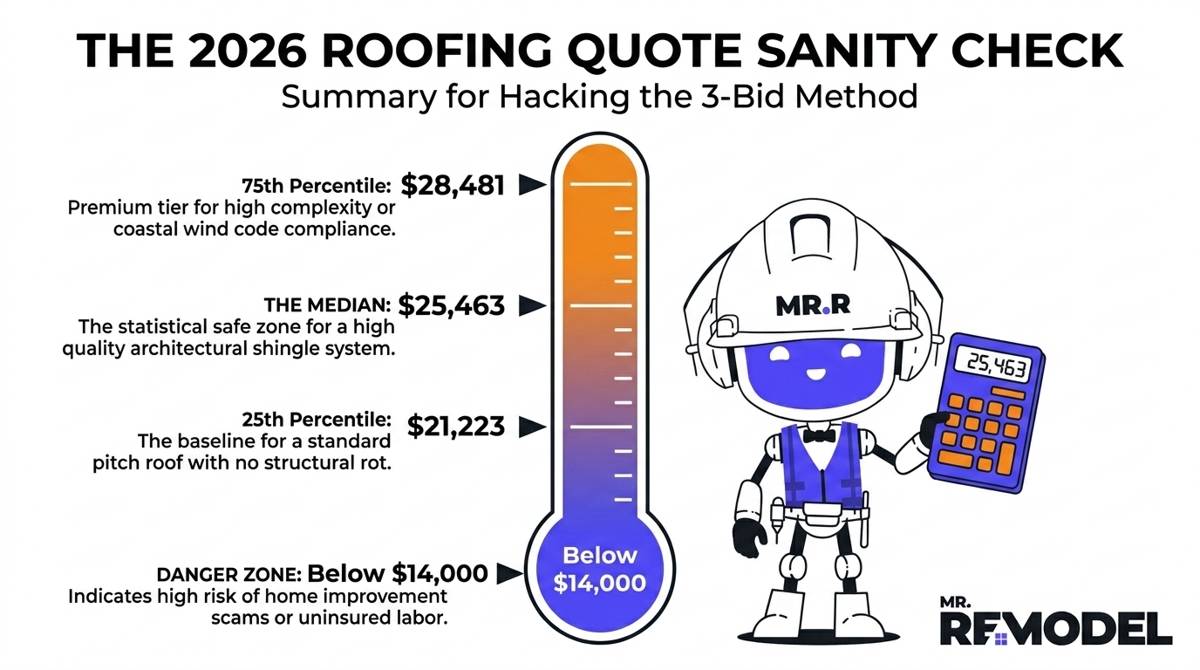
- The 25th Percentile ($21,223.00): This is the baseline for a straightforward, standard-pitch asphalt tear-off with no structural rot.
- The 50th Percentile ($25,463.20): This is the true market center. It represents a high-quality architectural shingle installation with proper ventilation.
- The 75th Percentile ($28,481.25): This is the premium tier, often involving high-complexity roof pitches or coastal wind-code compliance.
If you receive a bid for $14,000, you have found a major red flag. According to the Federal Trade Commission (FTC), home improvement scams often begin with bids that are significantly lower than the market average. A $14,000 quote on a project that should cost $25,000 means the contractor is likely cutting corners.
See Related: Roof Replacement Cost (2026): Materials, Labor, Regional Pricing & ROI
Roofing Estimates Explained: Line-Item Scrutiny
A professional roofing estimate is not a total price scribbled on a piece of paper. It is a technical document that should outline every component of the structural envelope. If a contractor provides a vague estimate, they leave the door open to change orders. Clarity in documentation is the hallmark of a professional contractor.
The most critical line item to look for is the decking contingency. Our data shows that 20% of projects, exactly one in five, encounter hidden structural rot once the old shingles are removed. If your quote does not include a per-sheet price for replacement plywood, you should be extremely cautious. This omission is a sign of a low-balling strategy.
The Importance of Structural Compliance
The Federal Emergency Management Agency (FEMA) explains in its technical guides that replacing rotted roof decking is a structural requirement. A transparent, high-quality contractor will put this contingency in writing on day one. Shady contractors often leave it off to make their initial bid look artificially low.
When reviewing your line items, ensure the following components are listed individually:
- Full tear-off and disposal of existing shingles.
- Installation of new drip edges on all eaves.
- Application of a self-adhering ice and water shield.
- Replacement of all pipe boots and flashing.
- Installation of a new ridge vent system.
See related: Roofing Estimates Explained: What Should Be Included.
Red Flags: Identifying the Low-Quality Operation
In the 2026 market, a significant red flag is a contractor aggressively pushing a cheap repair over a full replacement. While it may sound like they are trying to save you money, our data tells a different story. In our 2025 dataset, we recorded exactly $0 in revenue from standalone minor repairs. This highlights a critical gap in the market.
Reputable, warrantied contractors understand that a localized patch on a failing roof is a structural liability. A contractor offering to patch a leak for $1,000 is often a storm chaser looking for quick cash. They are taking your money for a fix that does not address the underlying failure and actively voids the manufacturer's warranty.
Behavioral Red Flags for Homeowners
Beyond the price, pay close attention to the contractor's administrative behavior. A professional operation will follow these protocols:
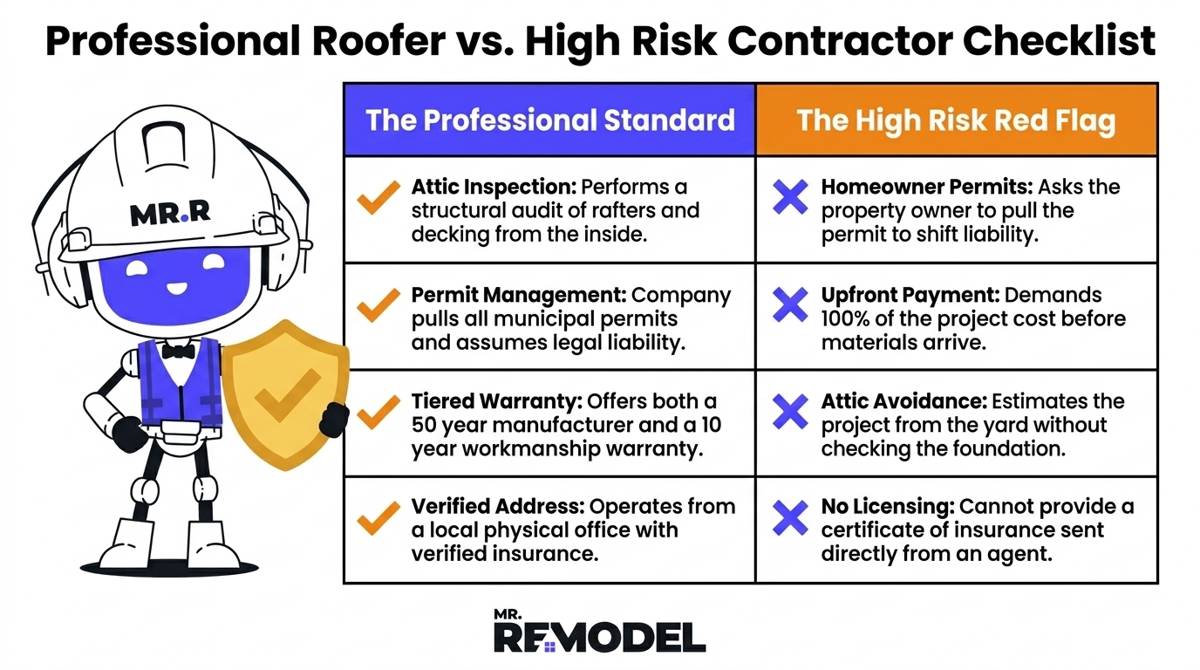
- They pull the municipal permit: If they ask you to do it, it is a tactic used by unlicensed companies to shift legal liability.
- They provide a structured payment schedule: A standard deposit is 10% to 33%, with the balance due upon final inspection.
- They perform a full attic inspection: If they do not look at your rafters from the inside, they are guessing at your home's health.
- They have a physical local address: A reputable company has an office, not just a cell phone number and a magnetic sign.
See related: Red Flags When Hiring a Roofing Contractor
The Financial Breakdown of Your $25,463 Investment
To choose a contractor effectively, you must understand where your money goes. A $25,000 quote can feel like a massive sum until you break down the actual costs. A quality installation is a labor-intensive project that involves distinct categories of expense. Understanding this helps you spot where a cheap contractor might be cutting corners.
The standard distribution of costs for a high-quality project usually follows this breakdown:
- Materials (40%): This includes shingles, synthetic underlayment, and metal flashing.
- Labor (35%): This covers the wages for a specialized crew and on-site supervisors.
- Disposal and Logistics (10%): This includes dumpster fees and the delivery of heavy materials.
- Overhead and Insurance (15%): This covers the licensing, Workers' Compensation, and permit fees.
Before you sign any contract, it is wise to get a free quote from Mr. Remodel. This allows you to see how your specific roof dimensions impact these standard categories. A data-backed quote provides a solid foundation for your budgeting and financing decisions. It removes the guesswork from your remodel.
See Related: Roof Replacement Cost (2026): Materials, Labor, Regional Pricing & ROI.
Licensing, Insurance, and the Legal Shield
Hiring a contractor without proper credentials is a gamble with your home's equity. In 2026, there are three non-negotiable legal shields you must verify before signing a contract. A failure in any of these areas should result in an immediate disqualification of the bid. These protections are designed to shield you from lawsuits and structural failures.
General Liability Insurance
This protects your property. If a contractor drops a bundle of shingles through your skylight, General Liability insurance ensures you are not paying for the damages. Without this, your own homeowners' insurance may be forced to cover the claim. That could lead to a massive increase in your annual premiums.
Workers' Compensation
This is the most important shield for a property owner. Roofing is a dangerous profession. If a worker falls off your roof and the contractor does not have Workers' Compensation, that worker can sue you. Always ask for a Certificate of Insurance (COI) to be sent directly to your email from the contractor's agent.
State and Local Licensing
A license is proof that the contractor has met the competency and bonding requirements for your region. It also ensures they are eligible to pull the necessary permits. These permits trigger municipal inspections, which are your only third-party verification. Never skip the permitting process to save on a few small municipal fees.
See related: Roofing Contractor Licensing, Insurance & Certifications
Roofing Warranties: Manufacturer vs. Workmanship
A $25,463 investment requires dual protection. Homeowners often confuse these two types of warranties, but they cover entirely different risks. Understanding the gap between them is essential for choosing a contractor who will stand behind their work. A warranty is only as good as the company that issues it, so longevity matters.
The 50-Year Manufacturer Warranty
This covers the physical shingles. If the shingles fail prematurely due to a manufacturing defect, the company that made them will pay for the replacement. However, the Asphalt Roofing Manufacturers Association (ARMA) notes that roofing warranties are often voided if the installation is not perfect.
The 10-Year Workmanship Warranty
This is provided by the contractor. It covers human error, such as improper flashing or incorrect nailing patterns. A premium roofing company will typically offer a 10-year workmanship warranty. Budget operations may only offer one or two years. This short-term guarantee is often a sign that they do not expect to be in business long.
See related: Roofing Warranties Explained: Manufacturer vs Workmanship
The Digital Filter: Skipping the 3-Bid Headache
Consumer behavior data is shifting rapidly in 2026. In our latest research, 94.8% of homeowners preferred digital form requests over direct phone calls. Homeowners are tired of the sales pitch and high-pressure tactics. They want a streamlined process that respects their time and provides immediate clarity on pricing models.
This is why choosing a contractor through a vetted network has become the gold standard. Instead of calling ten different roofers, you can use a digital filter. Find professionals whose pricing and quality already align with verified market models. This technology-driven approach ensures a higher success rate for your entire home renovation.
Why Data Beats Qualitative Reviews
Online reviews can be manipulated, but closed-won financial data cannot. By choosing a contractor through the Mr. Remodel network, you gain access to a pool of professionals. They have been vetted against the $21,223 to $28,481 interquartile range. You are not just getting a professional: you are getting a verified structural expert.
Using our digital routing system allows you to skip the exhausting 3-bid process. We filter out the contractors who do not meet our rigorous standards. This allows you to focus on the technical details of your project rather than the bureaucratic headache. You get straight to the high-quality installation phase of your remodel.
Frequently Asked Questions
Why is the $14,000 quote such a big red flag?
In 2026, the cost of materials and insured labor alone typically exceeded $14,000 for an average home. A contractor offering this price is likely cutting corners. This will lead to a roof failure within five years. They may also be operating without insurance, which puts your entire financial future at risk if someone gets hurt. Always remember that you get what you pay for in home remodeling.
Do I really need to check the attic?
Yes. You cannot diagnose a rotting sub-deck or mold growth from your driveway. A contractor who refuses to perform an attic inspection is guessing at your structural needs. This often leads to expensive surprise change orders once the shingles are off. An attic inspection is the only way to verify your home's structural foundation.
What is a Master Elite or Platinum certification?
These are the highest tiers of contractor certification from manufacturers. Only about 2% to 3% of roofers in North America hold these titles. Hiring a certified pro is usually the only way to get a full warranty. It signifies that the contractor has a proven track record of financial stability and quality work.
Is the median price of $25,463 the same in every state?
While $25,463 is the national median, regional factors can push this higher. Local labor market competition also plays a significant role.
How much of a deposit should I pay?
You should never pay 100% upfront. A standard deposit ranges from 10% to 33% to cover the initial material orders. You should only pay the final balance once the job is complete and you have the signed-off permit. This ensures the contractor has a financial incentive to finish every small detail of the job correctly.
Let the Data Decide Your Next Step
Holding three roofing quotes does not have to be a guessing game for property owners. By utilizing the interquartile range of $21,223 to $28,481, you have a mathematical baseline. It allows you to disqualify scammers and identify true professionals. Remember, a roof is a structural investment rather than a commodity.
Skip the exhausting 3-bid headache and the high-pressure sales pitches. Submit your details through our secure digital form, and Mr. Remodel will match you with a pre-vetted, fully insured contractor whose pricing aligns with our verified data. Protect your home from the top down and start the process with a professional today.