1-855-QUOTEMR

Table of Contents [hide]
Who This Is For
This guide is designed for property managers, mixed-use real estate investors, and commercial landlords converting light industrial or storefront buildings into multi-family residential housing who require rapid execution and transparent capital modeling.
Key Takeaways
- Capital Expenditure Baselines: National commercial-to-residential roof conversions average $25,307.08 across network data, scaling up to $57,146.10 for heavy multi-family TPO structural rebuilds.
- Rapid Deployment Priority: Investor data reveals 78.02% of commercial landlords demand project initiation within 7 days to protect asset equity and maintain tenant leasing schedules.
- Near-Total Replacement Bias: Over 99.45% of B2B property owners reject patch repairs, opting for full teardowns to eliminate structural liability and meet strict residential building codes.
- Geographic Flat-Roof Hotspots: High-volume conversion activity clusters heavily in Florida, California, and Pennsylvania, where mixed-use adaptive reuse projects dominate urban development.
Converting commercial structures into multi-family residential units presents unique architectural and structural challenges. The transition from flat commercial roof assemblies to residential-compliant building envelopes demands specialized engineering and rapid contractor execution.
Unforeseen roof membrane failures during adaptive reuse projects compromise newly installed interior framing and delay tenant occupancy.
Understanding localized capital costs, structural load modifications, and municipal zoning standards helps real estate investors maximize property valuation while minimizing vacancy loss.
Financial Modeling for Commercial to Residential Conversions
Real estate developers evaluating adaptive reuse projects face complex financial projections. Standard residential pricing models fail to capture commercial tear-off labor, mechanical curb modifications, and structural parapet alignment.
Internal project statistics from Mr. Remodel establish that the average capital expenditure for conversion roofing projects sits at $25,307.08.
However, complex multi-family assets involving heavy thermoplastic polyolefin membranes, rigid insulation taper systems, and structural framing upgrades reach up to $57,146.10.
Accurate capital forecasting prevents cost overruns during property repositioning.
See Related: Roof Replacement Cost (2026): Materials, Labor, Regional Pricing & ROI
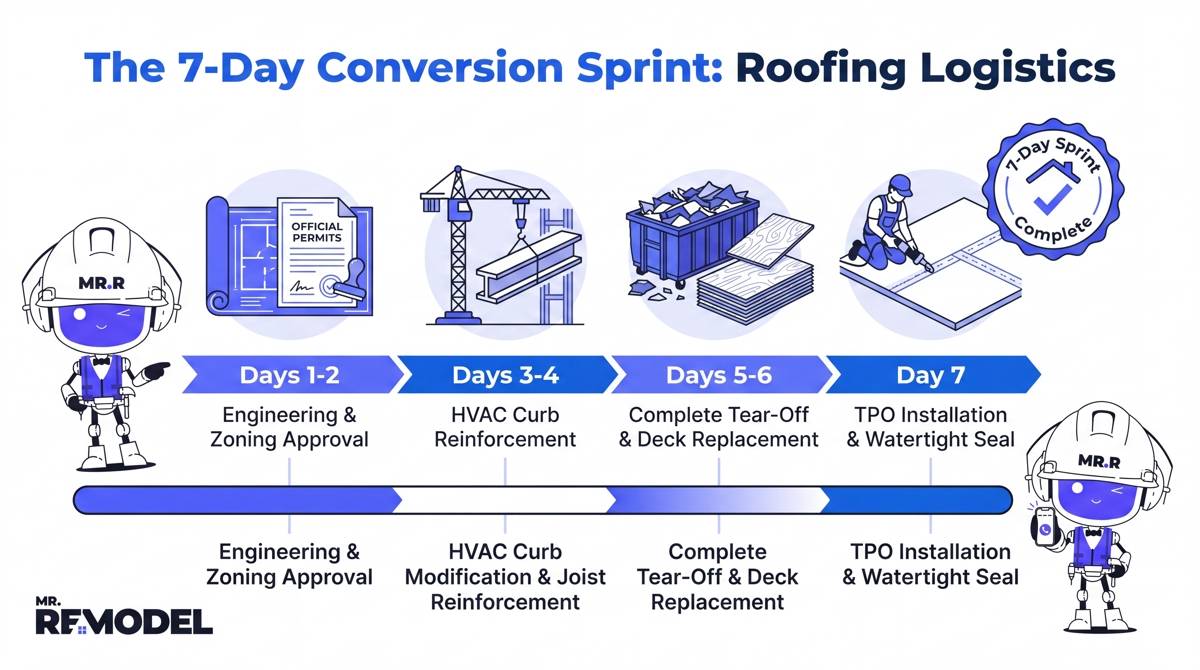
The 7-Day Sprint: Operational Timelines for Landlords
Unlike traditional homeowners who often take up to 30 days to review contractor bids, commercial real estate investors operate on condensed timelines.
Analysis of 182 B2B property leads shows that 142 investors (78.02%) require project initiation within 7 days of quote delivery.
Delayed construction schedules directly increase holding costs and threaten tenant lease commitments.
Contractors serving the B2B sector must maintain dedicated material supply chains and rapid site mobilization capabilities to meet aggressive developer schedules.
Why 99.45% of Investors Reject Patch Repairs
A primary decision point in adaptive reuse is choosing between localized membrane restoration and a complete structural tear-off.
Data indicates that 181 out of 182 investors (99.45%) insist on complete roof replacements rather than temporary patch fixes.
Commercial flat roofs converted for residential use must support modified HVAC equipment loads and increased roof penetrations for individual unit venting.
Patching aging EPDM or built-up roofing layers leaves compromised substrate insulation in place, risking hidden leaks above tenant living quarters.
Executing a complete teardown removes saturated insulation, secures structural decking, and establishes a fresh warranty foundation for long-term equity appreciation.
Structural and Zoning Adaptation for Adaptive Reuse
Transitioning a commercial roof assembly to meet multi-family residential standards requires strict adherence to local building codes and historic guidelines.
HVAC Load Modifications and Energy Code Compliance
Commercial roof decks designed for large centralized HVAC systems must be re-engineered when converting to individual residential split units.
Economic analysis published by the DC Policy Center details how modifying rooftop mechanical loads and updating zoning codes represent significant structural costs during commercial-to-residential conversions.
Contractors must reinforce roof joists around new curb penetrations while adding tapered polyisocyanurate insulation to meet residential energy efficiency codes.
Historic Architecture and Facade Preservation
In urban conversion corridors across Pennsylvania and California, storefront conversions must preserve historical exterior character.
Design guidelines established by the Borough of Phoenixville outline strict architectural requirements for maintaining decorative cornices and facade proportions during commercial property updates.
Selecting specialized commercial-to-residential roof replacement contractors ensures your conversion project satisfies municipal historical review boards while delivering watertight protection.
Partner with specialized contractors who understand B2B timelines, structural load modifications, and municipal zoning standards. Connect with pre-screened commercial specialists through Mr. Remodel to secure a free quote.
Regional Hotspots for Flat-Roof Conversions
Adaptive reuse volume concentrates in specific geographic markets where urban density drives demand for multi-family housing.
Market data identifies Florida with 25 projects, California with 24 projects, and Pennsylvania with 22 projects as the primary state corridors for commercial-to-residential roof overhauls.
Florida and California developments prioritize UV reflectivity and wind uplift resistance across broad flat-roof surfaces.
Pennsylvania projects focus on snow load capacities, internal drainage retrofits, and historical parapet restorations.
Partnering with contractors familiar with state-specific building codes ensures fast municipal permit approvals and seamless job execution.
How to Vet B2B Roofing Contractors for Conversion Projects
Selecting the right installation partner protects your capital investment and prevents costly construction delays.
Evaluate Commercial Experience and Rapid Mobilization
Verify that prospective contractors have documented experience handling both commercial flat-roof membranes and residential architectural installations.
Ensure the contractor offers guaranteed 7-day deployment capabilities to match your investment timeline.
Confirm Licensing, Insurance, and Performance Guarantees
Require proof of active commercial general liability coverage, full workers compensation insurance, and manufacturer-certified installer status.
Reviewing comprehensive scope proposals through Mr. Remodel connects property owners with trusted local contractors who provide detailed warranties and transparent cost structures.
Frequently Asked Questions
What is the average cost of a commercial-to-residential roof replacement?
Network project data shows that capital expenditures average $25,307.08 for standard conversion projects. Complex multi-family assets involving heavy structural decking repairs or custom TPO taper systems reach up to $57,146.10.
How quickly can a commercial roof replacement start for a converted property?
In the B2B investment sector, 78.02% of property owners require project initiation within 7 days. Specialized conversion contractors maintain dedicated crews and supply channels to meet these rapid deployment windows.
Why do investors choose complete replacement over patching flat roofs?
Over 99.45% of investors choose complete replacement because commercial-to-residential conversions require new roof penetrations and updated insulation. Patching old membranes leaves wet insulation and hidden structural rot intact.
How do services like Mr. Remodel assist landlords with roof conversions?
Services like Mr. Remodel assist property managers and real estate investors by matching them directly with vetted, licensed local contractors who specialize in commercial-to-residential conversions, providing free quotes and rapid project turnaround.
What roofing materials are best for commercial-to-residential conversions?
Thermoplastic polyolefin (TPO) and ethylene propylene diene monomer (EPDM) membranes are ideal for flat roof sections, while standing seam metal and architectural asphalt shingles work best for sloped residential facade transitions.
Maximize Conversion ROI with Specialized Roofing Partners
Converting commercial properties into multi-family residential housing requires precise capital planning, swift contractor deployment, and uncompromising trade craftsmanship. Leaving aging commercial membranes on a newly converted residential building risks catastrophic water intrusion and tenant turnover.
Protect your asset equity and accelerate your leasing timeline today. Connect with experienced, pre-screened roofing specialists through Mr. Remodel to get free, no-obligation quotes and schedule your property evaluation.