1-855-QUOTEMR

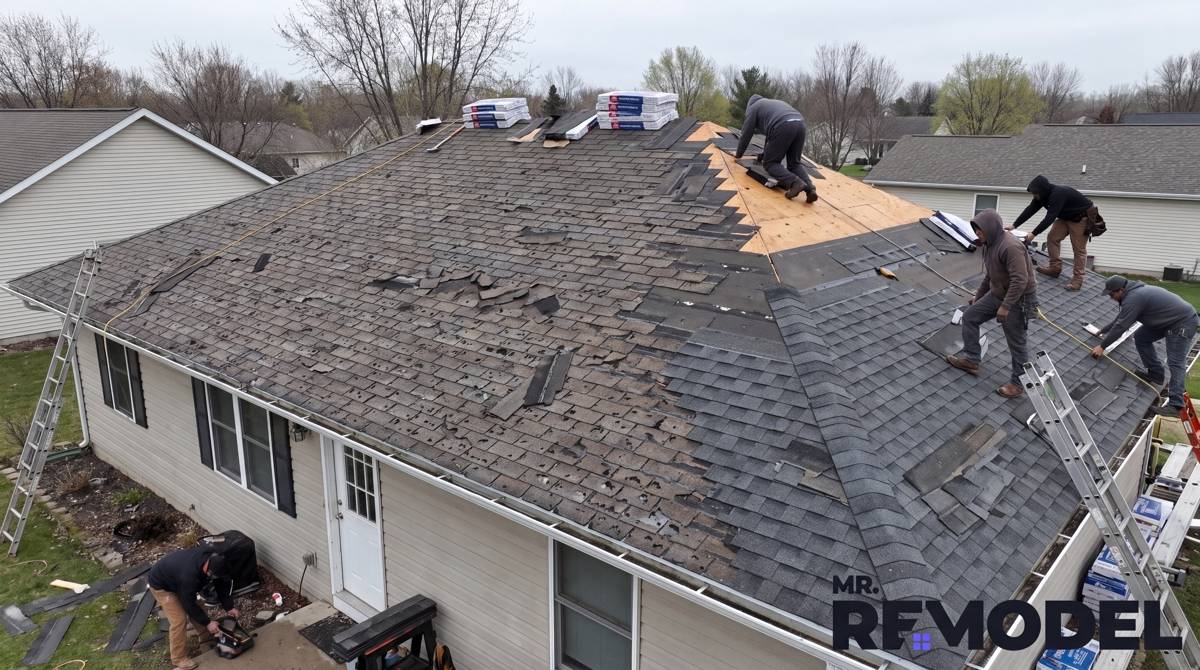
Table of Contents [hide]
Who This Is For
This guide is designed for property owners facing sudden hail damage who need immediate structural evaluation, transparent 2026 replacement cost benchmarks, and reliable guidance on vetting certified local roofing contractors.
Key Takeaways
- Financial Baselines: Average roof replacement costs across national network data sit at $25,307.08, with severe storm devastation reaching up to $57,146.10.
- The 99% Tear-Off Reality: Data reveals 99% of hail impact cases require a complete roof replacement rather than localized shingle patching.
- Rapid Deployment Window: Over 2,150 homeowners require immediate 0-to-1-day emergency dispatch following severe Hail Belt weather events.
- Impact-Resistant Upgrades: Transitioning to Class 4 UL 2218 rated shingles prevents future storm punctures and reduces long-term insurance premiums.
A sudden severe hail storm can puncture shingle surfaces and compromise your building envelope within minutes. When ice impacts break factory seals, water intrusion threatens underlying wooden decking and ceiling insulation.
Delaying structural repairs after severe weather exposure risks cascading moisture damage and expensive mold remediation.
Understanding localized replacement costs, insurance claim workflows, and rapid deployment standards helps homeowners restore their property value efficiently.
The Financial Reality of Hail Damage Roof Replacement
Homeowners navigating storm damage often struggle with inconsistent insurance estimates and generic repair pricing. Broad online calculators frequently omit critical line items like disposal fees, synthetic underlayment, and emergency tarping labor.
Internal project statistics from Mr. Remodel establish that the average finalized roof replacement sale amount sits at $25,307.08.
However, catastrophic hail strikes accompanied by severe wind shear can push total restoration figures to $57,146.10.
Equipping yourself with verified market numbers gives you leverage when negotiating claim settlements with insurance adjusters.
See Related: Roof Replacement Cost (2026): Materials, Labor, Regional Pricing & ROI
Why 99% of Hail Strikes Demand Complete Roof Replacement
Property owners often ask whether spot repairs can fix localized hail bruises. Real-world contractor records show that surface patching is rarely effective after severe hail storms.
Out of 16,023 hail damage projects, exactly 99% required a total roof replacement rather than minor surface repairs.
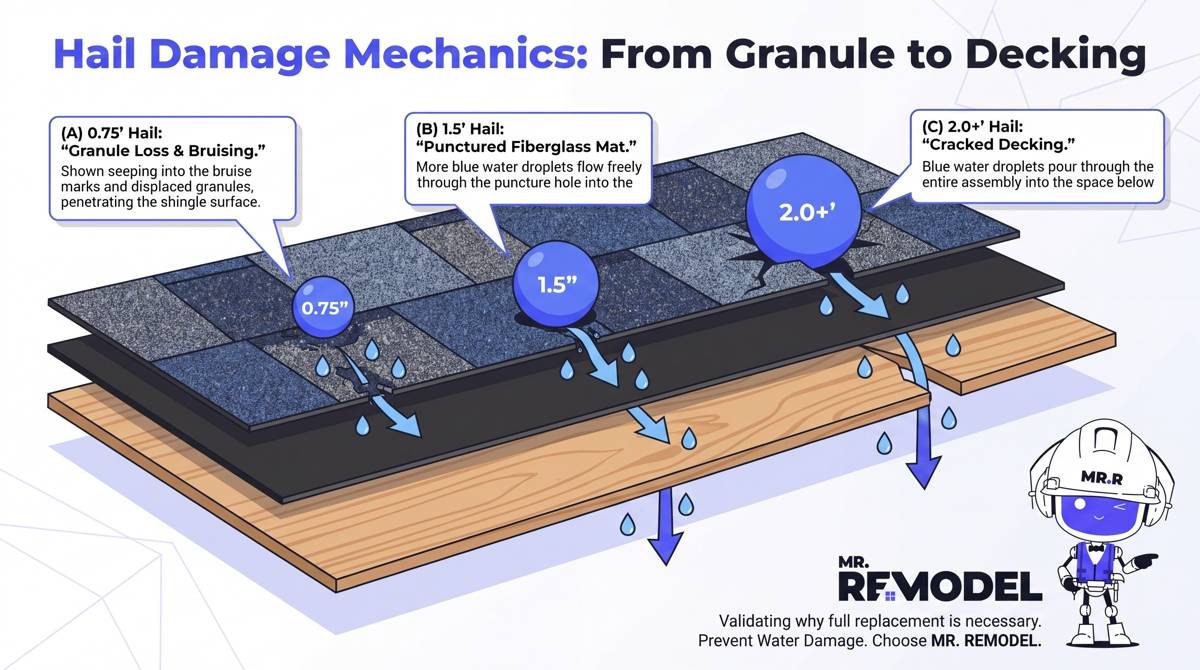
Hailstones striking composite shingles crush internal fiberglass mats, breaking the bond between mineral granules and asphalt coatings.
Even if shingles remain attached, microscopic fractures allow water to seep through underlayment felt during subsequent rainstorms.
Attempting spot repairs on a hail-dusted roof leaves fractured shingles scattered across your home, increasing future leak risks.
See Related: How to Choose a Roofing Contractor: Pricing, Quotes & Red Flags
Navigating Emergency Dispatch and Rapid Deployment Timelines
Severe hail storms create immediate operational demand for qualified roofing crews across affected regions.
Analysis reveals that 2,150 projects required emergency contractor dispatch within a 0-to-1 day window following major weather events.
Contractors responding to emergency calls prioritize rapid site stabilization to protect home interiors from water damage.
Securing emergency same-day deployment limits secondary water damage while formal insurance documentation is processed.
Hail Damage Mechanics and Building Code Upgrades
Hail impacts vary based on stone diameter, wind velocity, and shingle age. Understanding physical damage indicators helps you document loss accurately.
Identifying Composite Shingle Loss
Hailstone impacts create circular dark indentations where mineral granules are driven deep into asphalt layers.
Official insurance documentation from the Nebraska Department of Insurance confirms that loss of protective granules exposes underlying asphalt to rapid solar degradation, requiring replacement.
Upgrading to Class 4 Impact-Resistant Materials
Rebuilding after a major storm presents an ideal opportunity to upgrade your building envelope against future storms.
Building recommendations published by Spokane County Building & Planning highlight that Class 4 UL 2218 rated materials withstand severe steel ball impacts without cracking.
Installing Class 4 impact-resistant shingles or standing seam metal panels often qualifies homeowners for substantial annual insurance premium discounts.
See Related: Metal Roofing: Cost, Energy Efficiency & Durability
How to Vet a Hail Damage Roof Replacement Company
Selecting the right partner after a major weather event shields you from predatory storm-chasing contractors.
Verify Local Permits and Licensing
Transient contractors often enter disaster zones offering quick repairs without proper municipal authorization.
Regulatory consumer notices from the City of Bryan Development Services emphasize verifying local solicitor permits and withholding final payments until municipal building inspections pass.
Working with an established local contractor ensures your replacement meets current regional wind uplift building codes.
Review Manufacturer Warranties and Workmanship Guarantees
Always require written proof of general liability insurance and workers compensation before authorizing work.
Request detailed warranty disclosures that specify coverage for both material defects and contractor workmanship errors.
See Related: Roofing Warranties Explained: Manufacturer vs Workmanship
Protect your property today by partnering with a pre-screened, licensed hail damage roof replacement company. Receive rapid site dispatch and transparent pricing through Mr. Remodel.
Navigating Insurance Claim Steps for Hail Loss
Filing a successful hail damage claim requires systematic evidence collection and clear contractor communication.
Step 1: Conduct Ground Inspections and Document Evidence
Take photographs of bruised siding, dented metal downspouts, and dislodged shingle granules around your property perimeter.
Avoid climbing onto damaged, slippery roof decks; allow professional inspection crews to collect detailed overhead photographic evidence.
Step 2: Schedule an On-Site Adjuster Meeting
Notify your insurance provider immediately to open a formal loss claim.
Request that your chosen roofing contractor attend the official adjuster walk-through to ensure all subtle mat fractures are included in the repair scope.
Step 3: Review Itemized Payout Statements
Compare your insurance summary with your contractor proposal to confirm that all required materials, drip edges, and ridge ventilation line items match.
Resolving pricing discrepancies before tearing off old materials ensures full Replacement Cost Value recovery.
Frequently Asked Questions
How do I know if hail damaged my roof shingles?
Visual warning signs include dark circular bruises on shingle surfaces, missing granules piling up in downspouts, and dented metal roof vents. A professional contractor can detect subtle mat fractures from the roof surface.
How much does a hail damage roof replacement cost in 2026?
Average roof replacement investments average $25,307.08 across national project records. Major storm events causing severe decking damage or requiring heavy architectural upgrades can reach up to $57,146.10.
Why do contractors recommend full replacement instead of patching hail damage?
Data shows that 99% of hail impact cases require complete replacement because hail crushes internal fiberglass mats across entire roof slopes. Spot repairs leave hidden structural fractures that cause future leaks.
How do services like Mr. Remodel help homeowners after a hail storm?
Services like Mr. Remodel assist homeowners by matching them with pre-screened, licensed local roofing contractors who offer free quotes, emergency site tarping, and transparent cost estimates.
Will insurance cover my entire hail damage roof replacement?
If you hold a Replacement Cost Value policy, insurance typically covers full replacement costs minus your deductible, provided damage exceeds the deductible threshold and is reported within policy timelines.
Secure Your Property with Vetted Hail Damage Specialists
Recovering from a severe hailstorm demands fast action, accurate financial documentation, and certified contractor execution. Leaving bruised shingles untreated invites structural water rot, ceiling damage, and unexpected out-of-pocket expenses.
Take control of your home restoration today. Connect with top-rated, licensed roofing specialists through Mr. Remodel to get free, no-obligation quotes and schedule your professional roof evaluation.