1-855-QUOTEMR

Table of Contents [hide]
Who This Is For
This guide is for homeowners who feel anxious about the vetting process and want to avoid predatory scams. It translates common contractor behaviors into mathematical anomalies, helping property owners spot illegitimate companies by comparing them against 2026 market standards.
Key Takeaways
- Repair Discrepancy: Legitimate contractors record $0 in standalone repair revenue.
- Pricing Baseline: Bids falling far below $25,307 often indicate hidden traps.
- Structural Probability: 20% of roofs have rot that must be itemized upfront.
- Engagement Standards: 94.8% of modern homeowners now use digital quote routing.
- Panic Timing: Door-to-door sales during the 7-day post-storm window are high-risk.
Trusting your gut is a fine strategy for small purchases, but it is a dangerous way to manage a five-figure home renovation. Learning the red flags when hiring a roofing contractor is much easier when you use 2026 market data to spot bids that deviate from the statistical norm. When a contractor behaves like a mathematical outlier, they are usually a financial risk.
At Mr. Remodel, we act as a specialized referral network that filters out high-risk contractors before they ever reach your driveway. We are the data-driven bridge connecting you with pre-vetted professionals. They understand that a roof is a multi-layered engineering system rather than a cosmetic upgrade.
Red Flag 1: The Cheap Repair Hustle
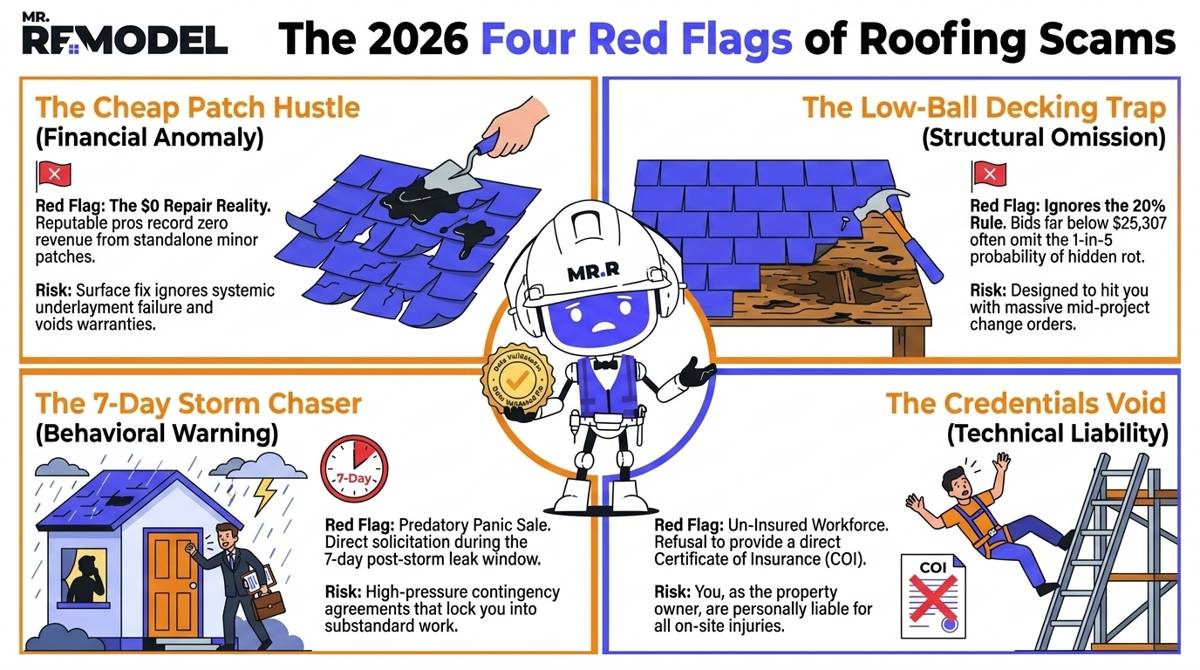
If a roofer offers to slap a $500 patch on a 15-year-old roof, it is an immediate warning sign. Based on our 2025 network data, reputable contractors reported $0 in closed-won standalone repair revenue. Vetted professionals do not sell or finance minor patch jobs because they create massive liability and rarely solve the underlying structural issue.
Legitimate roofing jobs are full structural tear-offs 99.04% of the time. When a handyman pushes a low-cost spot repair, they are often pursuing untaxed cash while leaving your home's foundation at risk. According to the Asphalt Roofing Manufacturers Association (ARMA), surface-level patches that ignore the underlayment actively void your 50-year manufacturer's material warranty.
Common signs of a repair-related scam include:
- Using leftover shingles that do not match your current roof color.
- Refusing to provide a written workmanship warranty for the patch.
- Demanding 100% of the cash payment before the work begins.
- Claiming the leak is fixed without performing an attic inspection.
See Related: How to Choose a Roofing Contractor: Pricing, Quotes & Red Flags
Red Flag 2: The Low-Ball Decking Trap
The statistical baseline for a standard, code-compliant roof in 2026 is $25,307.08. A major red flag is a contractor bidding $14,000 by intentionally omitting structural realities. These predatory contractors know that a low price gets them the job, but they plan to make their profit through mid-project upcharges that they discovered later.
Our data proves that 20% of roofs, exactly one in five, require extensive structural decking upgrades once the old shingles are removed. A legitimate bid will include a per-sheet contingency price for replacement plywood upfront. This protects you from a surprise bill. A quote that ignores this is a trap designed to hold your roof hostage on day two of the job.
The Federal Emergency Management Agency (FEMA) explicitly details the technical necessity of replacing compromised roof decking. If your contractor ignores this 20% probability in their estimate, they are ignoring federal building standards. This typically results in a failed final inspection or a roof that cannot withstand high-wind events.
Compare your estimates to current roofing costs and services to ensure you are not being low-balled. A transparent contractor will always explain the 20% structural risk before the first shingle is removed.
See Related: Roof Replacement Cost (2026): Materials, Labor, Regional Pricing & ROI
Red Flag 3: The Door-to-Door Storm Chaser
In major storm zones, 85.19% of repair requests are driven by sheer panic in the first seven days after a weather event. Predatory contractors use this exact window to force homeowners to sign contingency agreements before an insurance adjuster arrives. This high-pressure sales tactic is a massive red flag that suggests a lack of local accountability.
The Federal Trade Commission (FTC) warns that out-of-town contractors knocking on doors after a disaster pose a high risk. In 2026, modern consumers initiate quotes through secure digital channels 94.8% of the time. A door-to-door salesman is operating outside the data-validated standard of modern, reputable purchasing.
Before you sign any high-urgency paperwork, you should:
- Verify the contractor has a permanent, local business address.
- Check for active state licensing that matches your specific region.
- Ensure they are not asking for an insurance check sign-over upfront.
- Wait for a formal inspection from your insurance provider first.
To ensure your home remains safe, you should only work with vetted professionals who follow verified insurance claim protocols. Requesting a free quote through Mr. Remodel allows you to skip the door-to-door pressure entirely. This keeps your claim under your control rather than the contractor's.
Red Flag 4: Lack of Specialized Credentials
A roofer who cannot produce a Certificate of Insurance (COI) is the ultimate red flag. In 2025, our network processed project tickets totaling up to $57,000. Manipulating that level of structural capital without a multi-million-dollar liability policy is financial suicide. If an uninsured worker is injured on your roof, you are the one liable for the claim.
A premium roofing company will always be proud to show its factory certifications and insurance limits. If a contractor gets defensive when you ask for paperwork, they are likely hiding a lack of coverage. This puts your personal savings and your home equity at immediate risk during the renovation.
See related: Roofing Contractor Licensing, Insurance & Certifications
Frequently Asked Questions
Why is a $1,000 spot repair considered a red flag?
Legitimate professionals record $0 in standalone repair revenue because patches on aging roofs are structural liabilities. If a contractor offers a cheap fix, they are likely skipping the necessary permits and voiding your long-term warranties. They are taking your money for a temporary solution that ignores the root cause of the leak.
How do I know if a quote is too low?
If a bid falls more than 20% below our $25,307 national average, it is a statistical anomaly. This usually means the contractor is using uninsured day labor or is planning to hit you with massive change orders once your roof is torn off. Always compare the line items to ensure all protective layers are included.
Are door-to-door roofers always scammers?
While not all are scammers, door-to-door solicitation is a high-risk engagement method in 2026. Most reputable, local companies are already busy with digital referrals. A contractor who must knock on doors to find work often lacks the stability and local reputation of a premium roofing company.
Let Data Be Your Vetting Filter
Gambling with your largest financial asset is an unacceptable risk during a home remodel. In 2026, a roofing scam is simply a mathematical deviation from verified market data. By using the $25.3k baseline and the 20% structural rule, you can spot these anomalies before they cost you thousands of dollars in repairs and legal fees.
Don't gamble with your largest financial asset during a high-stress storm event. The Mr. Remodel network automatically eliminates every red flag by pre-screening every contractor in our system. Get your free quote today and skip the low-ball traps.