1-855-QUOTEMR

Table of Contents [hide]
Who This Is For
This guide is explicitly designed for property owners experiencing an active water intrusion crisis. It provides immediate, step-by-step triage actions, professional safety protocols, and transparent structural drying timelines to help protect investments and restore home safety.
Key Takeaways
- The 48-Hour Boundary: Immediate structural drying can save materials, but waiting over 48 hours usually triggers mandatory full replacement.
- Drywall Salvage Thresholds: Waterlogged drywall must be replaced if it stays wet for more than 72 hours due to mold risks.
- Climate Impact Variables: High ambient humidity in coastal areas makes structural drying difficult, often requiring complete structural tear-outs.
- Insurance Approval Limits: Adjusters approve full replacement over basic repairs when restoration costs exceed 70% of material values.
- Urgent Phone Communication: Local emergency data shows 100% of property owners in a crisis choose direct phone calls over web forms.
An unexpected indoor flood creates an immediate architectural emergency for homeowners. Saturated building materials degrade with every passing minute. Property owners must make fast choices regarding salvage options.
Behavioral statistics from Mr. Remodel show that 100% of crisis-driven homeowners skip digital estimate forms. Sufferers prioritize direct phone calls due to high stress.
See Related: Emergency Water Damage Cleanup Guide
The S500 Evaluation Framework: Salvage vs. Tear-Out
Professional restoration contractors do not guess which building materials can be saved. Instead, crews follow strict guidelines established by the American National Standards Institute (ANSI). The ANSI/IICRC S500 standard provides a clear benchmark for professional water damage restoration.
This standard evaluates structural salvage options based on water microbiology. Clean water leaks offer high repair potential if addressed quickly. Conversely, black water intrusions containing sewage mandate immediate full replacement of all porous structural items.
Drywall and Structural Framing Assessment Metrics
Interior walls act like sponges when exposed to unexpected plumbing failures. Determining whether to repair or replace drywall requires monitoring the exact moisture timelines.
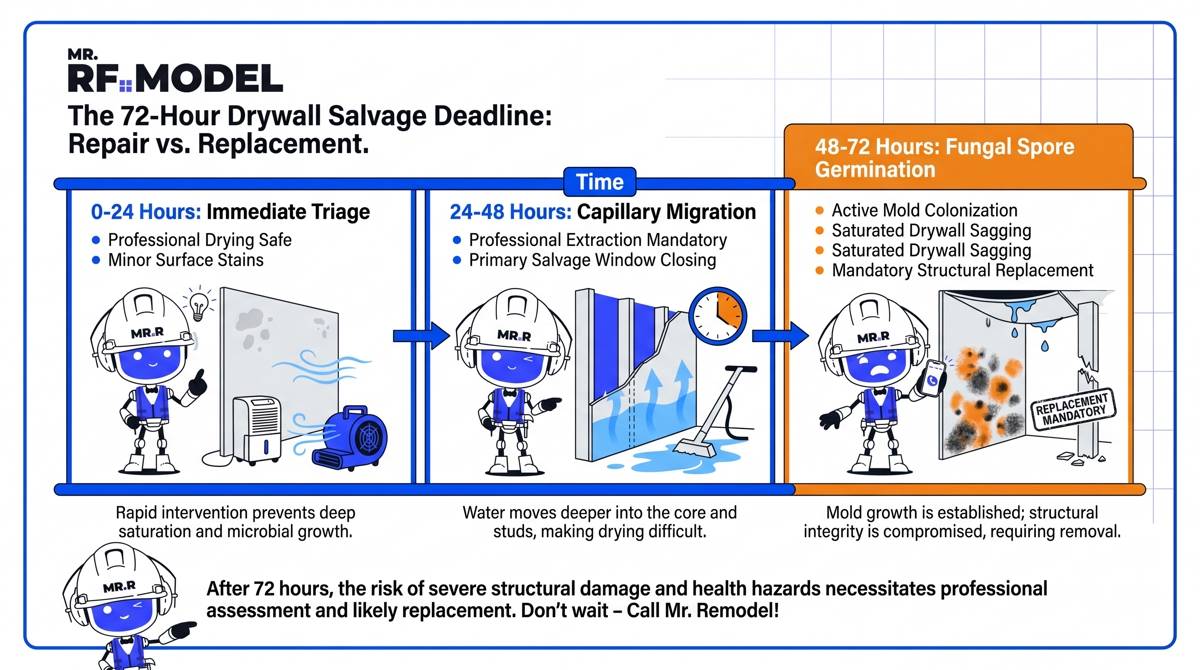
The 72-Hour Cut Line
According to structural maintenance guidelines from Northern Arizona University, drywall salvage requires immediate action. If drying procedures do not start within 48 hours or finish within 72 hours, full replacement is mandatory.
See Related: Mold Remediation Cost After Water Damage
Structural Framing Inspections
Unlike porous drywall, heavy timber framing studs can often be saved through commercial dehumidification. Technicians use deep-penetrating pin meters to evaluate moisture content inside structural wood. Timber framing is considered safe once moisture levels drop below 15%.
Hardwood Floor Cupping: Repair Options and Timelines
Premium hardwood flooring requires specialized care during an indoor flood. When planks absorb water, the edges swell and rise, creating a wavy condition called cupping.
Evaluating subfloor elements requires a methodical approach to moisture management. Property owners can reference historical safety preservation tips from the NC Historic Preservation Office to safely evaluate waterlogged building materials.
See Related: How Long Does Water Damage Restoration Take?
Localized Material Risks and Regional Climates
A single water damage rule does not fit every property across the country. Local weather profiles alter how building materials dry.
High-Humidity Coastal Hotspots
Regional climate data highlights specific property threats across different states. Internal data from Mr. Remodel indicates that 8.6% of emergency cases originate in Florida. High coastal humidity in Florida accelerates mold growth, making full drywall tear-outs necessary.
Dense Urban Infrastructure Challenges
Older urban environments face unique structural restoration issues. New York accounts for 8.6% of emergency cases, where aging infrastructure complicates basic drying. Saturated plaster walls in older builds require full replacement to protect structural integrity.
Low-Humidity Salvage Potential
Arid climates offer better opportunities for saving damaged building materials. California represents 12.5% of the total emergency case volume. The lower ambient humidity in California allows crews to save luxury wood finishes using high-velocity dehumidifiers.
Regional Storm and Freeze Profiles
Midwestern and coastal storm patterns create distinct household flooding scenarios. North Carolina accounts for 7.6% of cases, often driven by coastal storm runoff that requires subfloor replacement. Illinois represents 6.7% of volume, where sub-zero plumbing bursts flood basements rapidly.
Insurance Adjuster Guidelines: Repair vs. Replacement
Property insurance claims depend on clear structural documentation. Adjusters use specific math formulas to choose between material repairs or full replacement.
The 70% Financial Threshold
Insurance companies use a simple threshold rule for property claims. If repairing a material costs more than 70% of its total replacement value, adjusters approve a full replacement. You must provide clear extraction logs to support these calculations.
See Related: Insurance Coverage for Water Damage
The Seasonal Filing Surge
Restoration volume spikes dramatically during specific autumn weather transitions. Property data from Mr. Remodel shows that 60.5% of emergency cases occur in October. September and November each hold 16.3% of the annual volume.
Because adjusters face high claim volumes in October, providing clear drying logs accelerates approval timelines.
Financial Cost-Benefit Analysis: Out-of-Pocket Decisions
When water damage is not covered by insurance, homeowners must balance initial mitigation costs against long-term reconstruction expenses.
Choosing professional extraction early prevents expensive secondary damage down the road. Standard room mitigation typically averages between $1,500 and $4,500. Investing in immediate water extraction helps avoid a complete structural tear-out later.
See Related: Water Damage Restoration Cost Guide
Water Damage Repair vs Full Replacement FAQs
Can water-damaged drywall be repaired, or must it be replaced?
Drywall can be repaired if it was exposed to clean water for less than 24 hours and shows no sagging. However, if drywall stays wet for more than 72 hours, it must be replaced to prevent mold growth.
How do insurance adjusters decide between repair and replacement?
Adjusters compare the cost of professional drying against the expense of a complete tear-out. If mitigation costs exceed 70% of the replacement price, policies typically fund a full replacement.
Why does local climate affect structural drying success?
High ambient humidity slows down natural surface evaporation. In damp areas like Florida, materials stay wet longer, which increases mold risks and often makes full replacement necessary.
Can services like Mr. Remodel help during a plumbing emergency?
Yes, services like Mr. Remodel help protect property investments by connecting homeowners directly with vetted, local contractors. This ensures fast access to commercial extraction equipment during a crisis.
What are the main indicators that a subfloor needs replacement?
Key signs include deep wood cupping, material delamination, soft spots underfoot, and persistent musty odors. Saturated plywood subfloors usually require replacement if left wet for over 48 hours.
Secure Professional Guidance for Your Property Recovery
Managing unexpected water damage requires fast action to protect your home value. Postponing extraction turns a basic repair project into an expensive structural replacement. Using industrial drying equipment right away is the most reliable way to save your flooring, secure insurance approvals, and keep your home safe.
The mitigation experts at Mr. Remodel support homeowners by connecting them with vetted local contractors. Do not wait for structural timbers to warp or for biological hazards to multiply inside your walls. Take action today to get a free, no-obligation quote for emergency water extraction from certified restoration professionals in your area.