1-855-QUOTEMR

Table of Contents [hide]
Who This Is For
This guide is explicitly designed for property owners currently facing an active household water crisis. It serves as a real-time, live-call phone script to rapidly vet emergency restoration companies before they dispatch crews to your home.
Key Takeaways
- Immediate Verification: Always check a contractor's active certification and state-specific licensing before granting property access.
- Response Speed Baseline: Certified emergency mitigation fleets must arrive on-site within 60 to 90 minutes to prevent structural rot.
- The 48-Hour Fungal Window: Delaying industrial water extraction past 24 hours accelerates aggressive microbial spread across structural frames.
- Financial Transparency Standards: Reliable companies provide clear itemized estimates matching standardized insurance pricing parameters.
- Urgent Phone Communication: Internal data indicates 100% of emergency consumers skip online estimate forms to call dispatchers directly.
Discovering standing water inside your home creates a high-stress crisis. Saturated structural components degrade with every passing minute, forcing quick decisions. Property owners must vet local restoration options carefully despite the extreme pressure.
Operational lead tracking from Mr. Remodel indicates that 104 out of 104 emergency mitigation requests were initiated via direct phone calls. Homeowners completely bypass online quote sheets during an active flood. When water fills a living room, response time is measured in minutes.
To support homeowners during these intense calls, we compiled the top five questions to ask on the phone. This real-time script ensures you hire a certified professional team.
Top 5 Critical Questions to Ask on the Phone
Use these rapid-fire phone questions to separate reliable emergency dispatchers from uncertified subcontractors.
1. Are you certified by the IICRC for water damage restoration?
Do not hire any firm that lacks active credentials from the Institute of Inspection, Cleaning, and Restoration Certification (IICRC). The IICRC establishes the baseline scientific standards for safe structural drying. Uncertified workers often cause secondary property issues by leaving bound moisture inside wall cavities.
2. What is your exact emergency response arrival time today?
Your chosen contractor must provide an explicit on-site arrival window. Reliable emergency fleets maintain fully loaded service vehicles ready for immediate deployment. Look for a firm arrival guarantee between 60 and 90 minutes to stop ongoing structural issues.
3. Will you provide an itemized estimate using industry-standard pricing?
Avoid contractors who offer vague verbal price ranges over the telephone line. Trustworthy mitigation firms utilize specialized estimating software to generate transparent, line-by-line invoices. This documentation ensures billing totals match standard insurance parameters.
4. Do you carry comprehensive general liability and pollution insurance?
Standard home improvement policies do not cover accidental biohazard contamination or mold spread. Your restoration contractor must maintain specific environmental pollution liability insurance. This protection ensures you are not financially responsible if workers accidentally spread contaminants.
5. How do you monitor and document the daily structural drying process?
True moisture mitigation requires advanced scientific diagnostic equipment. Ask if their field technicians deploy penetrating pin meters and infrared cameras daily. Accurate structural dry-logs are required to validate insurance claims.
See Related: What To Do Immediately After Water Damage
State-Specific Licensing and Regional Vetting Nuances
Contractor regulations vary significantly across different state territories. Homeowners must adapt their phone screening questions to address specific regional requirements.
California: Verifying CSLB Active Standing
Operating within California markets represents 12.50% of emergency service requests. Homeowners in California must verify that the responding company holds a valid license with the Contractors State License Board (CSLB). Ask for their official state license number before crews arrive on your driveway.
New York: Managing Urban Infrastructure Failure
New York properties generate 8.65% of regional mitigation demand. The aging multi-family utility lines across New York require experience with winterization issues and frozen plumbing bursts. Ensure the company has deep experience navigating local multi-story infrastructure layouts.
Florida: Strict Mold Remediation Protocols
Florida represents 8.65% of national service requests. Due to persistent coastal humidity, the Environmental Protection Agency (EPA) warns that mold grows quickly on damp indoor items. Ensure your Florida contractor carries a dedicated state mold remediator license to handle large contaminations safely.
North Carolina: Handling Storm Surge Disasters
North Carolina properties account for 7.69% of regional lead volume. Residential homes in this area often face severe hurricane paths and coastal storm surges. Homeowners must ensure crews follow official disaster response protocols outlined by FEMA. Ask if their equipment can handle contaminated floodwaters safely.
Illinois: Subfloor and Basement Foundation Testing
Illinois represents 6.73% of emergency service volume. Severe Midwest weather shifts lead to extensive basement flooding and structural foundation stress. Ask technicians how they test concrete slab moisture levels before installing new finish materials.
See Related: Water Damage Insurance Claim Guide
Navigating Seasonal Surge Challenges in Your Area
Emergency water restoration requests spike predictably during specific seasonal weather shifts. Homeowners must understand these trends to protect their properties.
Proprietary business metrics from Mr. Remodel reveal that a massive 60.58% of all water emergencies occur in October. This extreme volume concentration creates regional shortages of industrial drying machinery.
Because local contractors face extreme demand in October, vetting speed is crucial. Uncertified companies often enter the market during surges to capitalize on panicked homeowners. Using a strict phone script helps you avoid these predatory operations.
Understanding Industry Pricing and Estimating Architecture
Evaluating water restoration invoices requires understanding how professional crews calculate structural drying costs.
Extraction Equipment Rates
Mitigation crews bill for their equipment using daily standard rates. Operating commercial truck-mounted extraction pumps and high-capacity air movers typically ranges from $1,500 to $4,500 per room. These fees cover direct water extraction and structural drying setups.
Hazardous Material Handling
Discarding saturated building items requires specialized waste handling. Transporting contaminated drywall sheets and old carpet padding adds $200 to $600 in disposal fees. Certified crews must bag these materials carefully to protect unaffected rooms.
Emergency Dispatch Coverage
True structural emergencies do not wait for standard business hours. Most professional companies charge an emergency portal-to-portal dispatch fee ranging from $150 to $350 for after-hours calls. This fee covers the cost of sending out a certified technician late at night.
If you notice exterior drainage problems before severe weather strikes, consider investing in preventive updates. Improving your exterior gutter layout helps route heavy stormwater away from basement walls.
See Related: Gutter Installation Guide: Costs, Timeline, and What Contractors Don’t Tell You
Contract Warning Signs: Avoid These Common Scams
Panicked property owners are highly vulnerable to deceptive marketing tactics. Watch for these specific warning signs during your initial phone call.
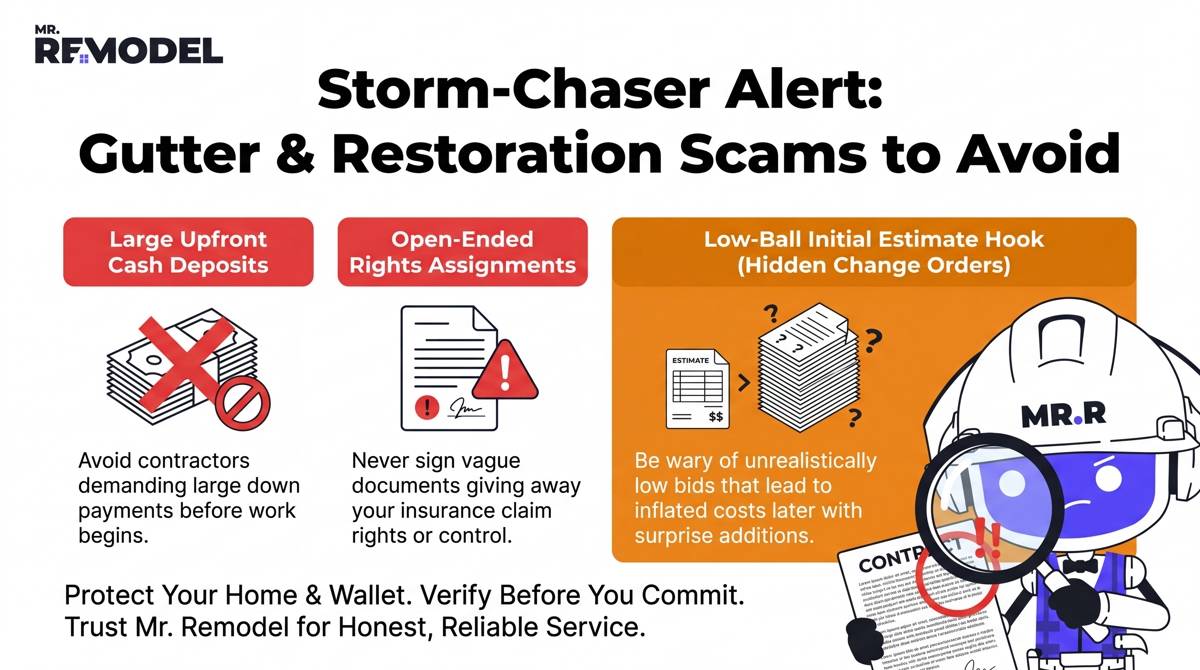
Avoid Large Upfront Cash Deposits
Never work with a restoration firm that demands a large upfront cash payment before starting extraction. Reputable emergency contractors bill your insurance provider directly or request standard authorization signatures. Large cash requests often signal uncertified storm-chasing operations.
Do Not Sign Open-Ended Work Contracts
Review every digital document carefully before granting property access. Avoid signing forms that give away your full insurance policy rights. A proper contract should focus exclusively on emergency water extraction and structural drying work.
Watch Out for Unusually Low Initial Bids
Be careful if a contractor offers an incredibly low price compared to other local companies. Shady companies use low initial estimates to get onto your property, then add expensive change orders later. Stick with providers who use standardized pricing systems.
Maintaining your exterior downspouts helps prevent major foundation issues. Directing roof runoff away from your basement walls lowers your risk of facing an interior flooding crisis.
See Related: Downspout Installation Cost and Why It Matters for Drainage
Water Damage Contractor Vetting FAQs
Why is IICRC certification mandatory for water restoration?
IICRC certification ensures technicians follow proper scientific formulas to dry properties safely. Incorrect drying methods leave moisture trapped inside wall framing, which causes structural rot.
How long does the structural drying process usually take?
A standard residential room requires 3 to 5 days to reach certified dryness. Thick building substrates like timber framing or concrete foundation floors may need extra drying time.
Can I remain inside the home during structural mitigation?
Living on-site is acceptable during Category 1 clean water projects if the noise is manageable. However, category three sewage backups require vacating the building due to biohazard risks.
Will standard home insurance pay for emergency extraction?
Most policies cover sudden plumbing failures, water heater bursts, and accidental appliance overflows. However, damage caused by long-term maintenance neglect or surface flooding typically requires separate coverage.
See Related: How To Prevent Future Water Damage
How do professional services simplify my emergency home recovery?
Services like Mr. Remodel help by matching you with vetted local contractors who understand emergency protocols. This matching process ensures your project receives the right industrial equipment while simplifying the path to a clean home.
Connect With Trusted Local Mitigation Experts
Managing an unexpected water crisis can feel overwhelming, but taking fast action protects your home investment. Postponing extraction turns a basic repair project into an expensive structural replacement. Using industrial drying equipment right away is the most reliable way to secure insurance approvals and keep your family safe.
The team at Mr. Remodel protects homeowners by matching them with vetted local contractors. Do not risk secondary mold growth or structural settlement issues while waiting on independent adjusters. Take action today to get a free, no-obligation quote for water damage mitigation from certified restoration professionals in your area.