1-855-QUOTEMR

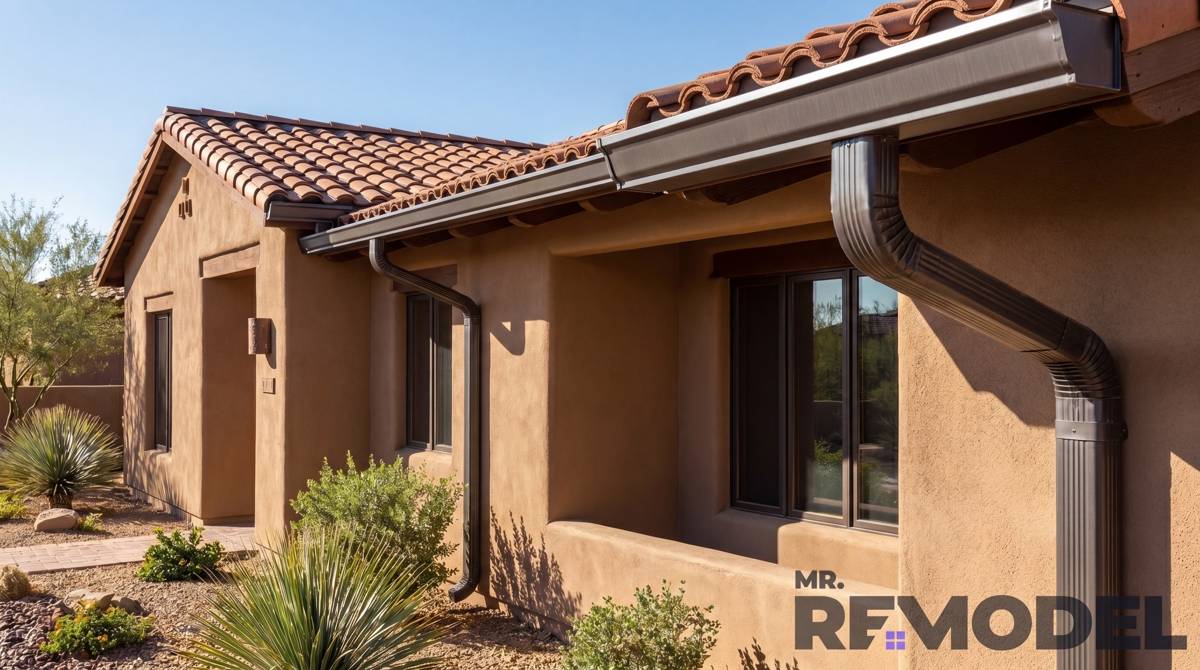
Table of Contents [hide]
Who This Is For
This guide is for homeowners in hot, arid climates like California, Arizona, and Nevada. It provides critical structural and financial data for choosing a gutter system capable of withstanding intense UV exposure, extreme heat, and sudden monsoon-style downpours.
Key Takeaways
- Sizing is Mandatory: 6-inch K-Style gutters are required to safely manage monsoon downpours for up to 8,000+ sq. ft. of drainage.
- Material Strength: Thin, standard metals warp in the heat. Heavy-gauge (0.032") aluminum or galvanized steel is necessary to survive extreme weather.
- Installation Standards: Insist on heavy-duty hidden hangers spaced every 16 inches instead of the standard 24 inches to withstand high-velocity winds.
- Financial ROI: A $2,200 to $5,000 installation protects against average water damage claims of $11,605 and foundation repairs reaching up to $25,000.
When homeowners in hot climates think of weather damage, they primarily worry about the sun and heat. However, the true structural threat comes from how arid environments react to sudden, massive volumes of water.
During the monsoon season, dry, hard-packed earth cannot absorb water quickly. According to data from the National Park Service on the 2015 Death Valley flash floods, arid regions can receive an entire year's worth of rain in just five hours. Without a high-capacity gutter system, this runoff crashes directly into your foundation.
This risk is compounded by regional wildfires. Research from Mt. San Antonio College shows that wildfire burn scars, which are common across CA, AZ, and NV, make soil highly water-repellent. This significantly increases the speed and volume of runoff during sudden downpours, making proper roof drainage a critical line of defense.
See Related: Storm Damage: Repair or Replace Decision Guide
Sizing is Mandatory: The Mathematics of Water Management
Many contractors treat gutters as a standard, aesthetic upgrade, installing standard 5-inch systems by default. In a monsoon climate, this is a recipe for disaster.
Standard 5-inch gutters top out at 5,500 sq. ft. of coverage. When hit with a sudden flash flood, they carry a high risk of overflow. Upgrading to 6-inch K-Style gutters is mandatory for heavy rain and monsoon zones because they hold nearly double the water volume, safely managing downpours for roofs up to 8,000+ sq. ft.
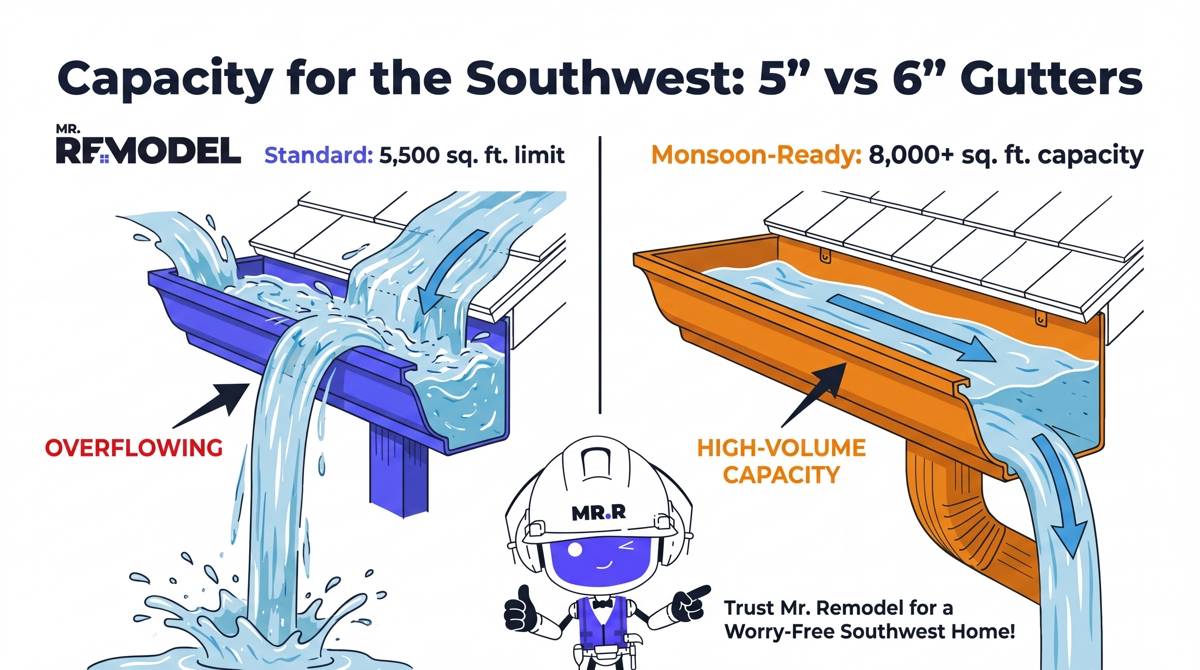
To properly control this runoff and prevent water from accumulating near your home's foundation, the Fairfax County Soil and Water Conservation District emphasizes the importance of routing water safely away from the property via oversized downspouts.
See Related: Best Gutters for Heavy Rain Areas
Material Strength: Surviving Heat and Storm Debris
Heat and UV exposure will destroy inferior materials. Vinyl gutters, for example, are universally condemned in hot climates because they warp, crack, and become brittle under intense sun.
Even standard metal is not enough. Standard 0.027" gauge aluminum dents easily from storm debris and hail. Homes in hot, storm-prone areas require heavy-gauge (0.032") aluminum or galvanized steel to withstand extreme weather without warping or failing. Seamless aluminum is highly recommended because it expands and contracts uniformly in the heat without breaking rust-prone seams.
See Related: Best Roofing Materials (2026): Cost, Durability & Climate Fit
The 3-Bid Weapon: Holding Contractors Accountable
When securing a gutter replacement, you must know exactly what to demand from your contractor. Use this knowledge as your "3-Bid Weapon" to vet professionals effectively:
You must demand that contractors use heavy-duty hidden hangers spaced every 16 inches, rather than the industry standard of 24 inches.
This tighter spacing provides the structural rigidity necessary to prevent system failure during the high-velocity winds that accompany monsoon microbursts. If a contractor pushes back against this 16-inch rule, immediately move on to your next bid.
See Related: Roof Replacement Cost (2026): Materials, Labor, Regional Pricing & ROI
Financial ROI: Gutters as an Active Insurance Policy
Upgrading your home's drainage is not an expense; it is a vital insurance policy. According to Mr. Remodel data, a professional installation averaging $2,200 to $5,000 is the ultimate defense against catastrophic foundation failure.
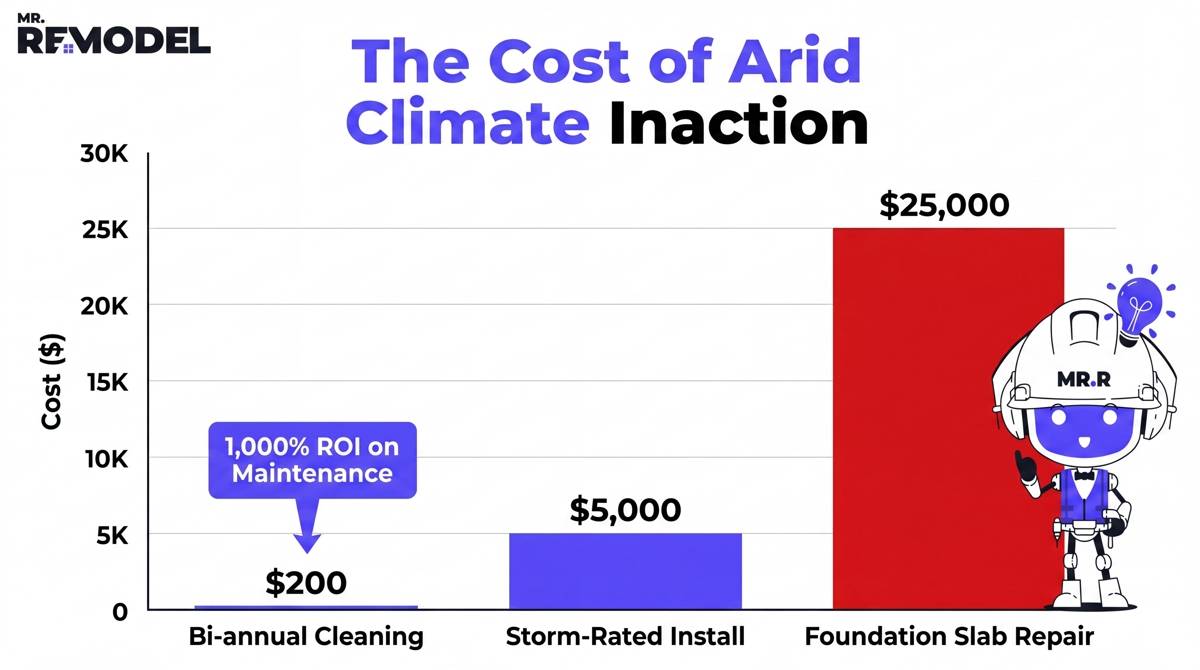
When gutters overflow in dry-soil climates, water pools at the base of the home, expanding the soil and cracking the slab. The cost of inaction is staggering: an average $11,605 insurance claim for interior water damage, or $8,000 to $25,000 in foundation repairs.
Furthermore, maintenance yields incredible returns. Spending $200 to $400 on bi-annual professional cleaning yields an ROI of over 1,000% by actively preventing these five-figure structural failures.
See Related: Roof Replacement Cost by Climate (Hot, Cold, Coastal Regions)
Research Methodology
This 2026 guide is based on a comprehensive analysis of 4,614 consumer inquiries from our proprietary dataset. We have combined these behavioral markers with 2026 industry-standard pricing models for residential homes. Our cost estimates are based on a standard 200-linear-foot home to provide an accurate financial anchor for your project.
FAQ: Hot Climate Gutter Systems
Are vinyl gutters okay for Arizona or Nevada?
No. Vinyl gutters will rapidly warp, crack, and fail under the extreme UV exposure and heat of the Southwest. Heavy-gauge aluminum is the standard.
Why do I need 6-inch gutters if it rarely rains?
While it may rarely rain, monsoons drop massive volumes of water in a matter of minutes. 6-inch gutters hold double the volume of 5-inch gutters, preventing overflows that destroy your foundation.
How much does a heavy-gauge gutter system cost?
In 2026, a professional installation of a high-capacity, storm-rated gutter system typically ranges from $2,200 to $5,000, depending on the linear footage of your home.
How far apart should gutter hangers be spaced in a storm zone?
To withstand high-velocity monsoon winds, heavy-duty hidden hangers must be spaced every 16 inches, not the standard 24 inches.
Secure Your Home with Mr. Remodel
A sudden monsoon can cause tens of thousands of dollars in damage if your home isn't prepared. By insisting on 6-inch capacity, 0.032" heavy-gauge materials, and 16-inch hanger spacing, you protect your property's foundation and equity.
Don't wait for the next storm to test your home's limits. Turn to Mr. Remodel to connect with local, vetted professionals who understand the exact structural requirements for California, Arizona, and Nevada climates. Get your free, no-obligation quote and safeguard your home against the extremes.