1-855-QUOTEMR

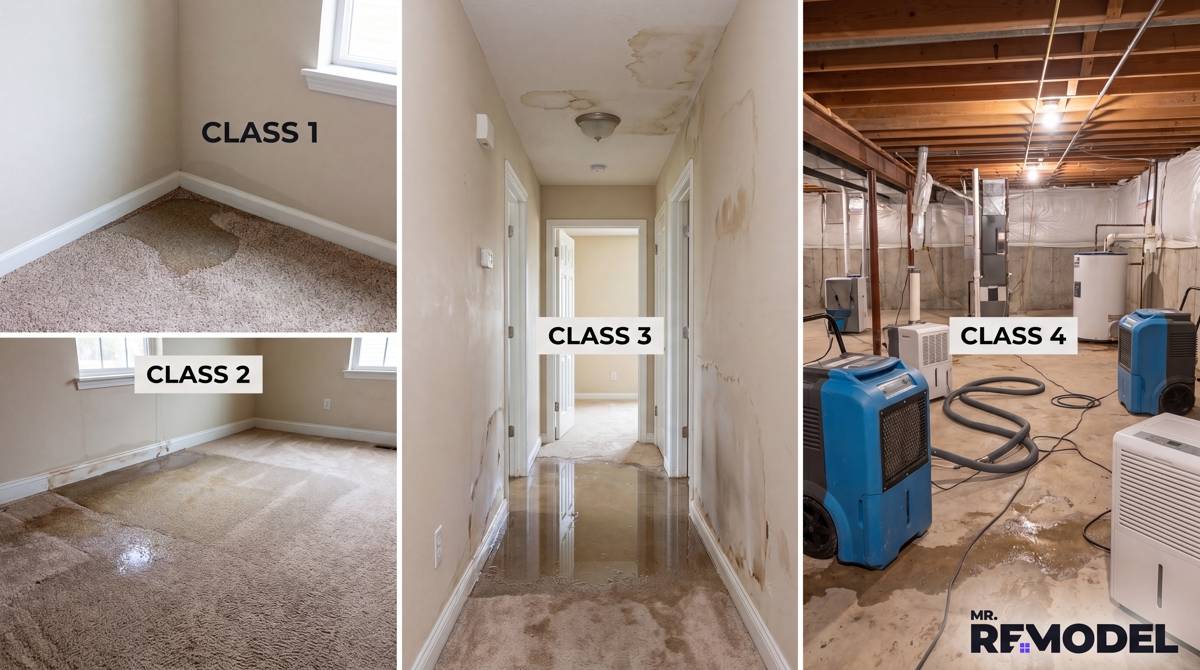
Table of Contents [hide]
Who This Is For
This guide is designed for property owners currently managing an indoor water emergency. It provides the diagnostic classification criteria, regional risk metrics, and professional triage steps necessary to evaluate structural damage severity before insurance adjusters arrive.
Key Takeaways
- Severity Tiers: Damage is ranked from Class 1 (slow, localized) to Class 4 (specialty drying), dictating the volume of equipment needed for extraction.
- The 48-Hour Threshold: CDC data confirms that active fungal growth begins within 24 to 48 hours of initial structural saturation.
- Conversion Urgency: Proprietary internal data confirms that 100% of property owners experiencing severe water damage prioritize phone dispatch over digital contact forms.
- Q4 Seasonal Surge: Analysis shows a massive 60.58% spike in emergency mitigation requests during October, confirming fall as the most dangerous time for infrastructure failure.
- Professional Standards: Accurate classification is required by insurance carriers to justify structural drying costs and prevent preventable total-loss scenarios.
Water intrusion events are rarely uniform. Professionals categorize these events into specific damage classes that define the speed and scope of the necessary structural drying process. Understanding these classes helps you communicate with your insurance provider and ensures your contractor deploys the correct industrial machinery.
When your property hits the higher tiers of water damage, passive research is no longer an option. You need immediate, professional emergency water damage restoration to stop the decay.
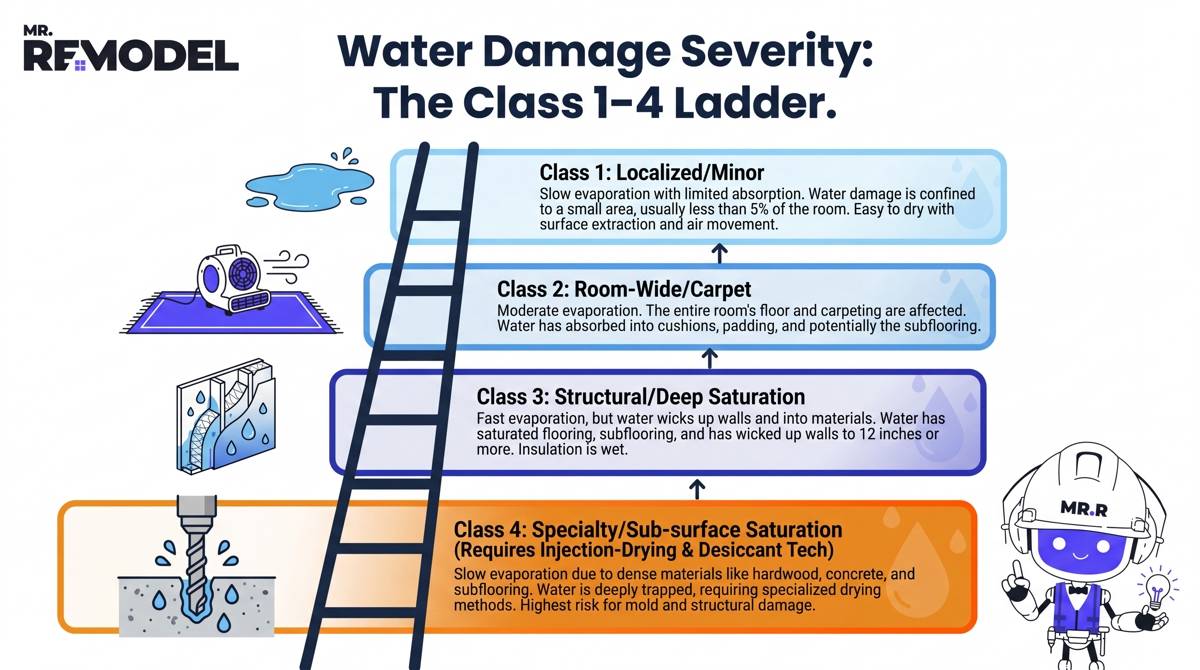
The Four Classes of Water Damage
Restoration experts utilize the ANSI/IICRC S500 standard to assess how much energy is required to dry a structure. These classes reflect the rate of evaporation and the physical surface area affected by the moisture.
Class 1: Minimal Absorption
This is the lowest tier of severity. Class 1 damage affects a small, localized area with low-permeability materials, such as a wood vanity leak in a bathroom with tile floors. Because the materials do not hold much water, evaporation occurs slowly, and the risk to structural integrity remains low if addressed quickly.
Class 2: High Absorption
Class 2 damage involves a larger affected area, typically covering an entire room. It involves materials with high absorption rates, such as wall-to-wall carpeting and padding. Moisture has likely moved up the walls at least 12 to 24 inches. This tier requires high-speed air movers to manage the increased volume of trapped water.
Class 3: Deep Saturation
Class 3 represents the most common emergency scenario. It involves overhead ceiling leaks or plumbing failures that saturate nearly all structural materials in a room, including insulation, subflooring, and ceiling joists. This class demands the highest rate of evaporation, as water has likely traveled through multiple building assemblies.
Class 4: Specialty Situations
Class 4 is the most complex tier. It refers to situations where water has permeated low-permeance materials like concrete, brick, hardwood floors, or stone. These materials hold bound water that requires specialized equipment—such as injection-drying tools or desiccant dehumidifiers—to extract moisture deep from the structural core.
See Related: Water Damage Categories Explained (Category 1, 2, 3)
Geographic Risk Profiles and Structural Impact
Your location dictates how these damage classes often manifest in your property. Climate factors and building age play a significant role in determining whether a leak remains a Class 1 issue or escalates rapidly to a Class 4 emergency.
- California (12.50% Demand): Often maps to Class 4. Hidden slab leaks deep within concrete foundations and luxury flooring require highly specialized moisture injection equipment.
- New York (8.65%) & Illinois (6.73%): Often map to Class 3 or Class 4. These regions face winterization failures and basement seepage that stress entire multi-level structural footprints during seasonal freeze-thaw cycles.
- Florida (8.65%) & North Carolina (7.69%): Often map to Class 3. Coastal humidity and storm surge events saturate entire rooms, requiring rapid extraction to prevent aggressive indoor air quality decline.
The 48-Hour Biological Countdown
Ignoring a water leak—regardless of its class—is the primary cause of secondary mold contamination. Once water sits, it provides the essential environment for biological growth. The Centers for Disease Control and Prevention warns that mold spores can germinate within 24 to 48 hours of saturation.
If you have detected hidden signs of structural moisture, you must act before this transition occurs. Professional mitigation crews are trained to identify the exact moment a Class 1 leak is becoming a potential biological liability.
See Related: Water Damage Restoration Cost Guide
Seasonal Surge: The October Danger Zone
Our database reveals a dramatic volume spike in emergency water restoration requests each year. October represents a massive 60.58% of our total lead volume.
This surge is not random. It is driven by the "Fall Transition." As temperatures drop, homeowners activate their heating systems. Dormant plumbing failures and hidden condensation points that were manageable during the summer suddenly fail under the stress of Q4 temperature shifts. This leads to an immediate need for Mr. Remodel and our vetted network of local contractors.
Salvageability and Insurance Documentation
Professional FEMA guidelines emphasize that the ability to salvage structural materials is directly tied to the speed of response.
When you hire a contractor, they must document the water damage class accurately. This data serves as the legal foundation for your insurance claim. Without a clear diagnostic report, carriers may attempt to deny coverage for expensive structural drying or reconstruction tasks.
See Related: Common Causes of Residential Water Damage
Frequently Asked Questions
Why does a contractor need to classify my water damage?
Classifying damage helps the contractor determine the correct amount of dehumidification and airflow required. It also provides the documentation needed to justify the restoration process to your insurance company.
Can Class 1 damage become Class 3?
Yes. If you ignore a localized leak (Class 1), the water can spread into subflooring and wall cavities, eventually saturating the entire room (Class 3) and significantly increasing the cost of repairs.
Do I need specialty equipment for Class 4 damage?
Yes. Class 4 involves water trapped in low-permeance materials like concrete or hardwood. This requires specialized injection-drying equipment that most standard restoration companies do not carry.
How can I tell if my home is experiencing Class 3 damage?
If you see signs of water intrusion in multiple areas, such as ceiling stains, warped floor boards, and saturated baseboards throughout a room, the damage has likely reached Class 3 severity.
How do services like Mr. Remodel help during a Class 4 emergency?
Services like Mr. Remodel protect your investment by connecting you with vetted contractors who have the specialized diagnostic equipment required for high-tier damage, such as hidden slab leaks or luxury hardwood flooring water extraction.
Connect with Certified Mitigation Experts
Accurate diagnosis is the difference between a minor structural adjustment and a complete home renovation. If you suspect your home is experiencing Class 2, 3, or 4 damage, do not wait for the property to dry on its own. The structural and biological consequences of delay are far too high.
Connect with Mr. Remodel today to get a free quote and find a professional restoration team ready to secure your home. Our network specializes in identifying the damage class and deploying the industrial drying equipment needed to protect your investment.