1-855-QUOTEMR

Table of Contents [hide]
Who This Is For
This guide is crafted for property developers, architectural planners, and real estate investors exploring adaptive reuse projects. If you need hard data on the financial leap from standard residential window baseline costs to complex commercial structural conversions, this resource will clarify your budget.
Key Takeaways
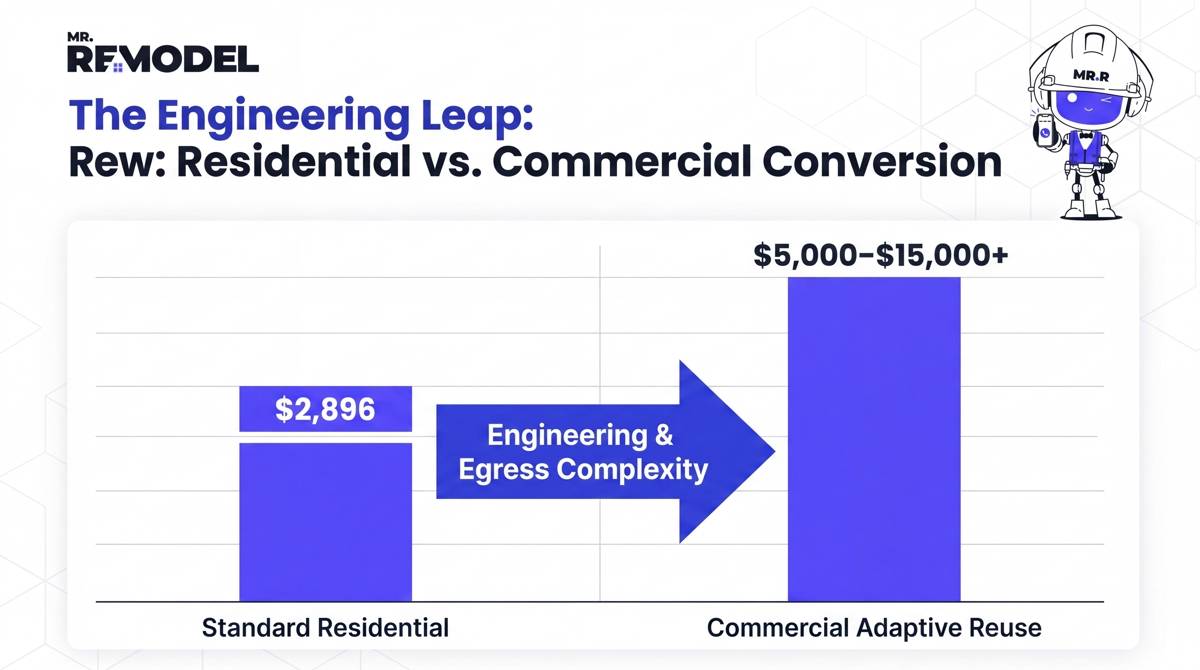
- The Baseline Gap: While standard residential replacement windows average $2,896.70 per unit, commercial conversions frequently escalate between $5,000 and $15,000 per structural opening.
- Building Codes: Fixed commercial glass must be converted into operable windows to satisfy strict residential egress and ventilation codes.
- Cost Efficiency: Older pre-war office buildings with existing operational windows are significantly cheaper to adapt compared to newer all-glass skyscrapers.
- Lead Times: While residential jobs book quickly, commercial conversions face extended logistical delays due to complex structural engineering and permitting requirements.
- Energy Impact: Federal sustainability goals require adaptive reuse projects to integrate high-efficiency, zero-emission glass solutions.
The commercial real estate landscape is undergoing a massive transformation. As urban office vacancy rates soar, investors are rapidly turning toward adaptive reuse, converting empty commercial towers into lucrative residential housing.
However, transforming deep commercial floor plates to accommodate natural light is a significant engineering hurdle. The largest logistical and financial barrier in these projects is the commercial-to-residential window conversion process.
Commercial structures rely heavily on fixed glass envelopes designed for centralized HVAC systems. Residential building codes demand operable windows for egress, safety, and natural ventilation.
At Mr. Remodel, we help property planners understand the stark financial difference between standard residential replacements and these massive structural overhauls.
See Related: When Window Repairs Are Not Worth It | 2026 Cost & ROI Data
The Financial Reality: Residential Baselines vs. Commercial Costs
To accurately forecast a commercial conversion budget, you must first understand standard residential pricing. This establishes a baseline for how much basic window logistics cost before high-rise structural factors are introduced.
Our proprietary internal data tracking thousands of consumer leads provides an exact metric. Standard residential projects yield an average cost of $2,896.70 per window unit. A typical residential project covers about six windows, averaging a $16,511.20 overall ticket price.
When developers pivot to commercial spaces, those numbers multiply rapidly. Removing fixed curtain walls and installing operable, code-compliant residential windows can escalate costs to a staggering $5,000 to $15,000 per window opening.
See Related: Window Replacement Options | 2026 Costs, Methods & ROI Guide
Navigating Building Types and Conversion Economics
Not all commercial buildings are created equal when it comes to adaptive reuse. The age and original architectural style of the building heavily influence your final window conversion budget.
According to research from the Bipartisan Policy Center (Converting Vacant Offices to Housing), older pre-war buildings are roughly 30% cheaper to convert. These historic structures often already feature operational windows and shallower floor plates.
Conversely, modern skyscrapers clad entirely in fixed glass require massive structural deconstruction. Developers must engineer custom operable units that integrate seamlessly into the existing commercial facade without compromising the building's exterior integrity.
See Related: Retrofit vs. New Construction Windows | 2026 Cost & Siding Guide
Code Requirements and Project Timelines
Standard residential window upgrades benefit from rapid fulfillment. Our data shows that 94.7% of standard residential customers are prepared to initiate their installations within 30 days of securing a bid.
Commercial adaptive reuse operates on a completely different timeline. Converting fixed windows to operable residential windows requires complex permitting, structural engineering reviews, and heavy municipal safety compliance checks.
Meeting Egress and Ventilation Codes
Residential building codes strictly mandate that living spaces possess secondary avenues of escape during emergencies. A fixed commercial pane simply cannot satisfy these mandatory life-safety egress requirements.
The Urban Institute (Converting Offices into Housing) highlights that navigating inoperable windows and unideal floor plans are the primary logistical constraints for city planners pushing for adaptive reuse.
Property developers must factor in the extended lead times required to custom-fabricate these specialized operable units. Supply chain logistics for high-rise commercial window systems often stretch delivery schedules across several fiscal quarters.
See Related: Window Replacement Timeline | Custom Lead Times vs. In-Stock Speed
Energy Efficiency and Sustainable Upgrades
When tearing out a commercial glass facade, developers have a unique opportunity to drastically improve the thermal performance of the property. Upgrading to high-performance glass ensures the new residential units remain comfortable and cost-effective to heat and cool.
Integrating High-Performance Glazing
Modern residential tenants demand energy efficiency to offset rising utility costs. Transitioning from older commercial single-pane glass to modern multi-pane residential windows creates a powerful marketing advantage.
For projects aiming for maximum thermal retention, developers must evaluate premium materials. If you want to understand the highest tiers of insulation, you should review our guide to energy upgrades.
See Related: Energy Efficient Windows | 2026 Ratings, Costs & Savings Guide
Federal Goals and Zero-Emission Standards
There is massive legislative pressure to modernize aging urban infrastructures. Adaptive reuse provides a pathway to update inefficient properties while creating desperately needed housing inventory.
The White House’s Commercial to Residential Conversions Guidebook explicitly outlines federal zero-emission goals. These initiatives heavily incentivize or require significant window efficiency upgrades during major structural renovations.
Installing advanced glazing systems, such as triple-pane units, helps developers meet these aggressive climate goals while future-proofing their investments against tightening municipal energy codes.
See Related: Are Triple Pane Windows Worth It? | 2026 ROI & V7 Tax Credits
Managing Complex Installation Labor
Because commercial conversions involve high-altitude rigging, structural steel modifications, and severe safety protocols, standard residential labor rates do not apply. Developers must rely on highly specialized commercial installation teams.
When managing small residential properties, homeowners often compare basic DIY vs. pro window installation routes. Commercial developers, however, must hire fully bonded, insured commercial glazing firms to handle the immense liability.
These specialized teams manage the safe removal of massive fixed curtain walls and the precise installation of heavy, operable residential units. The labor premium in commercial adaptive reuse accounts for a massive portion of the $5,000 to $15,000 per-window cost.
See Related: How Much Do New Windows Save on Cooling Bills | $16k Cost vs. ROI
Let our data guide your structural decisions. Contact platforms like Mr. Remodel to schedule your window conversion services and secure a transparent, data-driven logistical assessment.
Frequently Asked Questions
What is the average cost to convert a commercial window to a residential window?
While standard residential replacements average $2,896.70 per window, commercial adaptive reuse projects typically cost between $5,000 and $15,000 per structural opening due to engineering complexity.
Why do commercial buildings need new windows for residential conversion?
Residential building codes require living spaces to feature operable windows for emergency egress and natural ventilation. Most commercial structures utilize fixed, inoperable curtain wall glass that fails to meet these residential safety codes.
Are older office buildings cheaper to convert to housing?
Yes. Older pre-war office buildings often feature shallower floor plates and existing operable windows. These structures are generally up to 30% cheaper to convert than modern skyscrapers wrapped entirely in fixed glass.
How long does a commercial window conversion project take?
Unlike residential jobs that can begin within 30 days, commercial conversions face extended logistical delays. Engineering custom operable units, navigating municipal permitting, and fulfilling supply chains can take several quarters.
Do adaptive reuse window upgrades improve energy efficiency?
Absolutely. Replacing outdated commercial glass with modern, multi-pane residential windows drastically reduces thermal transfer, helping developers meet strict federal zero-emission standards and lowering tenant utility bills.
Engineering Your Commercial-to-Residential Window Conversion Success
Successfully navigating a commercial-to-residential window conversion requires a clear understanding of the massive financial leap from standard residential baselines to commercial structural realities. By preparing for costs ranging from $5,000 to $15,000 per window, developers can forecast accurate budgets.
Understanding the strict egress and ventilation codes ensures your adaptive reuse project avoids costly regulatory delays. Integrating energy-efficient glass not only satisfies federal guidelines but also creates a premium, highly marketable residential property.
Ready to engineer your structural transformation? Get started with Mr. Remodel today to get your free, no-obligation quote and ensure your commercial conversion is executed with absolute structural precision.