1-855-QUOTEMR

Table of Contents [hide]
Who This Is For
This main hub guide is designed for homeowners seeking to optimize their indoor living environment, reduce household respiratory triggers, and protect their mechanical equipment. It provides a technical, data-driven analysis of air purification systems, filtration limitations, and localized climate solutions.
Key Takeaways
- Pollution Levels Arise Indoors: Sourced studies indicate that indoor air is routinely two to five times more contaminated than outdoor air.
- The Filter Blind Spot Exists: A substantial 78% of homeowners mistakenly rely on basic one-inch fiberglass filters to clean their air completely.
- Mechanical Strain Inflates Bills: Clogged air streams introduce a 15% operational strain on heating and cooling systems, spiking monthly utility bills.
- Purification Scales with Technology: Complete whole-home mechanical air purification installations range between $500 and $2,500 depending on the technical system configuration.
- Humidity Dictates Biological Hazards: Maintaining indoor humidity levels below the 60% threshold is mandatory to halt rapid mold spore reproduction.
- Geographic Microclimates Require Specialization: Regional environmental threats demand targeted solutions, ranging from Western wildfire HEPA integration to Northeast winter humidification.
The modern home is built for maximum energy efficiency, sealed tightly against the elements. While this containment helps reduce energy usage, it creates an unintended consequence. Contaminants become trapped inside your living spaces, accumulating over time.
Data from the U.S. Environmental Protection Agency (EPA) Main IAQ Guide shows that indoor air environments are regularly two to five times more polluted than outdoor air. This creates a continuous biological burden on household occupants.
Chemical off-gassing from furniture, volatile organic compounds, pet dander, and mold spores circulate continuously through residential air loops. According to research from the National Institute of Environmental Health Sciences (NIEHS), exposure to these indoor agents is directly linked to chronic health conditions like asthma development.
To solve this issue, homeowners must look past superficial remedies. Achieving true environmental control requires a deep understanding of structural ventilation, advanced mechanical filtration, and whole-home air quality management.
The 78% Filter Blind Spot and HVAC System Strain
The most widespread misunderstanding in residential home maintenance revolves around the standard furnace filter. Many homeowners assume that the basic filter inside their return vent is purification technology.
Internal tracking by Mr. Remodel reveals that 78% of property owners rely solely on standard one-inch fiberglass filters. These basic filters were never designed to sanitize your breathing air.
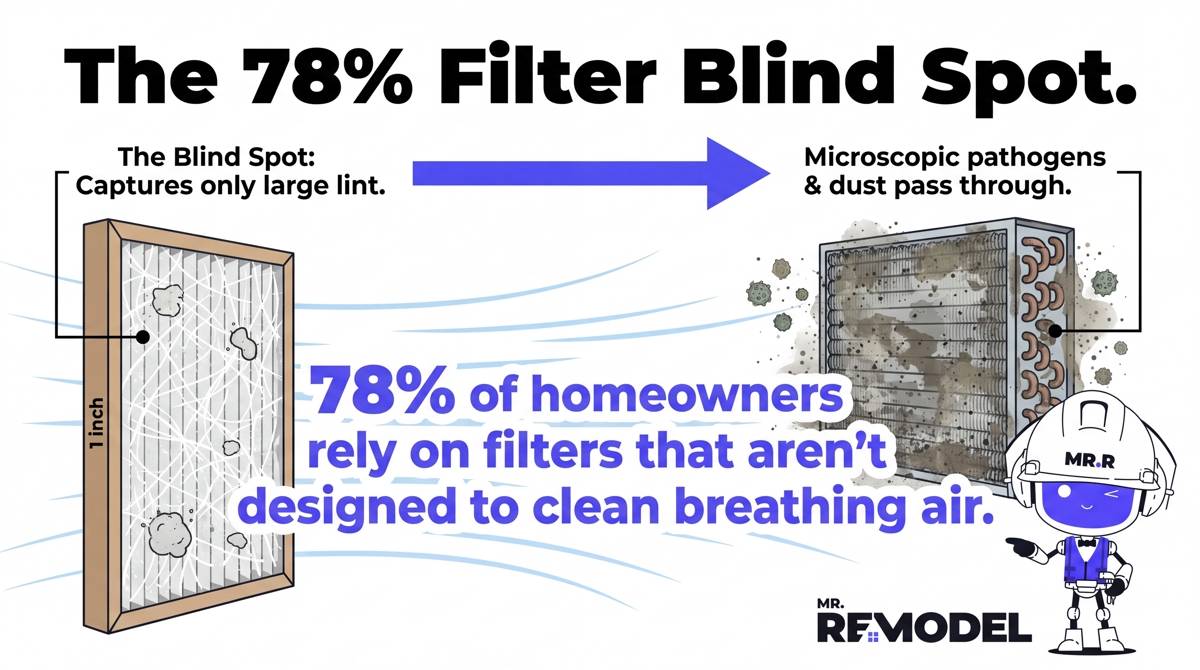
Instead, their engineering purpose is to catch large particles of dust and lint to prevent mechanical damage to your blower motor. They allow microscopic pathogens, mold spores, and fine smoke particles to pass through unhindered.
See Related: Signs of Poor Indoor Air Quality
When these small particles pass through an inefficient filter, they collect directly on your sensitive indoor evaporator coils. This accumulation restricts systemic airflow over time.
This restriction causes a compounding financial penalty. Saturated systems suffer from a 15% mechanical strain. This forces your compressor to run longer cycles, directly inflating your utility bills and accelerating component wear.
Financial Benchmarks for Advanced Air Quality Systems
Upgrading your home breathing environment requires a strategic capital investment. Homeowners must balance the initial equipment installation costs against long-term operational efficiency and health advantages.
The total cost to implement an air quality strategy depends on your home size, current ductwork, and chosen technology. The following table outlines standard market averages for professional air quality upgrades.
Baseline Installation Costs for Air Quality Upgrades
Hyper-Local Air Quality Stressors and Regional Metrics
Air quality profiles are not uniform across the nation. Different geographic regions face distinct environmental hazards that dictate specific mechanical solutions.
The Southern Sunbelt Region
In hot, humid zones, the primary indoor threat is biological proliferation. When outdoor humidity levels remain high, indoor spaces risk crossing dangerous thresholds.
According to data from the EPA Air Cleaners Home Guide, keeping indoor relative humidity below 60% is vital. Crossing this line allows mold colonies to grow rapidly on drywall and flooring.
See Related: Whole-Home Dehumidifiers
The West Coast Corridor
Western states face severe seasonal air quality challenges from wildfire smoke. These events introduce high concentrations of fine particulate matter into residential areas.
Mr. Remodel has tracked a 300% increase in regional demand for medical-grade HEPA systems in these zones. Homeowners require heavy-duty filtration setups to isolate their indoor spaces from outdoor smoke.
The Northeast and Midwest
Cold-climate zones experience severe winter air dryness. Running a central heating system continuously without moisture control drops indoor relative humidity below 20%.
This extreme dryness irritates human respiratory passages and cracks wooden structural finishes. Integrating an automated moisture delivery system into your central layout is required to preserve occupant comfort and property values.
See Related: Whole-Home Humidifiers
Regional Threats and Core Mechanical Countermeasures
Advanced Filtration: Comparing Clean Air Technologies
To choose the right equipment, homeowners must understand how different purification methods manage airborne particles.
Media Air Cleaners
These units replace your standard return grille with a deep cabinet that holds a thick, pleated four-inch filter. These systems utilize dense media to trap particles without creating high airflow resistance.
They offer a major upgrade over one-inch alternatives, lasting up to six months before requiring a replacement. They effectively catch pet dander, pollen, and dust.
True HEPA Systems
High-Efficiency Particulate Air filters represent the gold standard for residential filtration. These systems are tested to capture 99.97% of particles as small as 0.3 microns.
Because HEPA material restricts airflow, these units are typically installed in a bypass configuration. They pull a portion of air from the return duct, clean it, and feed it back into the stream.
See Related: Whole-Home Air Purifiers
In-Duct Ultraviolet (UV) Lights
UV systems do not filter particles from the air stream. Instead, they use ultraviolet radiation to disrupt the DNA of biological organisms.
Technicians install these lamps directly over the indoor evaporator coil. The continuous light stops mold from growing on the damp metal fins, keeping your system clean and efficient.
Technical Performance Matrix of Filtration Methods
A Step-by-Step Approach to Better Indoor Air
Achieving an allergen-free home requires a structured process that combines source management, ventilation, and mechanical cleaning.
- Eliminate Pollutant Sources: Remove chemical-heavy materials, store solvents in detached garages, and use low-VOC paints during renovations.
- Upgrade Your Filtration Baseline: Switch from fiberglass filters to pleated alternatives rated at MERV 11 or higher, ensuring your system can handle the density.
- Control Your Relative Humidity: Install automated monitoring tools to keep your indoor moisture levels between 30% and 50% year-round.
- Clean Your Air Distribution Network: Schedule a professional duct inspection if you notice dust building up quickly around your supply registers.
- Introduce Controlled Ventilation: Use mechanical recovery ventilators to exchange stale indoor air for fresh outdoor air without losing energy.
- Deploy Targeted Sanitization: Install UV lamps over your cooling coils to stop biological growth before it enters your ductwork.
Understanding Ventilation and Mechanical Exchange
Filtering your air is only part of the solution; you must also introduce fresh air into your home. Legacy homes relied on natural air leakage through walls and windows, but modern construction requires mechanical support.
Energy Recovery Ventilators (ERVs) and Heat Recovery Ventilators (HRVs) provide a controlled way to refresh your indoor climate. These systems capture energy from outgoing stale air and apply it to incoming fresh air.
This exchange allows you to ventilate your home without losing your heated or cooled temperature. It helps dilute indoor chemical buildups, carbon dioxide, and odors while maintaining your monthly utility budget.
FAQ
1. What is the difference between an air filter and an air purifier?
An air filter sits inside your ductwork to catch debris and protect your HVAC fan. An air purifier is an advanced system that actively destroys or captures fine particles, bacteria, and chemical odors.
2. How do I know if my indoor air quality is poor?
Signs include persistent dust buildup, lingering odors, frequent headaches, and unexplained allergy symptoms. You can verify these concerns with a professional air monitoring test.
3. How often should I clean my home’s air ducts?
Duct cleaning is recommended after major home renovations, if you discover mold growth inside the ducts, or if you deal with a severe pest infestation. Routine cleanings are generally unnecessary if you change your filters regularly.
4. Will an air purifier remove chemical odors and smoke?
Standard particle filters cannot stop gases or odors. To capture smoke and chemical fumes, you need an air purification system equipped with a heavy activated carbon stage.
5. Why is my home air so dry during the winter?
Cold outdoor air holds very little moisture. When that air enters your home and gets heated by your furnace, its relative humidity plummets, causing dry skin and respiratory irritation.
6. What air quality testing options does Mr. Remodel offer?
Mr. Remodel connects you with local experts who provide air testing services. They measure particulate counts, chemical concentrations, and mold levels to design a targeted filtration strategy.
Achieve True Breathing Comfort in Your Home
Managing your indoor air quality is a necessary step to protect your family’s health and maintain your mechanical systems. By moving past basic one-inch filters and adopting modern filtration and humidity controls, you can turn your home into a clean, healthy sanctuary.
Do not wait for poor air quality to cause health issues or trigger unexpected breakdown fees. Taking proactive control of your home’s air distribution setup protects your property value and your family’s comfort. Contact Mr. Remodel to get a free, no-obligation quote and connect with specialists to improve your indoor air quality.