1-855-QUOTEMR

Table of Contents [hide]
Who This Is For
This guide is for homeowners facing sudden gutter failures, severe leaks, detached gutters, storm damage, or overflow problems. It will help you understand what counts as a gutter emergency, what to do right away, and when repair may not be enough.
Key Takeaways
- Real Emergencies: Not every gutter issue needs emergency service.
- Urgent Signs: Detached gutters and severe leaks often need immediate attention.
- Fast Action: Quick steps can help reduce water damage risks.
- Repair or Replace: Some emergency repairs become full replacement projects.
- Cost Planning: Emergency repair costs depend on damage, access, and urgency.
A gutter problem can turn urgent when water starts going where it should not. Emergency gutter repair is often needed when gutters detach, overflow heavily, leak near vulnerable areas, or stop moving roof runoff away from the home.
The goal is not just to stop a drip. It is to protect the roofline, siding, fascia, foundation, landscaping, and walkways before the next rain worsens the damage.
What Counts as an Emergency Gutter Repair?
A true gutter emergency usually involves active water damage risk, safety concerns, or a system failure that cannot wait for routine maintenance.
The Environmental Protection Agency (EPA) explains, through its Soak Up the Rain program, that homeowners can help manage stormwater runoff by redirecting downspouts, using rain barrels, planting rain gardens, and improving drainage around the property. When gutters fail suddenly, that water may collect near areas that need protection.
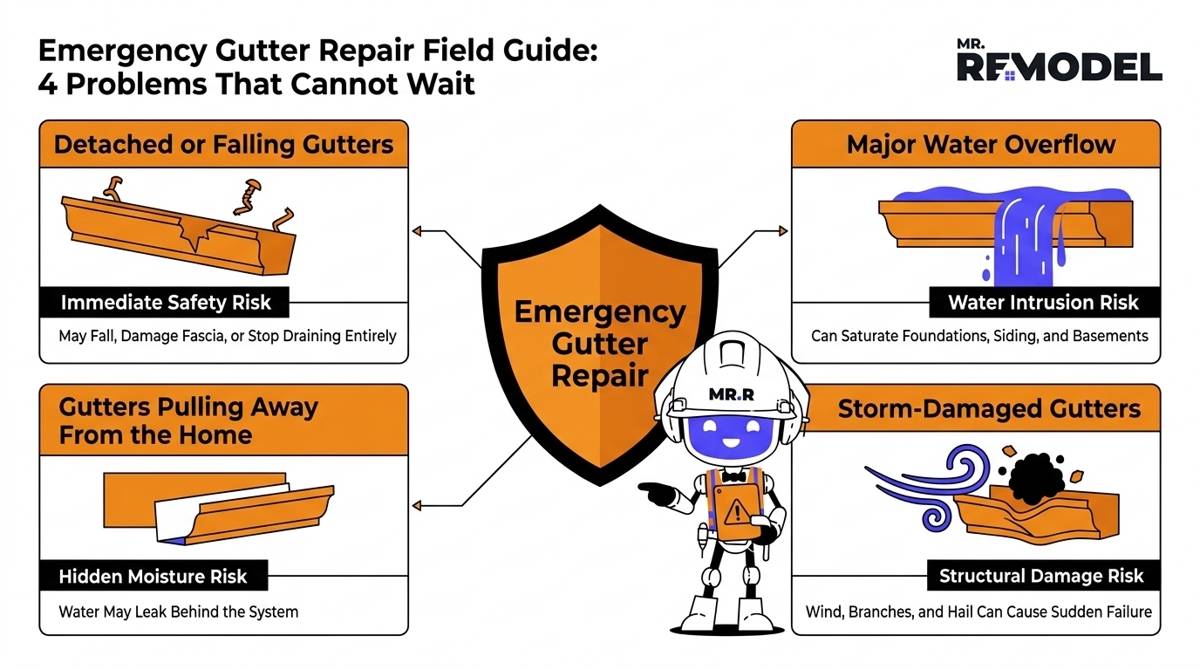
Detached or Falling Gutters
A detached gutter is an urgent problem because it may fall, damage fascia, or stop draining entirely. If the gutter is hanging loose, avoid standing under it or trying to pull it down yourself.
This situation often needs a professional inspection, especially if the fascia board, fasteners, or roof edge may also be damaged.
Major Water Overflow
Overflow becomes urgent when water is pouring over the gutter edge, collecting near the foundation, entering a basement, or soaking siding and trim.
A simple clog may be the cause, but severe overflow during rain can quickly become a drainage problem.
Storm-Damaged Gutters
Wind, branches, hail, and heavy rain can bend gutters, loosen hangers, disconnect downspouts, or tear sections away from the home.
Storm damage should be checked quickly because even one failed section can redirect roof runoff toward the wrong area.
Gutters Pulling Away From the Home
Gutters that pull away from the fascia may leak behind the system instead of draining into it. That can expose fascia boards, soffits, siding, and wall areas to moisture.
The National Institute of Building Sciences (NIBS) Whole Building Design Guide explains that water management systems are important for long-term building protection.
What Homeowners Should Do Immediately
The first step is to reduce risk, not perform unsafe repairs. Do not climb a ladder during a storm, on wet ground, in high wind, or near loose gutter sections.
If it is safe, take photos of the damage from the ground. This can help when speaking with a contractor or insurance provider.
Homeowners can also take simple temporary steps:
- Move outdoor items away from falling water
- Clear splash zones near doors or walkways
- Place downspout extensions where safe
- Redirect water away from the foundation
- Avoid touching loose electrical fixtures near water
- Keep children and pets away from damaged areas
- Call a professional if gutters are detached, bent, or unsafe
Do not attempt a roofline repair if the gutter is high, unstable, or attached to damaged fascia.
The Most Common Causes of Emergency Gutter Repairs
Emergency gutter issues often start as small maintenance problems. Then heavy rain, wind, ice, or age calls for urgent repairs.
Storm Damage
Storms can loosen gutters, snap fasteners, bend sections, and break downspouts. Fallen branches may also damage the gutter profile.
After a major storm, inspect from the ground for sagging, separation, dents, leaks, and disconnected downspouts.
Clogs and Overflow
Leaves, roof grit, pine needles, and debris can block water flow. When water cannot reach the downspouts, it spills over the edge.
See Related: Common Gutter Problems and Solutions
Ice and Snow Damage
In cold climates, snow and ice can add weight to the gutter system. That weight may cause sagging, separation, or fastener failure.
Ice-related damage should be handled carefully because gutters may be unstable.
Aging Gutter Systems
Older gutters may already have weak seams, rust, cracks, loose hangers, or poor slope. A storm may simply reveal problems that were already developing.
If emergency repairs keep happening, replacement may be the better long-term option.
Emergency Gutter Repair vs Gutter Replacement
Some urgent gutter problems can be repaired. Others are signs that the system is failing in too many places.
Mr. Remodel inquiry data shows that gutter repair generated 1,924 inquiries, while gutter replacement generated 6,273 inquiries. Replacement demand is more than 3 times higher than repair demand.
That does not mean every emergency needs replacement. But it does show that many homeowners eventually reach a point where fixing one section is not enough.
Repair may make sense when:
- One seam is leaking
- One downspout is damaged
- One section pulled loose
- One clog caused overflow
- The rest of the system drains well
Replacement may make sense when:
- Multiple sections are sagging
- Leaks appear in several places
- Gutters are rusted, cracked, or bent
- The system keeps overflowing after cleaning
- Repairs keep repeating
- Fascia or roofline damage is involved
See Related: Signs You Need New Gutters
How Much Does Emergency Gutter Repair Cost?
Emergency gutter repair costs depend on the type of damage, home height, access, materials, urgency, and whether related fascia or roofline repairs are needed.
Industry-standard repair estimates include:
These are planning ranges, not guaranteed prices. Emergency work may cost more if damage is severe, access is difficult, or immediate service is required.
See Related: Gutter Replacement Cost Guide
Ready to compare repair options? Mr. Remodel connects homeowners with fully vetted local contractors. You can use Mr. Remodel to find local gutter contractors and request a free, no-obligation quote.
When Water Damage Becomes the Bigger Problem
The gutter itself may not be the biggest issue if water has already reached siding, trim, fascia, the foundation, or interior areas.
The Federal Emergency Management Agency (FEMA) discusses water intrusion, drainage, and moisture-related risks in its Homeowner’s Guide to Retrofitting. That is why severe gutter failures should not be ignored.
Warning signs that water damage may be developing include:
- Stains on siding or fascia
- Soft or rotting wood near the roofline
- Water pooling near the foundation
- Soil erosion below the gutter
- Wet basement walls
- Moldy smells indoors
- Overflow that repeats during every storm
See Related: What To Do Immediately After Water Damage
Frequently Asked Questions
What qualifies as emergency gutter repair?
Emergency gutter repair usually involves a loose, detached, overflowing, leaking, or storm-damaged gutter that may cause water damage or safety risks. If water is actively entering the wrong area, treat it as urgent.
Can I wait a few days to repair a leaking gutter?
A small drip in dry weather may be able to wait for a scheduled repair. A major leak during rain, overflow near the foundation, or a detached section should be addressed faster. When in doubt, ask a contractor to assess the risk.
How much does emergency gutter repair cost?
Minor repairs may cost around $150 to $400, while reattaching gutters can range from $200 to $600. Section replacement or storm damage repair can cost more. The final price depends on damage, access, material, and urgency.
Will homeowners' insurance cover emergency gutter repairs?
Insurance may cover some storm-related damage, but it depends on your policy, the cause of damage, and inspection findings. Damage from poor maintenance may not be covered. Contact your insurance provider for claim guidance.
When should I replace gutters instead of repairing them?
Replacement may be better if gutters are sagging in several areas, leaking repeatedly, rusting, pulling away, or overflowing after cleaning. Recurring emergency repairs are often a sign that the system is no longer reliable.
When to Act Quickly and When to Plan for Replacement
Emergency gutter repair is about protecting your home before water damage gets worse. Detached gutters, severe overflow, storm damage, and major leaks should be addressed quickly, especially when water is reaching the foundation, siding, fascia, or roofline.
If the damage is isolated, a repair may be enough. If problems are widespread or keep returning, replacement may be the smarter long-term solution. To move forward, use Mr. Remodel as a contractor-matching platform to connect with fully vetted local gutter contractors.