1-855-QUOTEMR

Table of Contents [hide]
Who This Is For:
Homeowners comparing installers for a multi-window, energy-efficient replacement project.
Key Takeaways:
- Verify the Product: Confirm that the exact window configuration qualifies for the home’s climate zone.
- Review the NFRC Label: Compare U-factor, solar heat gain coefficient, and other applicable ratings.
- Check Installation Practices: Ask how the crew follows manufacturer instructions for flashing, insulation, and sealing.
- Plan Multiple Openings: Confirm the company’s measurement, ordering, crew, and quality-control capacity.
- Separate Warranties: Review product and workmanship coverage independently.
Choosing ENERGY STAR window replacement installers requires evaluating the products and installation plan separately. ENERGY STAR certifies qualifying window products, not the companies that install them. Homeowners should confirm that the exact product configuration qualifies for their location while assessing how the installer will measure, order, and install each unit.
Based on Mr. Remodel data, the median window installation inquiry involved five windows. Coordinating a project of this size requires accurate measurements, suitable specifications, proper installation, and a final quality check for every opening.
What ENERGY STAR Certification Means for Windows
ENERGY STAR-certified windows meet energy-efficiency requirements established by the U.S. Environmental Protection Agency. According to the official ENERGY STAR product criteria, qualifying products are manufactured by an ENERGY STAR partner and independently tested, certified, and verified through the National Fenestration Rating Council.
Certification Applies to Specific Configurations
A manufacturer may offer several operating styles, frame materials, glass packages, and options within one product line. These configurations can have different performance ratings.
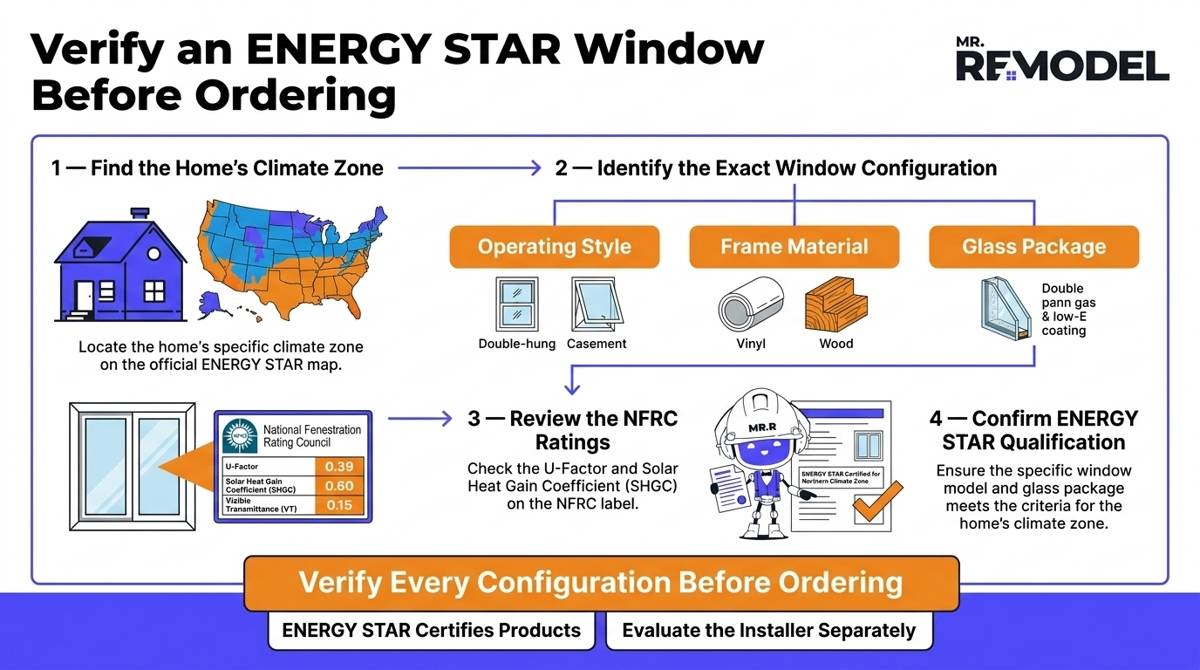
Ask the installer to identify the exact style, frame, glass configuration, and NFRC ratings in the written proposal. A brand or product-line name alone does not confirm that every available configuration qualifies.
ENERGY STAR Does Not Certify Installers
ENERGY STAR certification applies to eligible products rather than installation companies. An installer’s experience, installation methods, project management, and workmanship warranty require a separate evaluation.
Why the ENERGY STAR Climate Zone Matters
ENERGY STAR uses climate-specific performance criteria because windows face different heating and cooling conditions across the country.
The official ENERGY STAR climate-zone finder allows homeowners to search by state and county. Ask the installer to identify the applicable climate zone and confirm that each selected configuration qualifies before ordering.
Windows in the same home may also face different solar exposure, shading, and room conditions. Any differences in glass packages or configurations should appear in an opening-by-opening product schedule.
See Related: Energy-Efficient Windows
Compare U-Factor and Solar Heat Gain Coefficient
The ENERGY STAR and NFRC labels provide related information, but they serve different purposes. ENERGY STAR identifies configurations that meet program criteria, while the NFRC label presents standardized performance ratings for comparing products.
What U-Factor Measures
U-factor measures how readily heat passes through the complete window. Lower values indicate lower heat transfer.
Because the rating applies to the whole product, it provides a more complete comparison than a center-of-glass measurement.
What Solar Heat Gain Coefficient Measures
Solar heat gain coefficient, or SHGC, measures how much solar heat enters through the window. Lower values admit less solar heat, while higher values admit more.
The appropriate SHGC depends partly on the climate and project conditions. The lowest available number is not automatically the best choice for every home.
Other NFRC Ratings
The National Fenestration Rating Council may also report visible transmittance, air leakage, and condensation resistance. Each rating describes a different performance characteristic.
Ask the installer to compare complete NFRC labels rather than rely on a single isolated measurement.
See Related: Best Energy-Efficient Windows for Hot Climates
Why Installation Quality Affects Window Performance
A qualifying product still requires installation that follows the manufacturer’s written instructions. Measurements, opening preparation, flashing, insulation, sealing, fastening, and alignment all contribute to the completed assembly.
Confirm the Installation Method
Ask whether each opening will receive pocket or full-frame replacement. Pocket installation retains the existing frame, while full-frame replacement removes it and exposes more of the rough opening.
The proposal should identify the method planned for every location and explain how the crew will handle flashing, insulation, air sealing, trim, and visible deterioration.
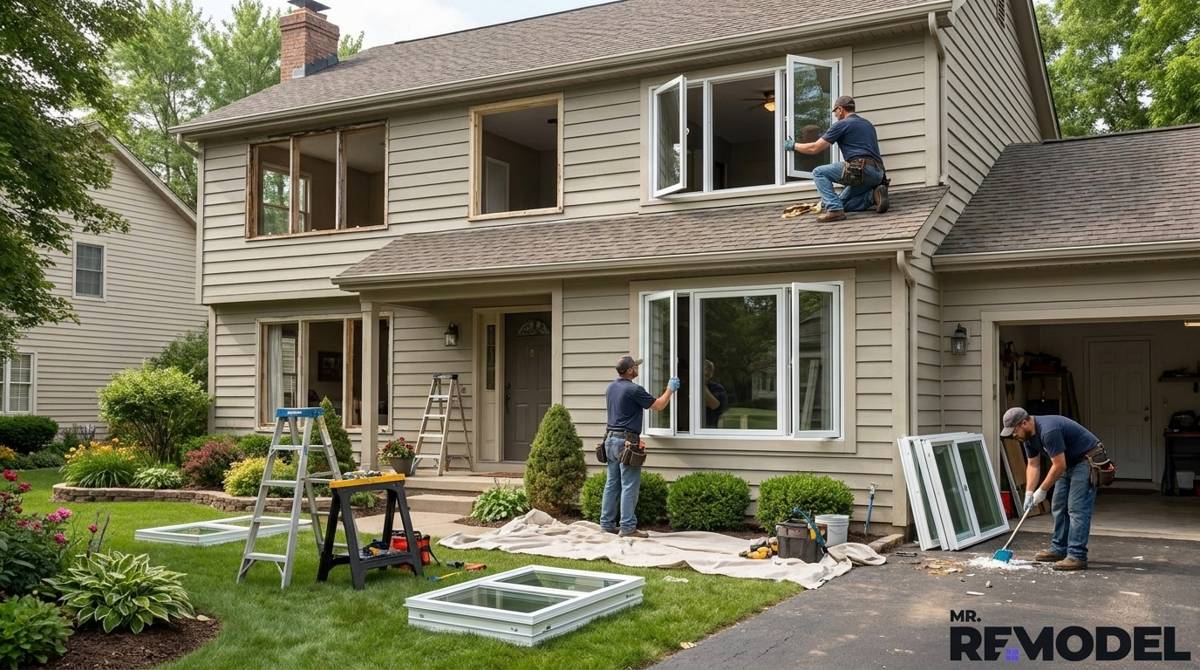
Plan for Multiple Openings
Based on Mr. Remodel data, 52.94% of window installation inquiries involved at least five windows. Similar-looking openings may require different dimensions, operating directions, glass packages, or installation details.
Assigning every opening a number helps keep measurements, products, and instructions organized. The installer should match each delivered unit with its assigned location before removing the existing window.
Prepare for Large Projects
Mr. Remodel data also shows that 27.07% of window installation inquiries involved at least 10 windows. At this scale, ask how the company supervises the crew and maintains consistent quality throughout the home.
The project plan should cover order verification, room protection, installation inspections, operation testing, cleanup, and correction of incomplete work.
Ready to compare energy-efficient products and installation plans? Get a free window replacement quote today.
Questions to Ask Window Installers
The consultation should clarify product eligibility, measurement responsibility, installation practices, and scheduling.
Does the Exact Window Qualify?
Request the manufacturer, product line, frame, glass package, and NFRC ratings for the proposed configuration. Confirm that it meets ENERGY STAR requirements for the applicable climate zone.
Who Approves the Measurements and Order?
Identify who takes the final production measurements and approves the completed order. The agreement should explain how the company handles an incorrectly sized or configured unit.
How Will the Crew Follow Installation Instructions?
Ask how the crew follows manufacturer requirements for flashing, fastening, insulation, sealing, and clearances. Confirm who supervises the installation and inspects each completed opening.
How Will the Project Be Scheduled?
Based on Mr. Remodel data, 95.07% of window installation prospects wanted to begin within 30 days. Discuss final measurements, product approval, ordering, delivery, and installation as separate project stages.
The agreement should also explain how the installer handles damaged deliveries or products that do not match the approved order.
See Related: Questions to Ask Window Installers
Compare Product and Workmanship Warranties
ENERGY STAR certification does not replace manufacturer or installer warranty coverage. Each warranty addresses different responsibilities.
A manufacturer warranty may cover eligible defects involving the frame, glass, seals, finish, hardware, or other listed components. Review the coverage period, exclusions, registration requirements, transferability, labor provisions, and claim procedure.
A workmanship warranty addresses covered installation problems. Confirm its duration, exclusions, service process, and the company responsible for evaluating a claim. The contract should also explain how the installer coordinates with the manufacturer when the source of a problem requires further evaluation.
FAQ About ENERGY STAR Window Replacement
Does ENERGY STAR certify window installers?
No. ENERGY STAR certifies qualifying window products that satisfy applicable EPA performance criteria. Homeowners should evaluate the installer’s experience, installation practices, project management, and workmanship coverage separately.
How can I verify that a window is ENERGY STAR certified?
Confirm the manufacturer, product line, operating style, frame, glass package, and other configuration details. Review its certification information and NFRC ratings, then verify that the product qualifies for the home’s climate zone.
What is the difference between ENERGY STAR and NFRC labels?
The ENERGY STAR label identifies products that meet program requirements for applicable climate zones. The NFRC label provides independently certified performance ratings, such as U-factor and solar heat gain coefficient, that help homeowners compare products.
Which window ratings matter in my climate zone?
U-factor and solar heat gain coefficient are central to ENERGY STAR window criteria. Visible transmittance, air leakage, and condensation resistance may provide additional information for comparing products.
How many windows should I replace at once?
The appropriate number depends on the home’s window conditions, priorities, and project plan. Based on Mr. Remodel data, 10 windows were the most frequently selected quantity, accounting for 26.65% of window installation inquiries.
Choose an Installer for Your Energy-Efficient Window Project
A well-planned project combines verified products with accurate measurements, suitable installation methods, and consistent quality control. Confirm each window’s climate-zone eligibility and NFRC ratings before ordering, then review how the installer will manage every opening through completion.
Ready to improve your home with energy-efficient windows? Get your free, no-obligation ENERGY STAR window replacement quote today.