1-855-QUOTEMR

Table of Contents [hide]
Who This Is For
This diagnostic guide is for homeowners currently facing an unexpected spike in monthly utility expenses. If you are tired of generic "turn off your lights" advice and want to understand the mechanical, data-backed HVAC failures that actually drive your energy costs upward, this resource will help you identify the root cause of your high bills.
Key Takeaways
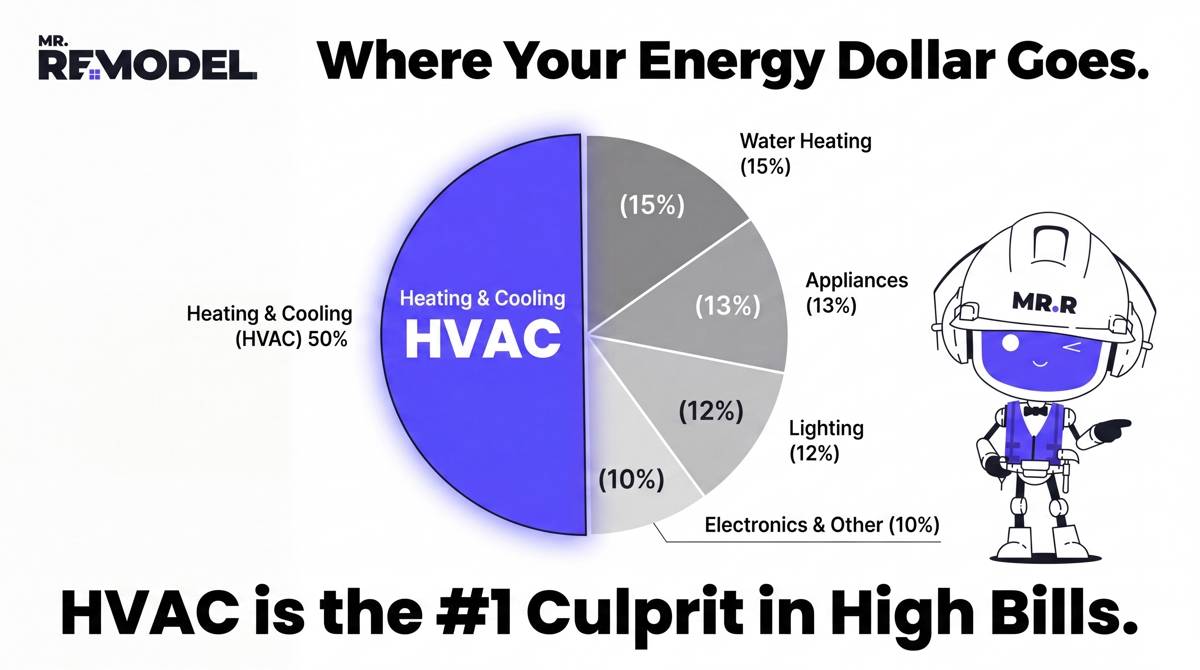
- The 50% Rule: Heating and cooling typically account for 50% of the average household's energy expenses.
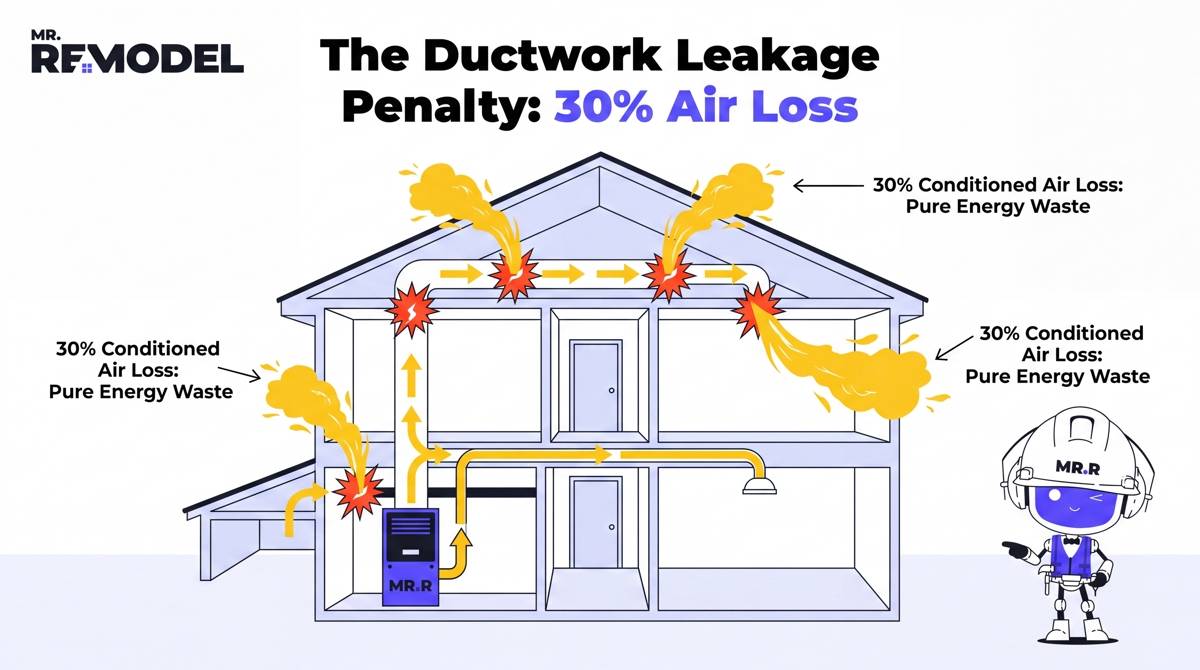
- The Ductwork Leakage Penalty: Degraded ductwork loses 20% to 30% of conditioned air into unconditioned spaces, forcing your HVAC system to run longer cycles to reach your target temperature.
- The Dirty Filter Tax: Neglecting filter replacements forces your blower motor to work harder, increasing your localized power consumption by up to 15%.
- Short-Cycling Waste: Malfunctioning systems that cycle on and off too frequently consume 25% more power while failing to adequately dehumidify your home.
- Proactive ROI: Replacing legacy systems with modern, high-efficiency technology can reduce your summer cooling expenses by nearly 40%.
There is nothing more frustrating than opening a monthly energy bill and finding a total that makes no sense. You haven't changed your habits. You haven't added new major appliances. Yet, the cost is significantly higher than last month.
When your utility expenses spike, the culprit is rarely the way you use your lights or appliances. In over 50% of cases, the answer lies hidden in your HVAC system’s mechanical performance.
At Mr. Remodel, we help thousands of homeowners stop the financial bleed by diagnosing the structural and mechanical failures that drive up energy consumption. If your bills are climbing, it is time to look beyond your thermostat settings and into the mechanical health of your home.
1. The Ductwork Leakage Penalty
Most homeowners assume their HVAC system is a closed loop, but that is rarely the case. In a typical home, up to 30% of the air traveling through your ducts leaks out into attics, basements, or crawlspaces before it ever reaches your rooms.
When your ducts are compromised, your air conditioner or heat pump works much harder to maintain a set temperature. It pushes air into an attic, tries to cool the remaining air, and fails to reach the set point. This leads to longer runtimes and massive energy waste.
If your home is over 20 years old, these ducts have likely degraded, causing a continuous drain on your finances.
2. The "Dirty Filter" Tax
Many users forget to change their air filters within the recommended 90-day window. This is the most common and most expensive piece of neglect in the home.
A clogged filter restricts airflow. This forces your blower motor to work against significant resistance to pull air into the system. Our internal data shows that this unnecessary physical labor can increase your HVAC unit's electricity consumption by 15%.
Think of it as trying to run a marathon while breathing through a narrow straw. Your system consumes far more power to achieve far less air movement.
3. Short-Cycling Inefficiency
If you hear your HVAC unit turning on and off every 10 minutes, you are witnessing "short-cycling." This occurs when a system is oversized for the home or has a failing sensor.
Every time an HVAC motor starts up, it draws a massive spike of electricity. When it does this continuously, that spike happens constantly rather than once per long cycle. This inefficiency results in 25% more power consumption and a failure to properly dehumidify your home.
If your home feels clammy in the summer despite the AC running, your system is likely short-cycling and burning through your budget.
4. The R-410A Refrigerant Phase-Down
If your unit has a slow refrigerant leak, you may have been told in the past that you just need to "top it off." In 2026, that advice is now a financial trap.
As the industry phases out legacy refrigerants like R-410A, the cost of these chemicals has skyrocketed. Topping off a system now often costs $100 to $200 per pound. If your system has a persistent leak, you are essentially pouring money into a failing asset.
At this stage, upgrading to energy-efficient HVAC systems is often more cost-effective than attempting to repair a system that is no longer chemically supported by the modern market.
See Related: Energy-Efficient HVAC Systems
5. Aging Systems and Efficiency Standards
An HVAC system is a machine that loses its efficiency over time. If you are running a unit from 15 years ago, you are likely operating with a SEER rating of 10 or 11.
Modern units are held to much higher benchmarks. By understanding SEER2 ratings and efficiency standards, you can see exactly how much energy you are wasting.
Older, low-efficiency units have to work longer and harder to achieve the same thermal comfort as a modern variable-speed system. You aren't just paying for comfort; you are paying for the inefficiencies of obsolete engineering.
You can also mitigate these costs by installing a smart thermostat to control HVAC runtime. This ensures your system only runs when it is truly needed.
See Related: SEER2 Ratings Explained
When to Seek Professional Help
If your bills have spiked, don't wait for the next billing cycle to address it. A professional inspection can identify if your issue is a simple filter change or a deeper, more expensive failure in the building envelope.
Look for platforms like Mr. Remodel to connect with local experts who can perform a diagnostic audit of your system. They have partners who are equipped to handle everything from duct sealing to full system resets.
Need a diagnostic check today? Get a free HVAC installation quote and see if your system's efficiency can be restored.
See Related: Ways to Lower HVAC Energy Costs
Frequently Asked Questions
Why does my energy bill spike in the transition seasons?
Transition seasons, like spring and fall, often involve fluctuating temperatures. Your HVAC system may have to work in heating mode in the morning and cooling mode in the afternoon. If your thermostat isn't configured for these shifts, the constant switching can spike your energy use.
Can sealing my home really lower my energy bills?
Yes. Sealing air leaks around windows and doors, along with properly insulating your attic, prevents your conditioned air from escaping. This reduces the total "thermal load" your HVAC system has to manage, directly lowering your monthly energy consumption.
How do I know if my ductwork is leaking?
If you notice rooms that are consistently warmer or cooler than the rest of the house, or if you see dust buildup near your supply registers, it is a strong indicator that your ductwork is losing air into unconditioned spaces.
What should I look for in a new HVAC quote?
When seeking a replacement, look for contractors who provide a Manual J Load Calculation. This is the only way to ensure the system is properly sized. An oversized system will short-cycle, wasting money.
How does Mr. Remodel help me lower my bills?
Services like Mr. Remodel help by matching you with vetted contractors who prioritize high-efficiency installations and comprehensive home audits. We ensure your system is optimized for your local climate, saving you money from day one.
Take Action for Lower Bills
Your energy bill is a roadmap of your home's mechanical health. When it spikes, your home is trying to tell you that its systems are struggling. Whether it is a dirty filter, a leak in your ducts, or an aging unit, these issues don't resolve themselves; they only grow more expensive.
Taking a proactive approach to your home’s energy management is the best way to protect your long-term finances. By addressing these hidden culprits, you ensure a more comfortable home and a lighter load on your monthly budget.
Ready to stop the utility bill spikes? Mr. Remodel simplifies the upgrade process. Get a free, no-obligation quote and get expert advice on proven ways to lower HVAC energy costs.