1-855-QUOTEMR

Table of Contents [hide]
Who This Is For
This performance comparison is crafted for single-family homeowners evaluating heating replacement options. If you are debating the long-term ROI of a traditional gas furnace against the modern, high-efficiency potential of a heat pump, this guide provides the current 2026 data required to make an informed, budget-conscious decision.
Key Takeaways
- The 300% Efficiency Shift: Modern heat pumps transfer heat rather than generating it via combustion, reaching up to 300% efficiency compared to the 98% AFUE cap of the best gas furnaces.
- The Financial Reality: While furnaces often have a lower initial price ($4k–$8k), they require a separate cooling system for summer months, whereas a heat pump provides both functions in one unit.
- Federal Tax Incentives: Qualifying high-efficiency heat pumps now benefit from federal Inflation Reduction Act (IRA) tax credits of up to $2,000, significantly reducing the "capital gap" between electric and gas systems.
- Dual-Fuel Hybridization: In severe northern climates, the smartest strategy is often a "dual-fuel" setup—pairing an electric heat pump for mild conditions with a gas furnace backup for extreme, sub-zero cold waves.
- Proactive ROI: 68% of system replacements are currently driven by emergency failures. Planning your system transition now avoids the inflated emergency rates of mid-winter crisis service.
Heating and cooling account for the largest percentage of your home's annual utility bill. When your furnace or AC reaches its 15-year limit, you face a critical choice: stick with a traditional fossil-fuel setup or upgrade to modern electric heat pump technology.
According to research from the U.S. Department of Energy, heat pumps are no longer the "alternative" choice. They are the new standard for high-performance home climate control. By moving thermal energy rather than burning fuel, they achieve a level of efficiency that traditional combustion furnaces simply cannot match.
At Mr. Remodel, we help you look past the initial price tag to see the total cost of ownership. Comparing systems requires looking at your local utility rates, the current state of your ductwork, and your regional climate profile.
See Related: Types of HVAC Systems | 2026 Cost & Efficiency Comparison Guide
The Mechanical Logic: Combustion vs. Heat Transfer
To understand the difference, you have to understand the process. A gas furnace generates heat by burning natural gas or propane. Even the most efficient units, rated at 98% AFUE, still lose 2% of their fuel energy during the combustion process.
A heat pump, conversely, is essentially an air conditioner that works in reverse. In the winter, it harvests heat from the outdoor air (even in cold conditions) and pumps it into your home. Because it moves heat rather than creating it, one unit of electricity can generate three units of heat energy, resulting in 300% efficiency.
Strategic Infrastructure Impacts
When you install a furnace, you are also required to install a separate air conditioning unit to handle the cooling load in the summer. This means you have two massive pieces of equipment to maintain, repair, and eventually replace. A heat pump acts as a single-source solution for both seasons.
2026 Cost and Rebate Benchmarks
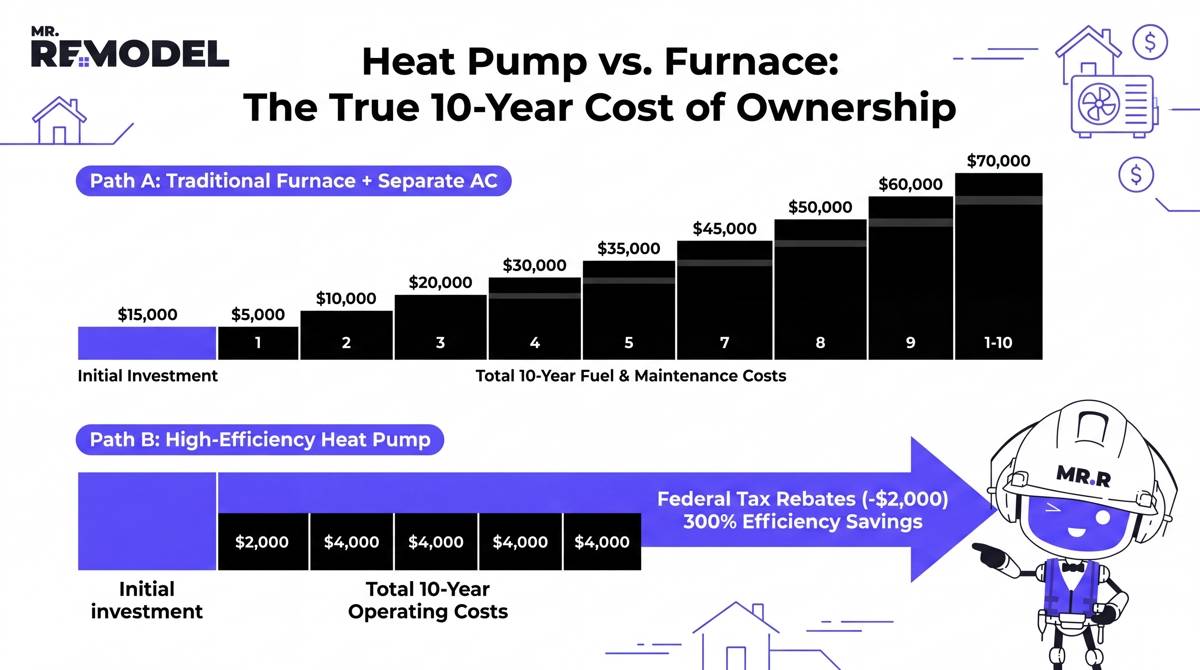
When comparing these two paths, it is important to analyze the "bundled" cost of a full climate system.
The "IRA" Rebate Factor
One of the most important developments in 2026 is the impact of the Inflation Reduction Act (IRA). Many high-efficiency heat pumps now qualify for federal tax credits of up to $2,000. These incentives do not just lower the price; they often tip the financial math in favor of the heat pump over the traditional furnace-plus-AC route.
Always check the Database of State Incentives for Renewables & Efficiency to see how your specific municipality stacks state-level rebates on top of federal ones.
Regional Climate Strategies: The Hybrid Approach
One of the biggest myths about heat pumps is that they do not work in the cold. While it is true that extreme sub-zero temperatures present a challenge, 2026 technology, particularly variable-speed inverters, allows units to run efficiently even in harsh winter conditions.
In northern regions (Climate Zones 5 & 6), we are seeing an operational migration toward "Dual-Fuel Hybrid" setups.
- The Setup: A high-efficiency heat pump handles your day-to-day heating and cooling.
- The Backup: A gas furnace remains in the system, programmed to kick in only when outdoor temperatures drop below the heat pump's effective threshold.
This "best-of-both-worlds" approach keeps your energy bills low during the spring and fall while providing a reliable backup for the coldest nights of the year.
See Related: Central Air vs Heat Pump
Professional Assessment: Do You Need an Upgrade?
Before choosing between a furnace and a heat pump, you must know the state of your home’s existing infrastructure. In homes older than 25 years, our data shows that 65% of air ducts have significant structural deterioration.
If you install a new 98% efficient furnace into a home with leaking, uninsulated ducts, you are wasting 30% of your energy to the attic or crawlspace. Regardless of which system you choose, we highly recommend that you schedule a professional inspection and get a free quote to assess your duct integrity first.
Frequently Asked Questions
Which system has the lowest monthly energy cost?
For most homeowners in temperate and mild climates, a heat pump will offer the lowest monthly energy cost due to its superior efficiency. In regions with extremely high electricity rates and cheap natural gas, a high-efficiency gas furnace can remain competitive.
Are heat pumps reliable in sub-zero weather?
Modern cold-climate heat pumps are designed to operate in temperatures as low as -15°F. However, for homes in regions that stay well below zero for weeks at a time, a dual-fuel hybrid system is the most reliable recommendation.
How does the 2026 tax credit work?
The IRA federal tax credit allows you to claim 30% of the cost of a qualifying heat pump installation, up to a maximum credit of $2,000. This is a direct tax credit, not a deduction, which directly lowers the tax you owe the government.
Does Mr. Remodel help me navigate the rebate process?
Mr. Remodel connects you with local experts who understand both the mechanical side and the financial side of your upgrade. They can help you identify which systems qualify for specific rebates and help you choose a solution that maximizes your efficiency.
Make the Right Call for Your Home HVAC System
The decision between a heat pump and a furnace is rarely about one being "better" in a vacuum; it is about choosing the system that fits your home's structural realities and your long-term energy goals.
By shifting toward modern electric or hybrid systems, you are not only taking advantage of current tax incentives but also insulating your household against the unpredictable costs of fossil fuel energy.
Whether you opt for a high-efficiency all-weather home upgrades strategy or a more traditional configuration, the key to success is planning. Mr. Remodel is your partner in this process, providing the transparency and vetted installation network you need to ensure your investment lasts for the next two decades.
Contact us to get a free, no-obligation quote and start your home's HVAC upgrade with complete confidence.