1-855-QUOTEMR

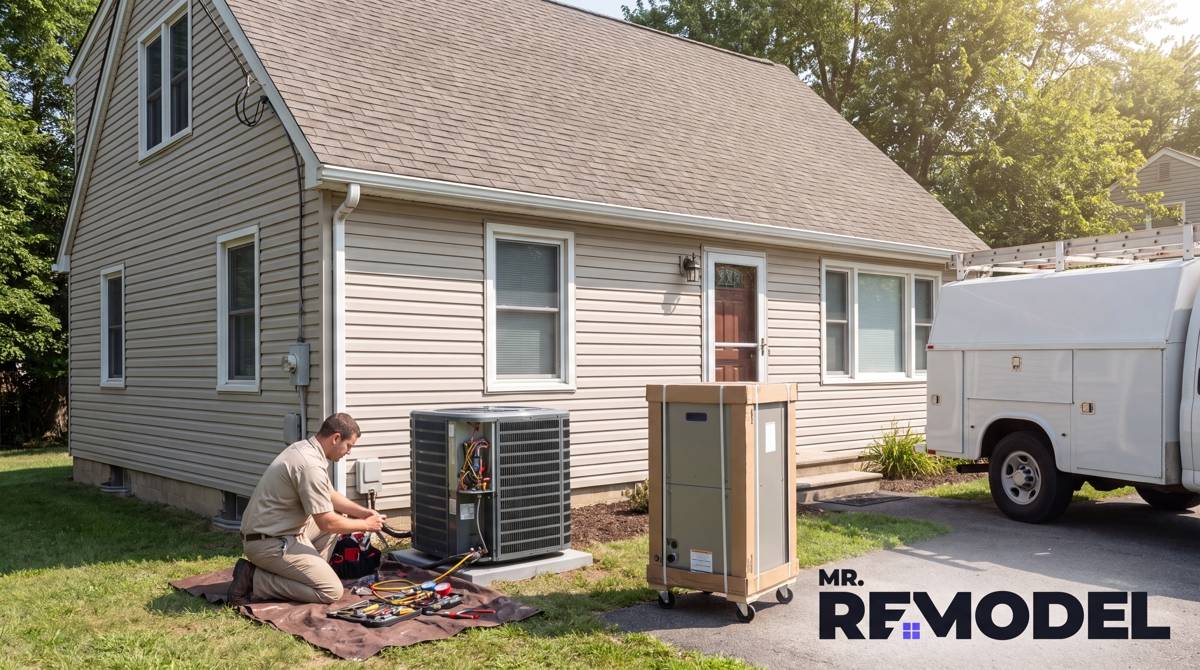
Table of Contents [hide]
Who This Is For
This decision-support manual is built for single-family homeowners navigating a mechanical HVAC breakdown, facing rising monthly energy bills, or evaluating an aging system. If you want to bypass generic repair advice and need empirical financial data to decide between a short-term fix or a 2026-compliant system replacement, this guide is for you.
Key Takeaways
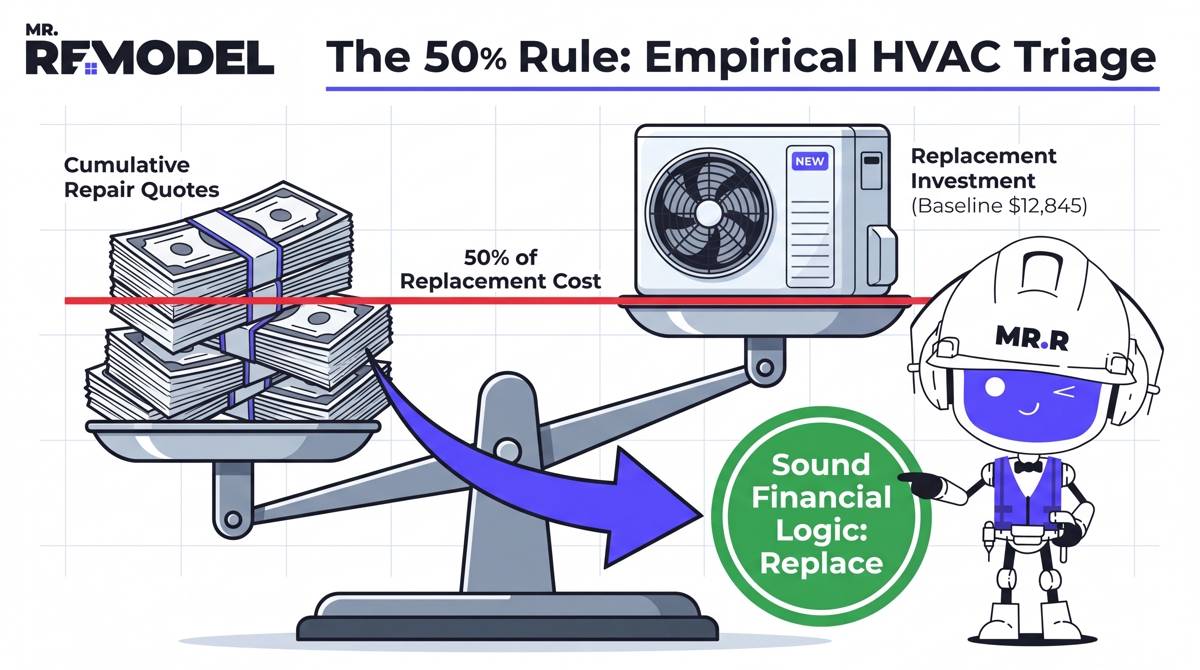
- The Repair-vs-Replace Threshold: Use the "50% Rule"—if a repair quote exceeds 50% of the cost of a new system, replacement is objectively the more sound long-term investment.
- The Efficiency Gap: Modern systems meeting 2026 SEER2/HSPF2 efficiency standards can reduce cooling expenditures by up to 40% compared to units from the early 2010s.
- R-410A Phase-Out: The mandated phase-out of traditional refrigerants means that repairing an older system is becoming increasingly expensive due to dwindling chemical supply and high market costs.
- Capital Benchmarks: A standard 2,000–2,500 sq. ft. home setup (AC plus furnace) requires a projected investment of $11,590 to $14,100, which can be partially offset by clean-energy tax incentives.
- Market Opportunity: 84% of homeowners searching for HVAC help have not yet selected a contractor, making transparency, speed, and hard data your most effective negotiation tools.
Is your heating and cooling system limping through another season, or are you noticing your utility bills creeping up despite regular filter changes? For single-family property owners, an HVAC failure creates an immediate, high-stress decision point.
The temptation to "fix it one more time" is strong, but often it leads to wasted capital that could have been invested in a permanent, high-efficiency solution.
According to federal standards from the Department of Energy’s HVAC Replacement Metrics, upgrading to a unit that meets current SEER2 and HSPF2 efficiency benchmarks is one of the most effective ways to lower your household energy overhead.
Investing in a properly sized, modern system does more than just restore comfort; it effectively resets your asset lifespan to zero.
See Related: HVAC Replacement Guide
The Economics of the 50% Rule
The single most reliable indicator for when to replace an HVAC system is the 50% Rule. To calculate this, take the age of your current system and multiply it by the cost of the repair quote. If that figure is greater than 50% of the total cost of a brand-new installation, you are essentially "throwing good money after bad."
Why Repair Costs Are Skyrocketing
Beyond simple mechanical age, the HVAC industry is undergoing a massive regulatory shift. As the Environmental Protection Agency’s Refrigerant Phase-out Guidelines continue to restrict the production of traditional R-410A refrigerants, the cost for simply recharging a leaking older system is becoming exorbitant.
When you factor in the labor and supply-scarcity costs of patching an older system, the financial logic often points directly to replacement.
See Related: Signs You Need a New HVAC System
2026 Energy Standards and Financial Incentives
The efficiency of your home’s climate control is dictated by SEER2 (Seasonal Energy Efficiency Ratio) and HSPF2 (Heating Seasonal Performance Factor) ratings. Older systems (often SEER 10 or 12) operate with massive waste compared to modern SEER2 15+ systems.
For many homeowners, the upfront investment of $11,590 to $14,100 for a standard AC and furnace combination is heavily offset by available government incentives. Before starting your project, check the Database of State Incentives for Renewables & Efficiency for localized tax rebates that can drive the net cost of high-efficiency heat pumps and furnace units down significantly.
Addressing the Reliability Gap
One of our most critical operational findings is the "Contractor Velocity Gap." We analyzed digital inquiry data and found that 89% of traditional HVAC contractors fail to respond to direct digital quote requests within one hour.
This systemic lack of speed leaves homeowners vulnerable during peak-heat or sub-zero events. In a climate emergency, waiting 48 hours for a quote is not an option. Our operational network is specifically optimized to provide real-time cost transparency and rapid deployment.
If you are currently researching your options, do not leave your comfort to chance. Obtain a free quote now to understand your home’s specific layout needs before the next failure cycle hits.
Vetting Your Installation Partner
An HVAC unit is only as efficient as its installation. Even the most advanced, high-efficiency heat pump will fail to reach its potential if the system is improperly sized or if the existing ductwork contains structural leaks.
When vetting contractors, insist on these three non-negotiables:
- Manual J Load Calculation: This is the only scientific method for sizing a system to your home's unique insulation and footprint. Never accept a "rule of thumb" sizing based purely on square footage.
- Ductwork Pressure Testing: A new furnace pushing air through leaking, disconnected, or blocked ducts is a recipe for efficiency loss.
- Code-Compliant Permits: Modern high-efficiency systems often require updates to your gas line or electrical panel. Ensure your contractor pulls all necessary city permits and schedules independent inspections.
Frequently Asked Questions
If my unit is 12 years old and needs a $2,000 repair, should I replace it?
Based on the 50% Rule, you must compare that $2,000 to the total cost of a new system (roughly $12,000). Since 50% of $12,000 is $6,000, and $2,000 is well below that threshold, a repair might still make financial sense—if the system is otherwise in good health and not leaking restricted refrigerants.
Does a new HVAC system really save 40% on bills?
Yes, if you are upgrading from an older, low-efficiency model to a modern high-SEER2 system. These savings accumulate rapidly, often paying for the cost difference between the base model and the high-efficiency model within five to seven years.
How do I know if my ductwork is the problem?
Persistent dust accumulation, hot or cold spots in the house, or high-pitched whistling sounds from vents are major indicators of duct leaks. Upgrading the HVAC unit without fixing the ductwork results in a system that "works hard but delivers little."
What is the R-410A phase-out?
The EPA is phasing out older refrigerants in favor of environmentally friendly alternatives. This means that as existing supplies of R-410A become scarce, the price to repair older systems that use this refrigerant will continue to rise.
How does Mr. Remodel ensure my new system is sized right?
Mr. Remodel connects you with pre-vetted, licensed contractors who prioritize scientific Manual J Load Calculations. We eliminate the guesswork by ensuring your unit is perfectly matched to your specific insulation R-values, floor plan, and local climate needs.
Fortify Your Home Climate and Secure Asset Value
HVAC system maintenance is a strategic pillar of your home’s long-term financial health. By understanding the 50% Rule and proactively monitoring for warning signs, you avoid the high-stress costs of emergency, mid-crisis installations and ensure your living space remains a haven of efficiency.
Investing in a modern, code-compliant system is one of the highest-ROI decisions you can make as a single-family homeowner. It preserves your structural framing, optimizes your energy consumption, and provides the climate reliability that 2026 buyers demand.
Ready to move from a reactive repair cycle to a proactive, high-efficiency future? Mr. Remodel simplifies the complex world of mechanical upgrades by connecting you directly with vetted local specialists. Get your free, no-obligation quote to analyze your home’s mechanical needs and launch your upcoming upgrade with absolute confidence.