1-855-QUOTEMR

Table of Contents [hide]
Who This Is For
This guide is engineered for homeowners planning a capital investment in a high-efficiency HVAC system. It provides authoritative technical benchmarks, clear federal rebate pathways, and the financial data required to navigate 2026 energy mandates and maximize your return on investment.
Key Takeaways
- Efficiency Standards (SEER2): Federal mandates for 2026 require higher SEER2 ratings; non-compliant equipment production costs have increased by 30%, making high-efficiency units more competitively priced than ever.
- Federal Tax Credits (25C): You can claim up to $2,000 annually for heat pumps and $600 for qualifying central air systems through the Energy Efficient Home Improvement Credit.
- HEEHRA Point-of-Sale Rebates: Eligible households can secure up to $8,000 in upfront rebates for all-electric heat pump installations, bypassing the need for long-term tax filings.
- Smart Integration: Integrating a modern smart thermostat provides an immediate 8% reduction in cooling energy costs, paying for the device within its first year of operation.
- Regional Compliance: Eligibility for federal tax credits hinges on meeting region-specific SEER2 standards—16.0 SEER2 for Southern split systems and specific "Cold Climate" certifications for the Northern region.
- Proactive Upgrades: Reactive "emergency" replacements in peak seasons often cost 15–20% more due to labor demand and inability to wait for high-efficiency unit delivery schedules.
Investing in an energy-efficient HVAC system in 2026 is no longer just a luxury; it is a financial strategy. With the tightening of Department of Energy (DOE) SEER2 efficiency standards, the market has shifted significantly.
Manufacturers are penalizing the production of low-efficiency units, effectively narrowing the price gap between standard and high-efficiency systems. For the modern homeowner, this transition creates a unique window of opportunity to swap aging, energy-draining infrastructure for state-of-the-art climate control systems that generate immediate utility savings.
Whether you are seeking professional HVAC services for a planned remodel or an urgent upgrade, understanding the financial architecture behind these systems is the first step toward reclaiming your monthly utility overhead.
Understanding Federal Incentives and Rebates
The financial burden of a new HVAC system is heavily mitigated by federal initiatives designed to accelerate the nation’s transition to carbon-efficient heating and cooling.
The Section 25C Energy Efficient Home Improvement Credit
This federal credit covers 30% of the cost of eligible systems, up to an annual limit of $2,000 for heat pumps and $600 for central AC or furnace upgrades. Unlike a deduction, a tax credit reduces your actual tax liability dollar-for-dollar.
HEEHRA Point-of-Sale Rebates
For low-to-moderate-income households, the High-Efficiency Electric Home Rebate Act (HEEHRA) provides immediate point-of-sale discounts. These rebates, which can reach $8,000 for comprehensive electric heat pump installations, are applied instantly at the contractor level, removing the need for a tax-year waiting period.
See Related: Ways to Lower HVAC Energy Costs
SEER2 and Regional Efficiency Mandates
Efficiency ratings are not universal. Because your home’s cooling needs vary based on your geographic region, the DOE mandates specific performance thresholds to qualify for federal tax breaks.
- Southern Region: Requires a minimum of 16.0 SEER2 for split-system heat pumps to qualify for federal credits.
- Northern Region: Requires ENERGY STAR Cold Climate Certification to ensure the system can maintain efficiency without frequent "emergency heat" activation.
See Related: SEER2 Ratings Explained
Ensuring your contractor performs a Manual J load calculation is critical. An oversized unit is never efficient, regardless of its SEER2 rating, because it wastes energy through "short cycling."
Optimizing ROI: Smart Integration and Planning
The return on your investment begins the moment the system is commissioned. By integrating smart climate-control technology, homeowners can optimize their savings without sacrificing comfort.
See Related: Smart Thermostats: Are They Worth It?
Modern smart thermostats utilize machine learning to adjust system performance based on historical usage patterns, external weather forecasts, and occupancy zones. This can result in an average 8% reduction in annual cooling costs, effectively turning your HVAC upgrade into a self-funding asset.
Comparative Investment Analysis
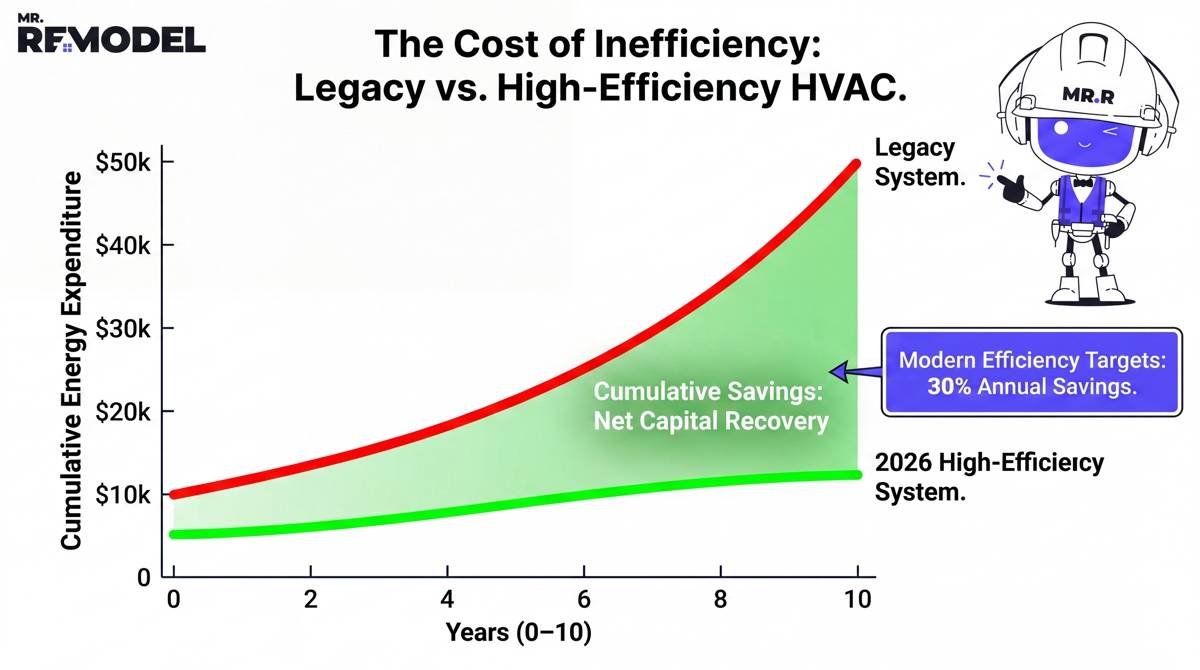
To help you visualize the cost-to-benefit ratio, consider how high-efficiency upgrades compare to standard remodels.
HVAC Efficiency ROI Breakdown
Professional Maintenance and Longevity
The most efficient system on the market will underperform if not installed correctly. Proper refrigerant charging, airflow balancing, and airtight ductwork are the invisible factors that dictate your system’s actual energy consumption.
Homeowners should leverage their installation package to include a multi-year service plan. Routine maintenance, such as coil cleaning and firmware updates, protects your manufacturer’s warranty and prevents premature system degradation.
When you trust Mr. Remodel, you are ensuring that your system is commissioned to the highest industry standards.
See Related: Why Is My Energy Bill So High?
Frequently Asked Questions
1. Does the size of my home impact my tax credit eligibility?
No, tax credits are based on the efficiency rating of the equipment itself rather than the square footage of the home. However, proper sizing (Manual J load calculation) is required for optimal performance and efficiency.
2. Can I combine HEEHRA rebates with federal tax credits?
Yes, in many cases, you can leverage both, provided the total claim does not exceed the cost of the system. We recommend verifying specific state-level combinations with your tax professional.
3. What should I look for in an HVAC contractor quote?
Ensure the quote explicitly lists the SEER2 rating, the ENERGY STAR certification status, and a commitment to performing a Manual J load calculation. Avoid quotes that size systems solely by home square footage.
4. Are high-efficiency systems noisier than older models?
Generally, no. Most high-efficiency systems use variable-speed compressors and fans, which operate at lower, quieter stages for longer durations, significantly reducing the "kick-on" noise common in older single-stage units.
5. Why do 2026 mandates specify SEER2 instead of SEER?
SEER2 is a more rigorous testing protocol that better accounts for real-world conditions like duct resistance, providing a more accurate estimation of how a system will perform after it is installed in your home.
Secure Your Energy Future
Upgrading to an energy-efficient HVAC system is a proactive step toward lower utility bills and increased home value. By navigating federal credits, securing available rebates, and focusing on high-efficiency equipment, you can turn a necessary replacement into a profitable home investment.
Don't wait for your system to fail during an extreme temperature spike, which limits your equipment options and inflates labor costs. Contact Mr. Remodel to get a free, no-obligation quote and connect with premier local contractors who guarantee high-performance installation.