1-855-QUOTEMR

Table of Contents [hide]
Who This Is For
This guide is for homeowners staring at an NFRC sticker or a contractor's quote filled with decimals like 0.22 and 0.19. If you feel overwhelmed by technical jargon and just want a "Plain English" translation of what these numbers mean for your specific house, you are in the right place. It is especially critical for those trying to verify if their new windows qualify for the 2026 Federal Tax Credit.
Key Takeaways
- U-Factor = Insulation: This number tells you how well a window prevents heat from escaping. Lower is better.
- SHGC = Solar Blocking: This measures how much heat from the sun enters your home. Lower means more heat is blocked.
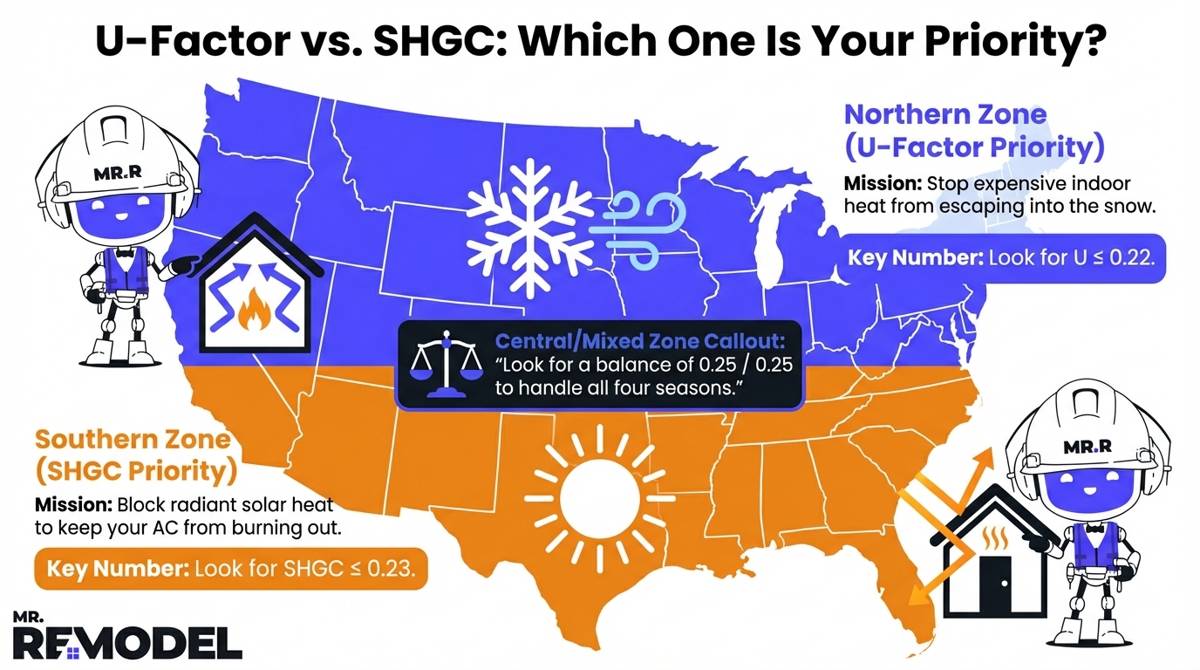
- Climate Dictates Priority: In the North, U-Factor is your primary target. In the South, SHGC is far more important for lowering cooling bills.
- Tax Credit Thresholds: To claim the $600 tax credit in 2026, your windows must meet strict Energy Star V7.0 ratings (e.g., U-Factor ≤ 0.22 in the North).
- Directional Strategy: You can use different ratings on different sides of your house to save money without sacrificing performance.
If you have recently started shopping for windows, you have likely encountered the NFRC (National Fenestration Rating Council) label. It looks a bit like a nutrition label for your house, but instead of calories and fat, it lists U-Factor and SHGC.
In 2026, understanding these numbers is no longer optional. With the implementation of Energy Star Version 7.0, the standards for windows have changed significantly. If you buy a window based on 2023 standards, you might find yourself with a home that is still drafty and a tax return that is missing a $600 credit.
Simply put, these decimals are the secret code for your home's comfort. U-Factor is about keeping your furnace heat inside during the winter, while SHGC is about stopping the sun from turning your living room into an oven during the summer. By the end of this guide, you will know exactly which numbers to look for on your quote to ensure you are buying a high-performance thermal shield.
U-Factor: The Heat Escape Metric
U-Factor measures the rate of non-solar heat transfer. In simpler terms, it tells you how fast your expensive indoor air is leaking through the window to the cold outdoors.
According to the NFRC, U-Factor usually ranges from 0.20 to 1.20. While we often think of insulation in terms of R-Value (where a higher number is better), windows use U-Factor, where lower is always better.
Why the North Replaces More Windows
Data from Mr. Remodel reveals a fascinating trend in behavior. Homeowners in cold markets like Indiana, New York, and Michigan replace an average of 7.6 windows per project. This is significantly higher than the national average.
The reason is simple: Drafts don't stay in one room. In cold climates, a high U-Factor allows heat to escape the entire house through conduction. To feel a real difference in comfort, Northern homeowners realize they must increase the R-Value of the entire "envelope" of the house.
The 2026 Target: For Northern zones, you should aim for a U-Factor of 0.22 or lower. This often requires triple-pane glass to achieve, but it is the benchmark for high-performance insulation.
See Related: Energy-Efficient Windows: The 2026 Buyer’s Guide by Climate Zone
SHGC: The Solar Heat Gain Metric
SHGC stands for Solar Heat Gain Coefficient. It measures how much solar radiation passes through a window and is released as heat inside your home. It is expressed as a number between 0 and 1.
If a window has an SHGC of 0.25, it means only 25% of the sun's heat is getting through. The other 75% is being blocked or reflected.
The Directional Strategy in the South
In hot markets like Texas and Arizona, Mr. Remodel data shows smaller average project sizes of 5.2 windows. This is because of the mentality that "the sun only hits one side at a time."
Homeowners in the South often focus their budget on the West-facing windows to stop the punishing afternoon bake. Because SHGC is primarily about blocking radiant heat from the sun rather than insulating against cold air, you can often solve your cooling problem by upgrading specifically where the sun hits hardest.
The 2026 Target: In hot climates, look for an SHGC of 0.23 or lower. Research from the American Council for an Energy-Efficient Economy shows that in these regions, a low SHGC is three times more important for lowering energy bills than the U-Factor.
See Related: Best Energy Efficient Windows for Hot Climates
How These Numbers Affect Your 2026 Tax Credit
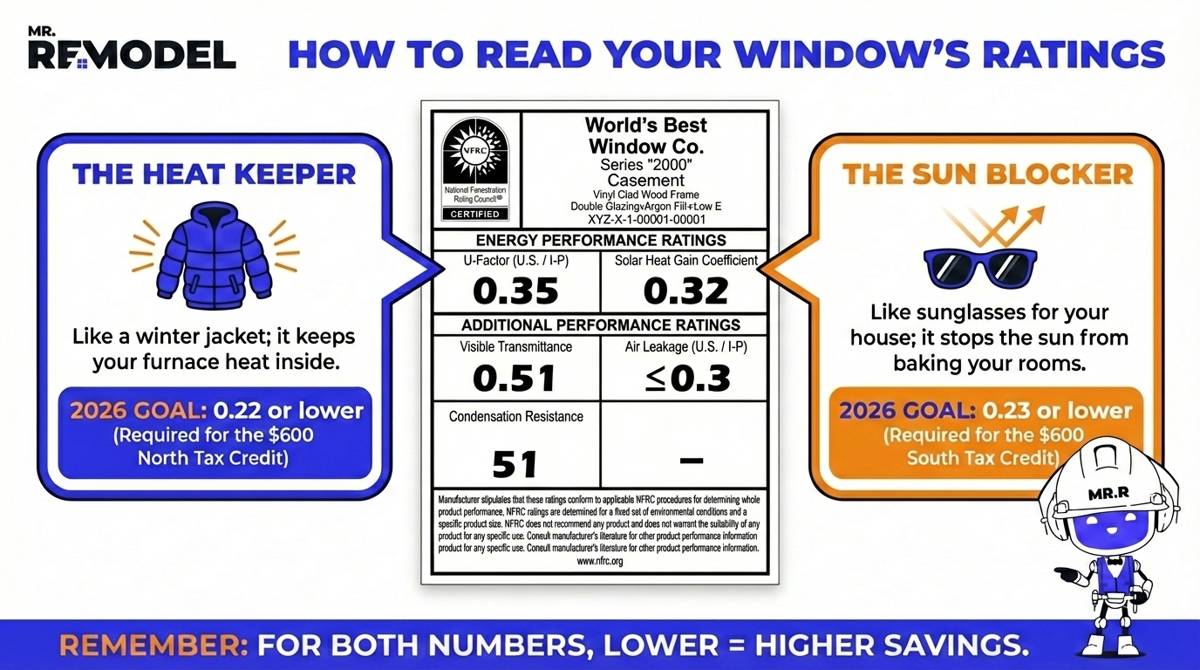
One of the biggest pitfalls for homeowners in 2026 is failing to check the tax credit requirements before signing a contract. To qualify for the Energy Efficient Home Improvement Credit (25C), which offers a 30% credit up to $600 annually, your windows must meet "Energy Star Most Efficient" criteria.
The Energy Star Version 7.0 standards are strict. Here is what you need to know:
- Northern Zone: You generally need a U-Factor ≤ 0.22. If your quote says 0.27, you are buying a decent window, but you are losing that $600 credit.
- Southern Zone: You need an SHGC ≤ 0.23. A window with a higher SHGC might be cheaper upfront, but the loss of the tax credit often makes the higher-performance window the better deal.
Always refer to the official IRS instructions for Form 5695 to ensure your specific product line is eligible.
The Balancing Act: Can You Have Both?
A common question we hear is: "Can I just buy the lowest number for both?"
Technically, yes, but it may not be smart. In some Northern climates, a slightly higher SHGC (around 0.35) can be beneficial. This is called "Passive Solar" heating. It allows the free winter sun to help warm your home during the day.
However, achieving an ultra-low U-Factor (0.20) while keeping a moderate SHGC (0.35) is technically difficult and often requires specialized "Hard Coat" Low-E coatings. This is why projects in regions like Oregon and Colorado often see higher costs, sometimes exceeding $24,000, as documented in our sales data.
The Rule of Thumb:
- If it's mostly cold: Focus on Low U-Factor (≤ 0.22).
- If it's mostly hot: Focus on Low SHGC (≤ 0.23).
- If you have both seasons: Look for a balance (U-Factor ≤ 0.25 and SHGC ≤ 0.25).
Frequently Asked Questions
What is a good U-Factor for cold climates?
For 2026, a good U-Factor for Northern climates like New York, Michigan, and Wisconsin is 0.22 or lower. This is the current threshold for the Energy Star Most Efficient rating and the Federal Tax Credit. While 0.30 was the standard for years, the new 0.22 benchmark usually requires triple-pane glass to achieve high-performance results.
What is a good SHGC for hot climates?
In hot climates like Florida, Texas, and Arizona, you should look for an SHGC of 0.23 or lower. This means the window blocks at least 77% of the solar heat. If the SHGC is higher (e.g., 0.40), your air conditioner will struggle to keep up during the summer afternoons, even if the window is well-insulated against the air temperature.
Do U-Factor and SHGC affect the window tax credit?
Yes. To claim the $600 Federal Tax Credit (25C), your windows must meet specific U-Factor and SHGC numbers based on your Climate Zone. In the North, the prescriptive requirement is typically a U-Factor of 0.22 or lower. In the South, the focus is on an SHGC of 0.23 or lower. Always verify that your specific window model is on the Energy Star Most Efficient list for the current year.
Can I have a Low U-Factor and a High SHGC?
Yes, and this is actually ideal for "Passive Solar" designs in very cold climates. High-performance Northern windows can use specific Low-E coatings to maintain a low U-Factor (great insulation) while allowing a higher SHGC (e.g., 0.40) to let the winter sun heat your home for free. However, these specific glass packages can be more expensive and may not be necessary if your home has significant shading.
How to Read Your Quote
When you are reviewing a window quote, ignore the marketing terms like "Super Insulated" or "Solar Shield." Look directly at the NFRC decimals.
- If the U-Factor is > 0.30: It is a basic, entry-level window. You will likely still feel drafts in a cold winter.
- If the SHGC is > 0.30: It is not a "cooling" window. Do not install this on a West-facing wall in a hot climate.
- If the numbers meet V7.0 standards: You are buying a high-performance asset that will protect your home and qualify for tax incentives.
Mr. Remodel specializes in translating these technical specs into real-world comfort. We can help you compare quotes from local contractors to ensure you are getting the right ratings for your specific zip code.
Don't guess on your efficiency. Get a professional quote today.