1-855-QUOTEMR

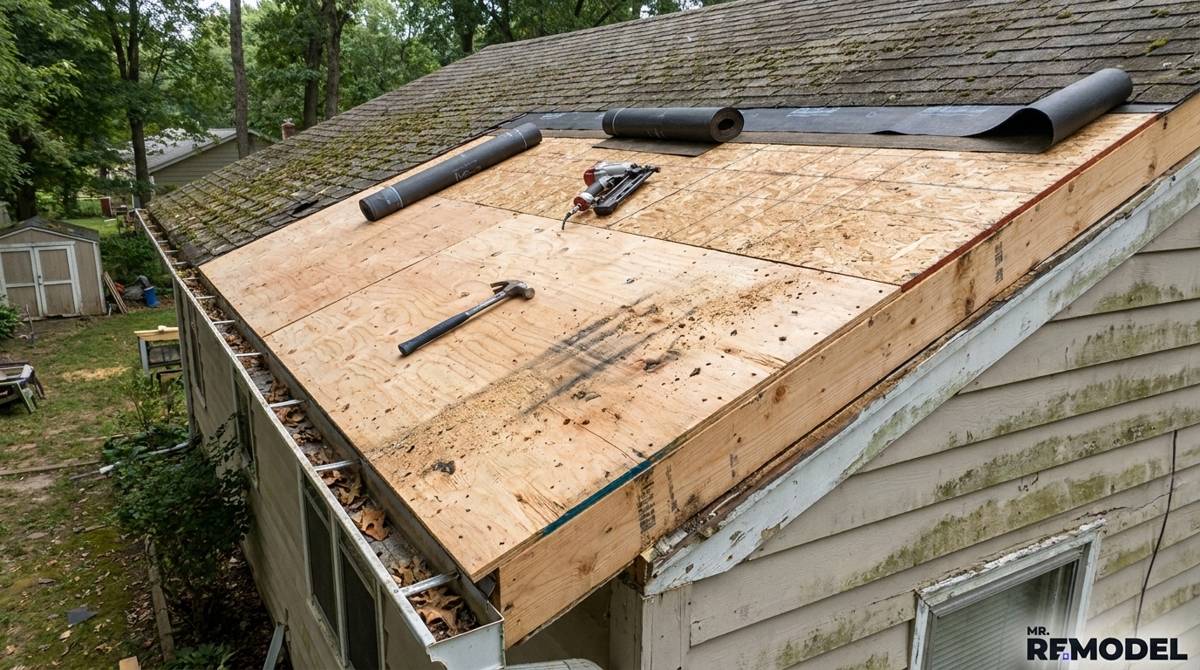
Table of Contents [hide]
Who This Is For
This is for homeowners preparing for a roof replacement who want to understand the potential for hidden structural costs. This guide helps you identify when plywood or Oriented Strand Board (OSB) must be replaced to meet modern safety codes and protect your home investment.
Key Takeaways
- The 20% Rule: One in five homes requires a structural overhaul.
- Cost Variance: Decking failure can add over $17,000 to a project.
- Safety Mandates: Rotted wood cannot support high-wind nailing patterns.
- Code Compliance: Modern shingles require a solid-surface foundation.
- Pre-Inspection Value: Detecting rot early prevents mid-project budget shocks.
The most expensive phone call you will ever receive during a home renovation happens on day two of your roof installation. This is the moment a contractor discovers that the wood beneath your old shingles is rotted, soft, or structurally unsound. Understanding if you need to replace roof decking is essential for managing your budget.
At Mr. Remodel, we act as a specialized referral service that connects property owners with pre-screened, local contractors. We ensure you are matched with experts who can identify structural risks before the tear-off process begins.
Normalizing the 1-in-5 Reality
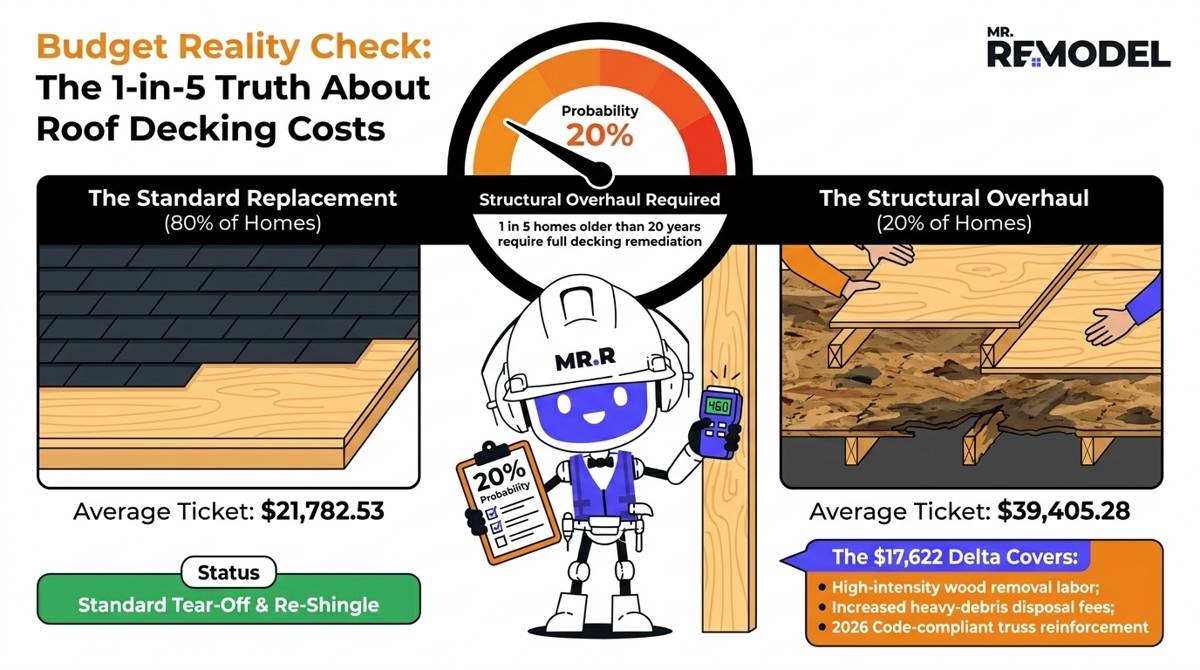
Many homeowners feel targeted when a contractor suggests that their wood foundation is failing. However, our 2025 closed-won project data shows that this is an expected part of the process for many properties. While 80% of projects proceed as standard replacements, 20% require extensive structural or decking overhauls.
This 20% probability is a baseline for homes older than twenty years. As materials age and moisture seeps through older underlayment, the wood foundation inevitably degrades. By acknowledging this 1-in-5 chance upfront, you can view decking remediation as a standard safety contingency rather than a surprise upcharge.
Professional contractors look for specific structural red flags that mandate a full board replacement. The following list identifies the primary reasons why a municipal inspector or a professional contractor will require you to install new plywood sheets:
- Fungal Growth: Visible mold or mildew spreading across the interior attic wood.
- Delamination: Plywood layers are separating due to long-term moisture exposure.
- Structural Sagging: Areas of the roof that dip or bow between the rafters.
- Fastener Failure: Wood that is too soft to grip and hold a roofing nail.
See Related: Roof Inspection Checklist Before Replacement
The Truth About Decking Costs
Generic internet guides often quote raw material prices ranging from $50 to $ 80 per sheet of plywood. This is incredibly misleading for a homeowner trying to finance a project. Our data reveals that the true cost of a structural failure is measured by the compound impact on the total project ticket.
Our records show that a standard tear-off and re-shingle project averages $21,782.53. However, when a project transitions into a high-complexity structural overhaul, the average ticket price jumps to $39,405.28. This represents a massive structural variance of $17,622.75 for the average property owner.
This financial delta is not just the cost of wood. It represents the intensive labor required to remove rotted material and to install new safety components. The following list breaks down the specific factors that contribute to the $17,622.75 cost increase during a structural project:
- Labor Intensive Tear-Off: The extra hours needed to safely remove heavy, wet wood.
- Increased Disposal Fees: Higher dumpster costs for the weight of rotted decking.
- Underlayment Upgrades: Mandatory application of new ice-and-water shields.
- Code-Compliant Reinforcement: Bringing old rafters or joists up to 2026 standards.
Get a free quote from Mr. Remodel today to establish a firm budget before your installation begins. Getting an early look at your wood foundation is the most effective way to manage the roofing costs and services required for your specific property.
See Related: Roof Replacement Cost (2026): Materials, Labor, Regional Pricing & ROI
The Spaced-Slat Warning for Older Homes
If you own a home built before the 1980s, you likely have cedar shakes or older spaced-slat decking. This was a common construction method that allowed wood shakes to breathe. However, modern architectural shingles require a solid, continuous surface to adhere properly and maintain their fire-resistance rating.
The U.S. Department of Housing and Urban Development (HUD) provides residential rehabilitation codes that mandate solid decking for modern materials. If your home has slats, you are automatically part of the 20% high-ticket bracket. You must budget for a full solid-decking conversion to ensure your new roof is legal and safe.
What Happens If You Ignore It?
Attempting to nail a premium shingle system into rotted wood is a recipe for catastrophic failure. According to the Engineered Wood Association (APA), moisture-compromised wood loses its nail-holding capacity. If the decking cannot grip the fasteners, your new roof could blow off during the very next minor windstorm.
Furthermore, the Federal Emergency Management Agency (FEMA) emphasizes that roof deck attachment is the most critical factor in a home's wind-uplift resistance. In 2026, municipal inspectors will strictly enforce these high-wind nailing patterns. Failing to replace soft wood is a code violation that will halt your project mid-day.
Maintaining the integrity of your decking is about protecting your roofing and exteriors as a single, structural envelope. When the wood is strong, the shingles can perform as designed. When the wood is weak, even the most expensive shingles in the world cannot protect your home from water intrusion.
See Related: Roof Replacement Process: Timeline, Permits & Installation Steps
Frequently Asked Questions
Can I just patch the small areas of rot?
While small patches are possible, most contractors recommend a full sheet replacement. If moisture has compromised one section of a plywood board, it has likely weakened the structural adhesive throughout the entire sheet. Patching often leads to uneven surfaces that affect the look of your new shingles.
Will my insurance pay for new decking?
Most standard homeowners' insurance policies do not cover rotted wood, as it is classified as a maintenance issue rather than sudden storm damage. However, if your decking was smashed by a fallen tree or debris during a covered event, you may be eligible for a partial payout to cover the structural repairs.
How do I know if I have spaced-slat decking?
You can easily identify this from inside your attic. If you look up at the underside of your roof and see gaps between the wooden boards, you have spaced-slat decking. If you see a solid, continuous sheet of wood, you have modern plywood or OSB decking.
Securing a Professional Pre-Inspection
Don't get blindsided on day two of your installation. Transparent pricing starts in the attic, where a professional can assess your wood's density and look for signs of delamination. Identifying these issues before you sign a contract allows you to secure financing that covers the true scope of the work.
Get a free quote through the Mr. Remodel network to uncover hidden rot before you sign a contract. We connect you with vetted professionals who prioritize structural integrity and honest communication, ensuring your home remains a safe and dry sanctuary for decades to come.