1-855-QUOTEMR

Table of Contents [hide]
Who This Is For
This guide is for homeowners holding a window replacement quote filled with confusing acronyms like LoE-272, LoE-366, or Hard Coat. If you are trying to verify if these upgrades are worth the money, or if you are worried that new energy-efficient windows will make your house look dark and tinted, this article is your translator. It is specifically designed to help you match the right glass technology to your specific climate zone.
Key Takeaways
- Geography Dictates Glass: The Low-E glass you need in Minnesota is completely different from the glass you need in Florida. Buying the wrong one can actually increase your energy bills.
- Hard Coat vs. Soft Coat: Hard Coat is durable and lets in free heat, making it ideal for the North. Soft Coat is delicate but reflects 95% of heat, making it standard for the South.
- Low-E 366 is the Southern Standard: For hot climates, Triple-Silver Soft Coat is mandatory to block the intense sun without darkening your view.
- The Whole Home Rule: Replacing just one window breaks the thermal seal of your home. This is why homeowners in extreme climates replace an average of 7 windows at once.
- It Is Not a Tint: Modern Spectrally Selective coatings block invisible heat while letting visible light pass through, avoiding the dark limousine tint look of the 1990s.
If you have looked at a window quote recently, you have likely seen the term Low-E Glass listed as a standard feature. It stands for Low Emissivity. In 2026, it is the most critical component of an energy-efficient window. But what is it?
Simply put, Low-E is a microscopically thin layer of metal sprayed onto the glass surface. This layer is usually silver or tin oxide. It is thinner than a human hair and is virtually invisible. Its job is to act like a thermal mirror. It reflects heat to its source.
However, Low-E is not a single product. It is a category. Low-E glass, explained simply, requires looking at where you live. Mr. Remodel data shows a massive split in the market. About 41% of homeowners need to keep heat out in the Sun Belt, while 38% need to keep heat inside in the Snow Belt. If you install Souther glass in a Northern home, you lose the benefit of free winter sun. If you install Northern glass in a Southern home, you turn your living room into a greenhouse.
To make the right decision, you must understand the two main types of technology: Hard Coat and Soft Coat.
The Core Split: Hard Coat vs. Soft Coat
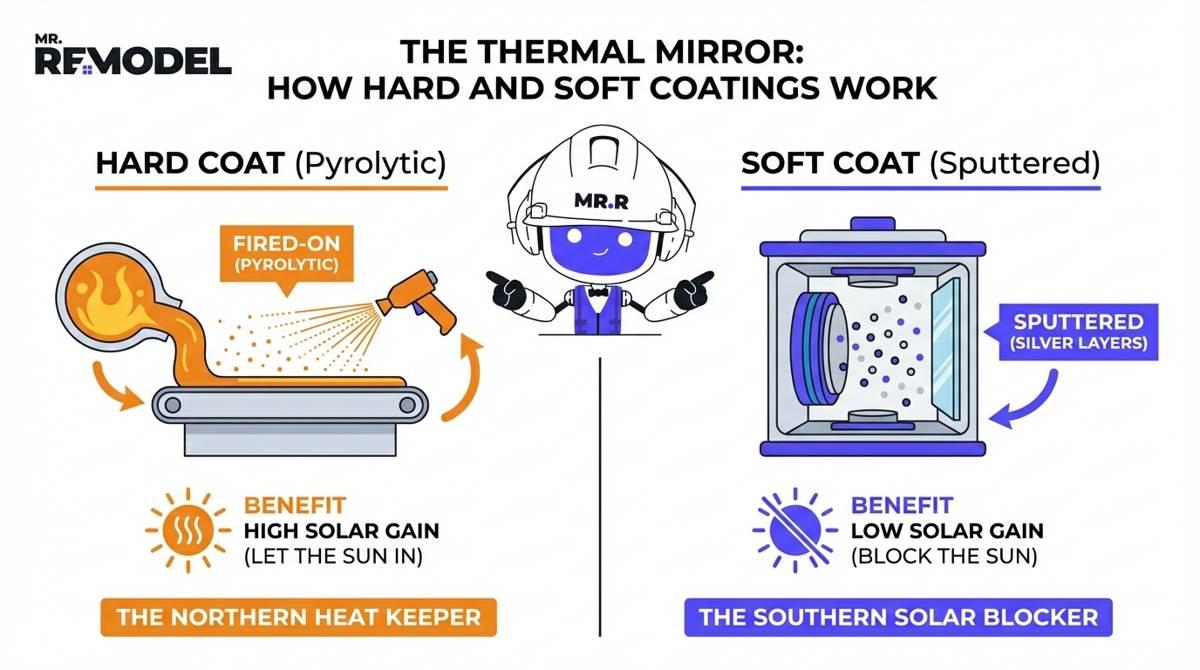
The difference between these two technologies comes down to how they are manufactured and what they are designed to do. According to the Lawrence Berkeley National Lab, understanding this distinction is the key to climate-specific efficiency.
Hard Coat (Pyrolytic)
This coating is applied to the glass while it is still in a molten state at the factory. The metal fuses into the glass surface as it cools.
- Durability: Extremely high. It is like a baked-on finish.
- Performance: It allows a high amount of solar heat to pass through. This is known as High Solar Gain.
- Best For: The Northern Heat Keeper. If you live in Minneapolis or Buffalo, you want this. It lets the winter sun warm your home for free while preventing your furnace's heat from escaping at night.
Soft Coat (Sputtered)
This coating is applied in a vacuum chamber after the glass has already been cut. It consists of multiple delicate layers of silver and anti-reflective metal oxides.
- Durability: Delicate. It can be scratched easily. This is why it is always sealed inside the double-pane unit, where you cannot touch it.
- Performance: It reflects almost all solar heat. This is known as Low Solar Gain.
- Best For: The Southern Solar Blocker. If you live in Las Vegas, Phoenix, or Miami, you need this. It acts as a shield. It bounces the punishing summer sun off your house before it enters.
Deep Dive: Low-E 366 (The Southern Shield)
If you live in the Sun Belt, your quote likely specifies LoE-366 or Triple-Silver. This is the gold standard for hot climates.
What is Triple-Silver?
Standard Soft Coat glass has two layers of silver. Low-E 366 adds a third layer. According to Cardinal Glass Industries, this third layer allows the glass to block 95% of solar heat while maintaining a clear view.
The Vegas Reality
Our data shows that window projects in Las Vegas average over $18,000. Why is the cost so high? Homeowners there are not just buying glass. They are buying a thermal defense system. In temperatures of 110 degrees, a standard Hard Coat window would fail to stop the heat. This would force your AC to run nonstop. The extra cost of Triple-Silver glass is an investment in equipment longevity.
See Related: Best Energy Efficient Windows for Hot Climates
Deep Dive: Passive Solar (The Northern Trap)
For homeowners in the North, the advice is reversed. A common mistake is buying Southern windows because they appear to have better numbers.
The Free Heat Argument
In Michigan or Maine, the winter sun is your friend. It provides free heating energy. The Efficient Windows Collaborative explains that you want a High Solar Heat Gain Coefficient (SHGC) in these regions.
If you install Low-E 366 in a Northern home, you are blocking that free heat. You might save a little on AC in July, but you will pay significantly more in heating bills from November to March. You need a Passive Solar Low-E coating that traps furnace heat inside without blocking the sun.
See Related: Energy Efficient Windows: The 2026 Buyer’s Guide by Climate Zone
The Whole Home Rule
You might be tempted to replace just the windows on the front of your house to save money. Our data suggests this is a mistake. The average project size in extreme climates is nearly 7 windows.
The Cooler Lid Analogy
Think of your home like a styrofoam cooler. The Low-E glass is the lid. If you replace 5 windows with high-tech Low-E glass but leave 5 old single-pane windows, it is like leaving the lid of the cooler halfway open. The heat will simply bypass your expensive new windows and rush through the old ones.
To see real results on your energy bill, you must seal the entire envelope of the home. This comprehensive approach is critical for achieving the results discussed in our main buyer's guide.
Will It Look Like a Tint?
A major fear for homeowners is that Low-E glass will make their house look dark or have a weird, mirror-like reflection.
The Science of Spectral Selectivity
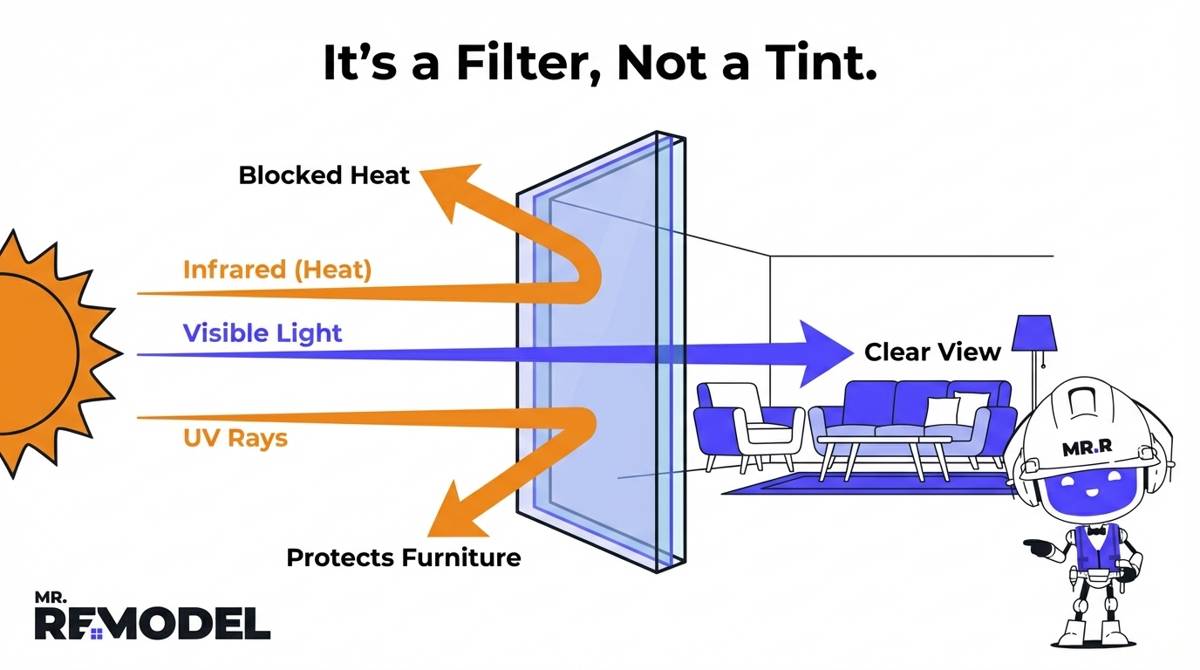
In the 1990s, window films were dark because they blocked all light to stop heat. Modern Soft Coat Low-E is spectrally selective. As explained by Vitro Architectural Glass, these coatings are tuned to block specific wavelengths of the spectrum.
- Visible Light: Allowed to pass through.
- Infrared (Heat): Blocked.
- UV Rays: Blocked to protect furniture from fading.
The result is a window that looks virtually clear to the naked eye but performs like a brick wall against heat.
Frequently Asked Questions
What is the difference between Hard Coat and Soft Coat Low-E?
Hard Coat (Pyrolytic) is fused to the glass while it is molten. It is durable and typically allows more solar heat in. This makes it ideal for Northern climates like Michigan or New York, where you want free heat from the winter sun.
Soft Coat (Sputtered) is applied in a vacuum chamber. It is more delicate and sealed inside the double pane but offers superior heat reflection. This makes it the standard for Southern climates like Texas or Florida to block summer heat.
Does Low-E glass look tinted?
Modern Soft Coat Low-E is spectrally selective. This means it blocks invisible heat while letting visible light pass through. It appears virtually clear and avoids the dark reflective tints used in the 1990s. However, some Hard Coat Low-E can have a slight hazy or bluish tint when viewed in direct sunlight.
Which Low-E glass is best for hot climates like Arizona or Florida?
For hot climates, you need a Low Solar Heat Gain Coefficient (SHGC). Look for Triple-Silver Soft Coat glass. This is often labeled as LoE-366. This glass blocks up to 95% of the sun's heat without darkening your room. This drastically reduces your air conditioning load.
Is Low-E glass worth the extra cost?
Yes. In extreme climates, Low-E glass is now the standard because it pays for itself. While it adds 10% to 15% to the window cost, it reduces energy loss by 30% to 50% compared to standard clear glass. In most climate zones, you cannot meet building codes or qualify for the $600 Tax Credit without it.
Choosing the Best Coating for Your Home
Low-E glass acts as a filter for your home. Your job is to decide what you want to filter out based on your climate.
- If you are in the North, you want to filter out cold air but let the sun in. Choose Hard Coat/Passive Solar Low-E.
- If you are in the South, you want to filter out the sun's heat entirely. Choose Soft Coat/Low-E 366.
Do not leave this decision up to a generic salesperson. Check the specifications on your quote. Ensure the glass technology matches the climate zone you live in.
Mr. Remodel can help you verify your quote. We connect you with local professionals who know the specific glass requirements for your zip code, ensuring you make a choice that lasts for decades.
Ready to get a quote for the right glass?