1-855-QUOTEMR

Table of Contents [hide]
Who This Is For
This guide is for homeowners planning a roof replacement who want to maximize their long-term financial returns. It is specifically designed to help you compare the energy efficiency of different materials against real-world installation costs.
Key Takeaways
- Baseline Investment: The national average for a closed roofing project currently stands at $25,307.08.
- Material Efficiency: Metal roofing accounts for 18.9% of the market and offers superior UV reflection compared to traditional shingles.
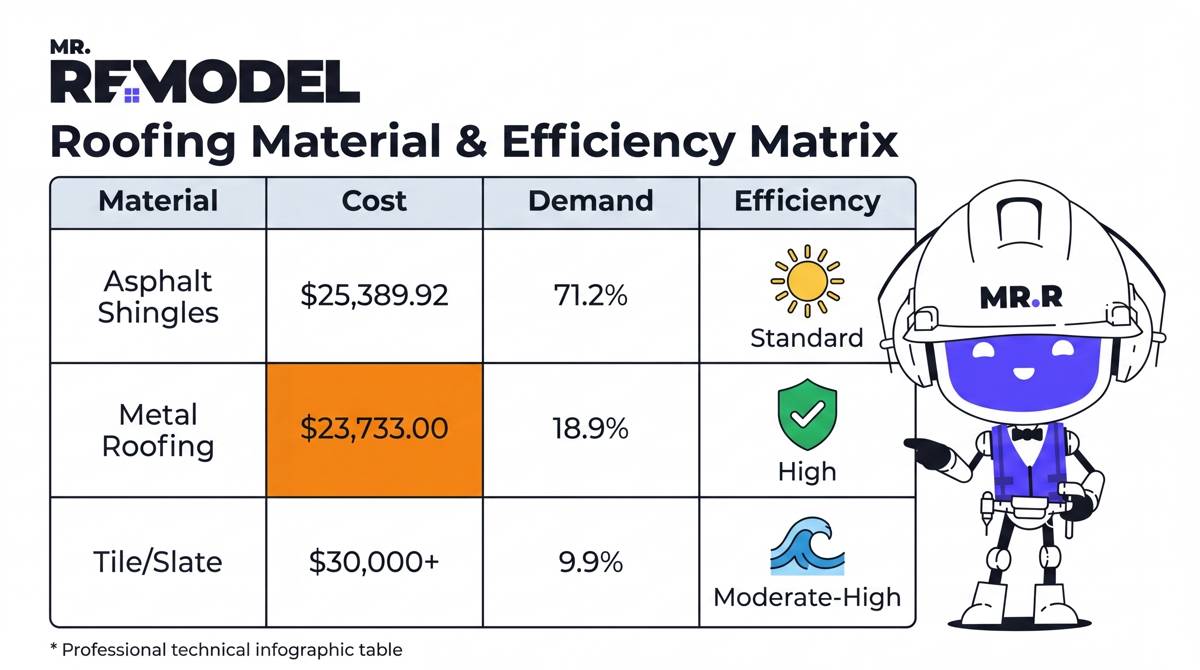
- Cost Comparison: Surprisingly, our data shows average metal projects at $23,733.00, while shingles average $25,389.92.
- Regional Savings: Homeowners in high-heat states like Florida and California see the fastest payback periods through reduced cooling costs.
- Strategic Upgrades: Since 98.9% of homeowners choose full replacements over repairs, choosing an energy-efficient material is the most effective way to build equity.
A roof replacement is a major capital expense that requires careful financial planning. Data from Mr. Remodel indicates that the national average for a closed roofing project is $25,307.08. Understanding how material choice affects your monthly utility bills is essential for calculating a true return on investment.
Many homeowners focus only on the upfront price of labor and materials. However, your roof is the primary barrier against thermal transfer. Choosing a material with high solar reflectance can drastically reduce the strain on your HVAC system. This leads to lower costs over the lifespan of the home.
How Roofing Materials Influence Energy Consumption
The way a roof handles heat depends on its solar reflectance and thermal emittance. Reflectance is the material's ability to reflect sunlight away from the building. Emittance is the ability to release absorbed heat. Together, these factors determine the temperature of your attic and living spaces.
Traditional dark materials tend to absorb radiation. This heat eventually migrates into the home, forcing air conditioners to work harder. Modern engineering has enabled manufacturers to create "cool roofs" that remain significantly cooler than standard installations. These upgrades are a core component of modern exterior roofing.
See Related: Roof Replacement ROI by Material Type
Comparing Asphalt Shingles and Metal
Our proprietary data shows a shifting trend in material demand. While 71.2% of homeowners still choose asphalt shingles, 18.9% are now opting for metal. This shift is often driven by the desire for better energy performance and long-term durability.
The Cost Reality of Energy Efficient Upgrades
Many homeowners assume metal is always more expensive. However, our closed lead sample data shows standard shingle projects average $25,389.92. In contrast, metal projects in the same dataset came in around $23,733.00. This makes metal a highly competitive option for those seeking immediate efficiency.
Reflectivity and Heat Absorption
Asphalt shingles are typically composed of granules that can absorb a high percentage of solar energy. While "cool shingle" options exist, standard products often struggle with heat retention. Metal roofs are naturally more reflective. This allows them to stay cooler even during the peak of summer.
See Related: Does a New Roof Increase Home Value? (Data + % ROI)
The Science of Cool Roofs and ROI
According to the Department of Energy, a cool roof can stay more than 50 degrees Fahrenheit cooler than a conventional roof. This temperature difference prevents heat from soaking into the structure. The result is a more comfortable interior and a longer lifespan for your cooling equipment.
The Environmental Protection Agency also highlights how energy-efficient materials mitigate the heat island effect. This is particularly important in urban environments where building density leads to higher ambient temperatures. By choosing reflective materials, you contribute to a cooler local climate.
Measuring Solar Reflectance Index (SRI)
The Lawrence Berkeley National Laboratory uses the Solar Reflectance Index to grade materials. A higher SRI indicates a cooler roof. Many modern metal coatings achieve high SRI scores. This helps homeowners qualify for energy efficiency credits and reduces long-term overhead.
See Related: Insurance Premium Changes After Roof Replacement
Regional Battlegrounds: Where Energy Savings Matter Most
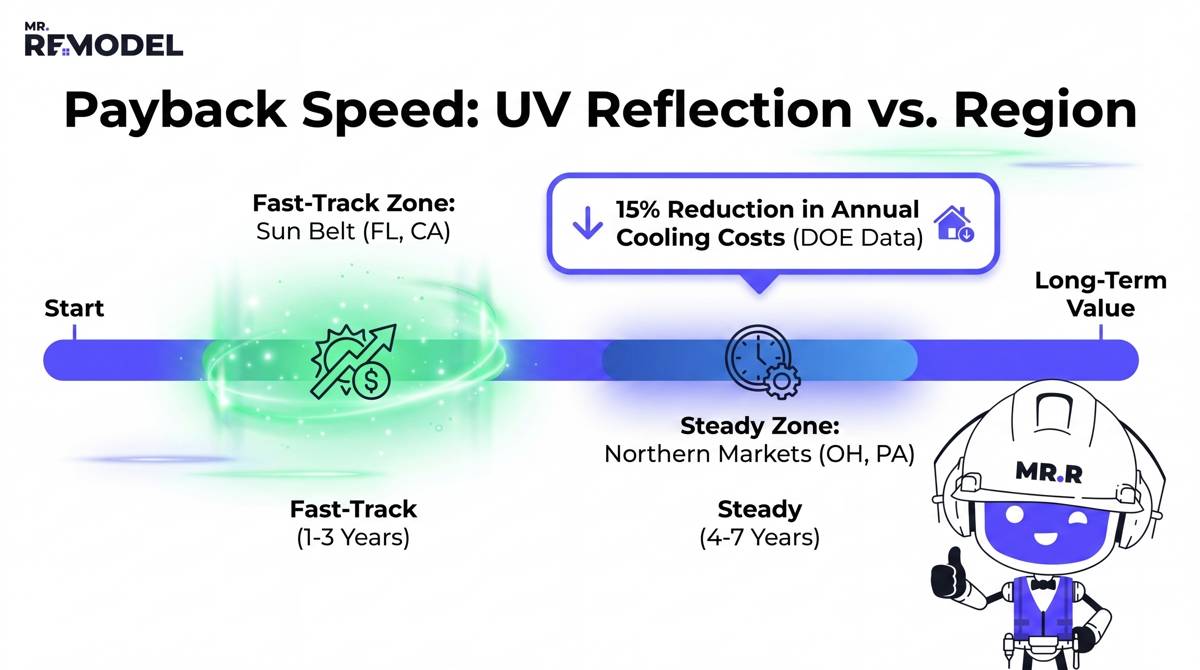
The payback period for a new roof varies by geography. In the Sun Belt states, the focus is on UV reflection. In Northern states, the focus shifts toward thermal retention during the winter months. Understanding these regional realities is key to a successful upgrade.
High Heat Markets: Florida and California
Florida ($31,882) and California are high-volume lead states where cooling is the primary concern. In these markets, the energy savings from a metal roof can offset the installation cost much faster. High reflectivity is not just a luxury; it is a necessity for managing rising utility rates.
Northern Markets: Ohio and Pennsylvania
In Ohio and Pennsylvania, roofing systems must handle extreme temperature swings. While summer cooling is important, winter thermal retention is equally vital. Homeowners in these areas often look for lifetime roofing and siding upgrades to provide a comprehensive thermal envelope for their property.
See Related: Storm Damage: Repair or Replace Decision Guide
Full Replacement vs. Repair: The Efficiency Gap
Our data shows that 98.9% of homeowners choose a full replacement. Only 1.0% of inquiries are for repairs. This is because a repair rarely improves the energy efficiency of the structure. A full system replacement allows for the installation of modern underlayments and better attic ventilation.
Why Patching Fails the Energy Test
Patching a roof might stop a leak, but it does nothing to address thermal transfer. An old roof with degraded shingles will continue to absorb heat. By opting for a full installation, you can ensure the entire surface area of your home is protected by modern, reflective technology.
See Related: Roof Leak Repair vs Full Replacement Cost
If you are dealing with a sudden failure, remember that 40.6% of homeowners need to start their project within seven days. This urgency often leads to rushed decisions. However, even in an emergency, you should get a free roofing quote that includes an energy-efficient material option.
The Financial Impact of High Urgency Projects
About 7.5% of homeowners require next-day service. This level of urgency is usually the result of storm damage. While your primary goal is to protect your home from water, this is also the perfect time to upgrade your materials for better efficiency.
Insurance claims often cover the cost of a standard replacement. By paying the small difference for a metal or high reflectivity shingle, you can secure lower utility bills for the next 30 years. This strategic move turns an emergency into a long-term financial win.
Working with the best local roofing company ensures that your insurance claim is handled correctly. They can help you document the need for a full replacement. This ensures you receive the maximum benefit from your policy while upgrading your home's energy profile.
Frequently Asked Questions
Which roofing material saves the most on energy bills?
Metal roofing generally provides the highest energy savings due to its superior solar reflectance. Bouncing sunlight away from the home, it keeps the attic cooler and reduces the workload on your air conditioning system, especially in hot climates.
How much can I save with a cool roof?
Depending on your local climate and current insulation levels, a cool roof can reduce your annual cooling energy use by up to 15%. Over the lifespan of the roof, these savings can total thousands of dollars in reduced utility expenses.
Does Mr. Remodel help with energy-efficient roof financing?
Services like Mr. Remodel connect you with contractors who offer various financing options for high-efficiency projects. This allows you to invest in a superior material like metal without the burden of a large upfront payment.
Is a full roof replacement better than a repair for insulation?
Yes, a full replacement is significantly better because it allows for the installation of new radiant barriers and improved ventilation. Repairs only fix surface issues and do not address the thermal performance of the entire roofing system.
Do energy-efficient roofs increase home resale value?
Energy-efficient roofs are highly attractive to modern buyers who are wary of rising energy costs. A roof that offers lower utility bills and high durability is a strong selling point that can help you recoup a larger percentage of your investment.
Investing in a Smarter Home Roof
Maximizing your roof's ROI requires looking beyond the initial $25,307.08 national average cost. By selecting materials based on their energy-saving potential, you create a home that is both more comfortable and more affordable to maintain. The data shows that metal is a high-performance alternative that is increasingly cost-competitive.
Whether you are in a high-heat market like Florida or a variable climate like Ohio, your roof is your first line of defense against thermal loss. Don't settle for a basic replacement when you can upgrade to a system that pays you back every month.
Take control of your home's efficiency today. Mr. Remodel helps you find top-rated professionals who specialize in energy-efficient installations. To get started, get a free roofing quote and see how much you can save on your roof replacement.