1-855-QUOTEMR

Table of Contents [hide]
Who This Is For:
Homeowners who see terms like ENERGY STAR certified, NFRC certified, manufacturer certified, and EPA Lead-Safe Certified while comparing window companies and want to know which credentials apply to the installer, the window product, or the project itself.
Key Takeaways:
- There Is No One Universal Credential: Not every qualified residential window installer must hold the same national certification.
- Manufacturer Certification Applies to Training: It usually relates to a specific product, brand, or installation method.
- ENERGY STAR and NFRC Usually Apply to Products: These labels help homeowners compare window performance, not contractor skill.
- Older Homes May Need Lead-Safe Credentials: Covered work in pre-1978 homes can require EPA or authorized-state certification.
- Certification Is Only One Check: Homeowners should also verify licensing, insurance, references, installation practices, and warranties.
The word “certified” sounds reassuring. But when you are comparing certified window replacement specialists, the first question should be simple: certified by whom, and for what?
A window company may advertise certified installers because of manufacturer training. The window itself may be ENERGY STAR certified. The product may also have National Fenestration Rating Council (NFRC) ratings. If your home was built before 1978, lead-safe certification may matter too.
Those are not the same thing.
Mr. Remodel window data shows that installation or replacement represents about 91.6% of classified window inquiries. Among those inquiries, 24,841 came from homeowners, or about 99.3%. That makes credential verification especially useful for homeowners comparing larger residential window projects.
What Does “Certified Window Specialist” Actually Mean?
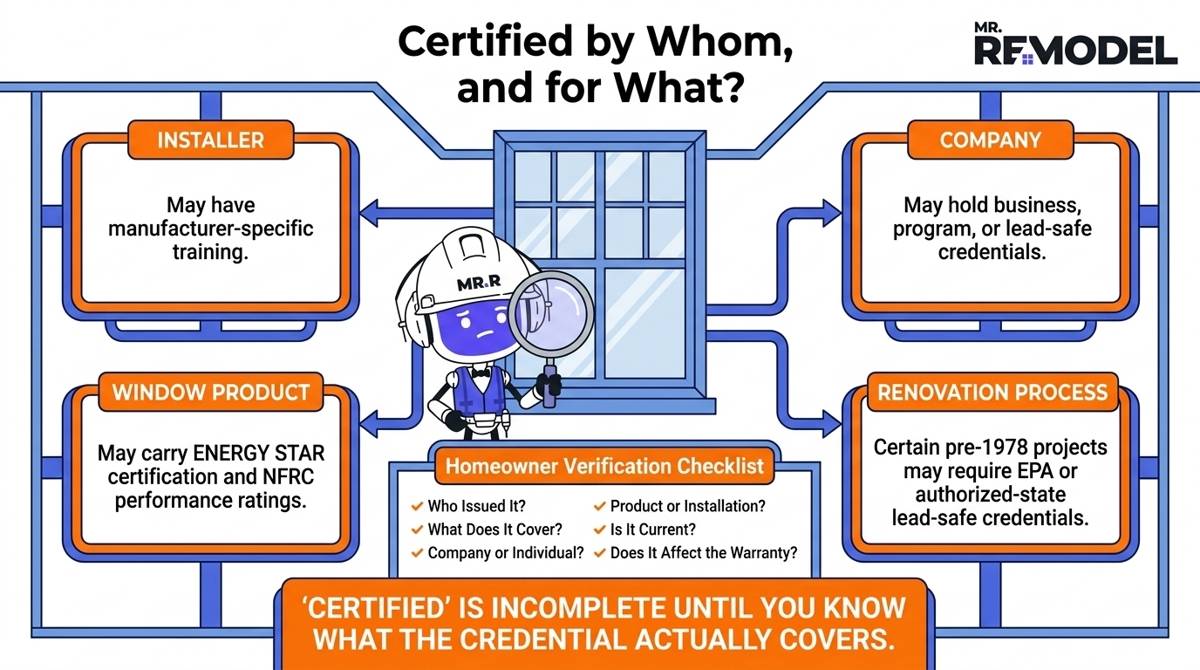
“Certified” is incomplete unless you know what the credential covers. A certification could belong to the company, the individual installer, the product being installed, or the lead-safe renovation process.
Ask These Questions First
Before trusting the label, ask:
- Who issued the certification?
- What does it cover?
- Is it for the company or the installer?
- Does it apply to the product or the installation?
- Is it current?
- Does it affect the warranty?
This matters because a contractor may be trained by one manufacturer, while the product carries separate ENERGY STAR or NFRC information. These credentials should not be treated as interchangeable.
Manufacturer-Certified Installers
Manufacturer certification or training is usually the credential most directly tied to installation. It can show that the installer has received product-specific instruction.
ENERGY STAR recommends seeking trained professionals and asking whether installers are certified to install the product being purchased through its Residential Windows, Doors, & Skylights guidance. It also notes that some manufacturers may require certified installers for warranty purposes.
What Manufacturer Training May Cover
Manufacturer certification may include:
- Product-specific installation steps
- Approved fasteners
- Flashing requirements
- Frame preparation
- Product adjustments
- Warranty-related instructions
Not every manufacturer requires certification. Still, it is worth asking whether the installer has training for the exact window line being quoted.
What to Ask the Contractor
Ask:
- Which manufacturer certified you?
- Does the credential apply to the crew installing my windows?
- Is it current?
- Does the warranty require certified installation?
- Can you provide documentation?
See Related: Understanding Manufacturer Warranty vs Installation Warranty
ENERGY STAR Does Not Mean the Installer Is ENERGY STAR Certified
This is one of the most common points of confusion. ENERGY STAR certification usually applies to the window product, not the installer.
ENERGY STAR explains that qualifying windows are manufactured by ENERGY STAR partners, independently tested and certified through NFRC, and must meet Environmental Protection Agency (EPA) energy-efficiency criteria through its window performance criteria.
What the Label Means
An ENERGY STAR label tells you the window meets energy-performance criteria for the correct climate zone.
It does not automatically mean the contractor has an EPA-issued “ENERGY STAR window installer” credential. Be careful with phrases like “ENERGY STAR-certified installer” unless the contractor can document a real credential from the product manufacturer or another recognized program.
For homeowners, the smart move is to verify both sides: the window’s performance label and the installer’s actual training.
See Related: Energy Efficient Windows | 2026 Ratings, Costs & Savings Guide
NFRC Certification Applies to Window Performance
The National Fenestration Rating Council helps homeowners compare window performance through certified ratings.
NFRC’s Certified Products Directory allows homeowners to search for currently certified windows, doors, and skylights.
What NFRC Ratings Can Show
NFRC product information may include:
- U-factor
- Solar Heat Gain Coefficient (SHGC)
- Visible transmittance
- Air leakage, where rated
These ratings help you compare one window product against another. They do not prove that the contractor is an NFRC-certified installer.
Why This Matters
A window can have strong ratings and still perform poorly if installed incorrectly. Product certification and installation quality both matter, but they are separate checks.
Certification labels can be confusing because some apply to the window while others apply to the company or installer. Mr. Remodel helps homeowners connect withfully vettedd local window contractors so they can compare qualified professionals for their project.
Lead-Safe Certification Matters in Older Homes
Lead-safe certification is different from product labels and manufacturer training. It is a government-related credential for certain renovation work.
The EPA’s Renovation, Repair and Painting (RRP) Rule applies to paid renovation work that disturbs painted surfaces in applicable pre-1978 homes and child-occupied facilities. EPA consumer guidance specifically identifies replacing windows as an activity that can create lead-contaminated dust.
EPA also explains that covered renovation firms must be certified and must assign certified renovators to applicable projects through its RRP firm certification guidance.
What to Ask in a Pre-1978 Home
Ask:
- Is the company EPA Lead-Safe Certified or certified through an authorized state program?
- Who is the certified renovator?
- How will the work area be contained?
- How will dust and debris be cleaned?
- What documentation will be provided?
Some states administer their own EPA-authorized RRP programs, so requirements should be checked for the project location.
Certification Is Not the Same as Contractor Licensing
A certified installer is not automatically a licensed contractor. A licensed contractor is not automatically manufacturer-certified. Insurance is another separate issue.
|
|
|---|
The Federal Trade Commission (FTC) recommends checking applicable contractor licensing and requesting proof of insurance through its home improvement scam guidance.
See Related: Licensed Window Replacement Contractors
How to Verify a Certification
You do not need to memorize every credential. You need a practical way to verify what a contractor is claiming.
Ask Who Issued It
Do not accept “we are certified” without knowing the organization, manufacturer, agency, or program behind the credential.
Ask What It Covers
Find out whether the certification applies to the company, an individual installer, the product, or lead-safe renovation work.
Check Whether It Is Current
Ask for current documentation. If the issuing organization has a public lookup, use it.
Confirm the Installation Crew
A salesperson’s credentials do not always mean the crew installing your windows has the same training.
Ask How It Affects the Warranty
Some manufacturers may require installation according to specific instructions. Others may require manufacturer-certified installers for certain warranty terms.
See Related: Questions to Ask Window Installers: Hiring Guide
Does Certification Guarantee Good Installation?
No. Certification can be useful, but it does not guarantee flawless workmanship.
Certification may show training, product knowledge, compliance with a program, or eligibility for certain warranty conditions. But homeowners should still evaluate references, installation process, flashing and sealing, workmanship warranty, insurance, applicable licensing, and final inspection procedures.
The FTC recommends checking contractor qualifications, insurance, reviews, multiple estimates, and written contracts instead of relying on one claim alone.
See Related: Choosing A Window Replacement Contractor | Vetting Guide
Why Certification Matters More on Multi-Window Jobs
When several windows are being installed, consistent methods matter. One correct installation does not help if the rest of the openings are handled carelessly.
Among Mr. Remodel installation or replacement inquiries with recorded counts, the median project size was 5 windows. The largest recorded window-count group was 10-window inquiries, with 6,664 inquiries.
That is why homeowners should ask whether the crew has training for the full project, not just whether the company uses the word “certified” in marketing.
Do Not Rush Credential Checks
Many homeowners want window projects started quickly. Mr. Remodel recorded 8,074 inquiries with a desired start within 7 days and 23,771 with a desired start within 30 days.
These figures reflect desired project timing, not actual installation schedules. A near-term goal should not stop you from verifying credentials before signing.
The FTC also cautions homeowners about contractors who pressure them into making immediate decisions.
Certification Red Flags
A contractor may use confusing wording without meaning to mislead. Still, unclear certification claims should be verified.
Watch for These Issues
Be cautious if:
- A contractor says “ENERGY STAR certified installer” but cannot explain the credential
- NFRC certification is presented as installer certification
- A manufacturer credential belongs to someone who will not work on the project
- Certificates are expired
- The issuing organization is unclear
- Warranty-related certification requirements are not explained
- A pre-1978 home contractor cannot explain lead-safe requirements
If the answer is confusing, ask for documentation before moving forward.
Frequently Asked Questions
Is there an official certification for window installers?
There is no single universal national installer credential required for every residential window replacement project. Installers may hold manufacturer-specific training or certifications, while separate government credentials may apply depending on the location and project.
Does ENERGY STAR certify window installers?
ENERGY STAR certifies qualifying window products that meet EPA efficiency requirements. ENERGY STAR recommends seeking trained installers and asking whether installers are manufacturer-certified for the product, but the ENERGY STAR window label itself is a product certification.
Does NFRC certify window contractors?
NFRC primarily certifies and publishes energy-performance ratings for windows, doors, and skylights. Its Certified Products Directory is designed to verify certified products and their performance information.
Why does manufacturer certification matter?
Manufacturer certification or training can show that an installer has received product-specific instruction. Some manufacturers may also require certified installers or adherence to specific installation instructions for warranty coverage.
Do window installers need lead-safe certification?
For covered paid renovation work that disturbs painted surfaces in applicable pre-1978 housing, EPA RRP requirements apply. Firms must be appropriately certified, and homeowners should check whether EPA or an authorized state program administers the requirements in their location.
Certified Window Replacement Specialists: Final Takeaway
Homeowners searching for certified window replacement specialists should first determine what is being certified. Manufacturer training, ENERGY STAR products, NFRC ratings, EPA lead-safe credentials, contractor licenses, and insurance all serve different purposes.
Certification can be helpful, but it should not be the only reason you hire someone. To compare qualified options, get a free quote from fully vetted local window contractors through Mr. Remodel.