1-855-QUOTEMR

Table of Contents [hide]
Who This Is For
This guide is for property owners who want to understand the legal requirements of a roof replacement and why strict building codes in 2026 impact their total project estimate.
Key Takeaways
- Legal Necessity: 99.04% of projects require permits.
- Regional Premiums: Compliance adds $6,920 in specific states.
- Consumer Protection: Inspectors ensure structural and fire safety.
- Warranty Security: Unpermitted work often voids manufacturer coverage.
- Resale Value: Documented permits are essential for home sales.
Skipping a municipal permit might save you a few hundred dollars today, but it could cost you $25,000 or more in voided warranties and denied insurance claims tomorrow. Understanding roofing permits and code requirements is the only way to protect your long-term investment during a major exterior renovation.
At Mr. Remodel, we act as a specialized connector that links you with pre-screened, local contractors who manage every legal detail of your project. We ensure you are matched with professionals who treat local regulations as a vital safety standard rather than just government red tape.
The 99% Permit Trigger
Many homeowners believe that minor work does not require city involvement. While a small patch job might fly under the radar, our 2025 data shows that 99.04% of roofing leads are for full system replacements. In nearly 100% of United States municipalities, a full structural tear-off legally triggers the need for a permit.
Because a roof is a primary structural component, local governments use the permit process to verify that the work meets current safety standards. This oversight prevents contractors from cutting corners on essential elements like flashing or ventilation, which are critical for the long-term health of your home.
The Compliance Tax and Regional Standards
The cost of a new roof is heavily influenced by where you live and the specific threats of your local climate. While the average ticket price for a standard roof in the United States is $24,961.03, homeowners in strict-code states face a much higher baseline.
Data shows that in Florida, California, and Texas, the average project price jumps to $31,882.00. This $6,920.97 code compliance premium is not an arbitrary fee. It covers the advanced materials and labor required to meet the most aggressive structural standards in the country.
See Related: Roof Replacement Cost (2026): Materials, Labor, Regional Pricing & ROI
State-Specific Code Requirements
Homeowners in these regions are paying for specialized protection mandated by law:
- Florida: Mandatory hurricane strapping and specific nailing patterns to survive high-wind events.
- California: Adherence to Title 24 Building Energy Efficiency Standards, which require reflective cool roof materials.
- Texas: Compliance with Texas Department of Insurance (TDI) windstorm requirements for coastal properties.
According to the California Energy Commission, these energy-saving materials are essential for reducing the state's power grid load. In hurricane-prone zones, FEMA notes that strict municipal codes are the primary defense against total structural failure during extreme weather.
For homeowners in Florida or Texas, these regulations often overlap with the requirements of hurricane window contractors. Building a wind-resistant envelope requires a holistic approach that includes every opening and surface of the property.
Get a free quote before signing a roofing contract. Mr. Remodel will ensure your quote explicitly includes the cost of all municipal permits and required code upgrades for your specific zip code.
The Mid-Project Inspection and Surprise Costs
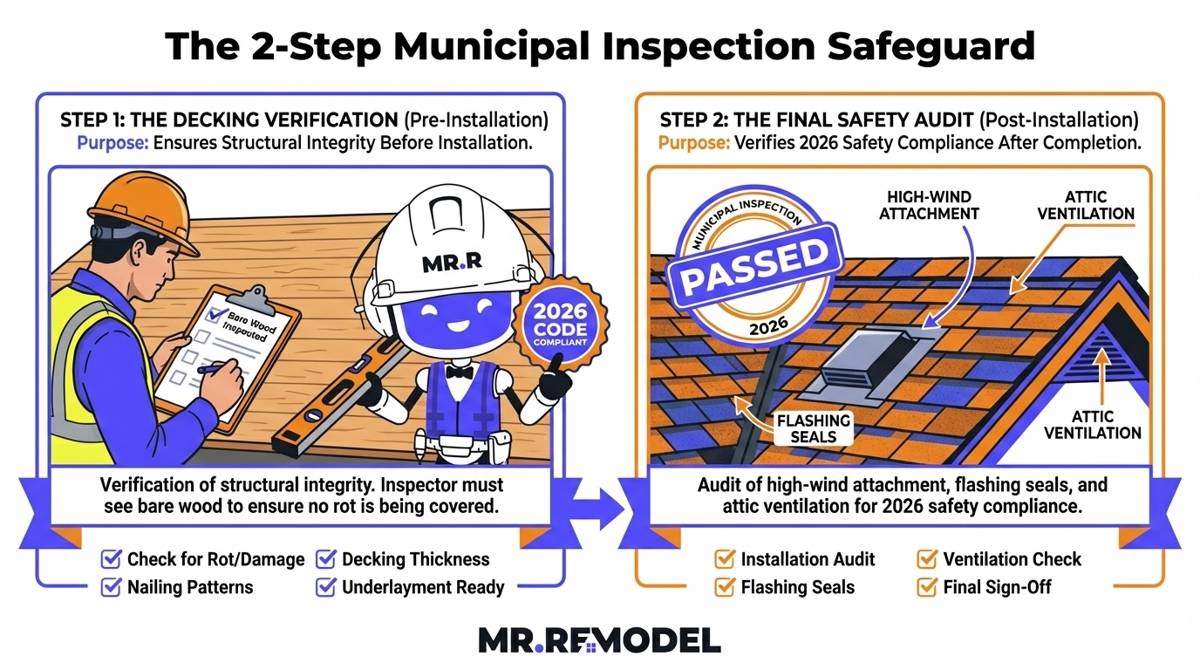
The most stressful part of the process is often the mid-project inspection. Once the old shingles are removed, a municipal inspector must verify the condition of the roof deck. Our research indicates that 20% of projects surge past the $30,000 mark during this exact phase.
This 20% outlier group represents projects where the inspector discovered non-compliant decking. In 2026, many older homes still have spaced slat decking that must be replaced with solid plywood to meet current safety codes. This discovery forces an immediate upgrade to ensure the roofing and exteriors meet modern standards.
See related: Roof Replacement Process: Timeline, Permits & Installation Steps.
Project Compliance Checklist
To ensure your project stays on the right side of the law, use this checklist to track the documentation your contractor should provide:
- Permit Application: Verified filing with the local building department.
- HOA Approval: Written consent from your Homeowners Association (HOA) for material and color.
- Pre-Decking Inspection: City sign-off on the bare wood before new materials are laid.
- Final Walkthrough: A closed-out permit document is provided at the end of the project.
The Unpermitted Nightmare
Attempting to bypass the permit process carries severe financial risks. According to the Insurance Institute for Business & Home Safety (IBHS), unpermitted work can actively void your homeowners' insurance payouts. If a storm damages a roof that was never inspected for code compliance, the carrier may deny the claim entirely.
Furthermore, unpermitted structural work will red-flag a future home appraisal. If you decide to sell your property, a title search will reveal the lack of permits, potentially stalling the sale or forcing you to pay for a second, code-compliant replacement before the closing date.
Frequently Asked Questions
Can I pull the roofing permit myself as a homeowner?
While some cities allow this, it is highly discouraged. When you pull the permit, you become the person legally responsible for the work meeting code. A professional contractor should always pull the permit to ensure they are the party liable for the inspection results.
How long does it take for the city to issue a permit?
Depending on your municipality, permit approval can take anywhere from three days to three weeks. High-urgency repairs may qualify for expedited processing, but you should always factor this time into your 30-day project window.
What happens if my roof fails the city inspection?
If the inspector finds a violation, the contractor must pause work and correct the issue before the next phase begins. This is why hiring a vetted professional is vital, as they understand the local codes well enough to avoid these costly delays.
Secure a Contractor Who Handles the Paperwork
Managing the bureaucracy of a Homeowners Association and local building departments is a full-time job. A quality roofing company never asks the property owner to navigate the red tape alone. They act as your advocate to ensure every step of the installation is legally documented and structurally sound.
Don't risk a code violation or a denied insurance claim on a $25,000 investment. Connect with a Mr. Remodel vetted contractor who manages all local permitting, zoning, and HOA approvals for you. Get your free quote from us today.