1-855-QUOTEMR

Table of Contents [hide]
Who This Is For
This detailed guide is for homeowners who need to verify their budget estimates against real market numbers for specific property dimensions. Whether you own a compact starter home or a sprawling estate, this data helps you understand how the physical footprint influences the final price of your renovation.
Key Takeaways
- Base Calculation: Our data establishes a clear 2026 baseline of $12.65 per square foot for standard professional installations.
- National Average: The typical 2,000-square-foot home requires an investment of approximately $25,300 to ensure full protection.
- Complexity Premium: Larger homes with 3,000+ square feet often face higher costs due to complex rooflines and increased material waste.
- Pitch Impact: A steep roof pitch can increase the total surface area by 20% to 40% compared to a flat living space.
- Connector Value: Using a referral service ensures you are matched with pre-screened local contractors who understand these pricing nuances.
Calculating the true cost of a new roof starts with your home's physical footprint, but the final number often surprises homeowners who rely on generic online tools. Finding an accurate roof replacement cost by size requires considering current labor rates and the price of high-quality materials.
Planning a significant exterior upgrade can be a complex task for any property owner. Mr. Remodel serves as a trusted connector, matching you with experienced, local contractors who provide detailed estimates. We help you navigate the process by ensuring you work with pre-screened professionals in your area.
The 2026 Square Footage Baseline and Calculation Logic
Our data indicates that the average cost for a professional roof replacement in 2026 is approximately $12.65 per square foot. This figure is derived from our national average project size of $25,307.08. While some competitors might quote lower ranges, those figures often fail to account for modern permit fees and safety requirements.
Many online guides still suggest outdated price points like $5 or $8 per square foot. These low estimates usually ignore the reality of the current labor shortage and the rising cost of high-performance shingles. Our math provides a realistic starting point to help you avoid unpleasant surprises during the bidding phase.
See Related: Roof Replacement Cost (2026): Materials, Labor, Regional Pricing & ROI
Why Average Ranges Fail Homeowners
Relying on a wide range can lead to significant budgeting errors for your family. A small error in the square foot calculation can result in a thousand-dollar discrepancy in your final bill. Professional contractors use precise measuring tools to ensure their quotes reflect the true surface area of your unique structure.
When you use a high-quality referral service, you get access to modern roofing expertise. These specialists understand that size is just the beginning of the story. They look at the structural integrity of your decking and the specific needs of your local climate to provide a comprehensive and fair quote.
Cost Estimates for Common Home Sizes
To help you visualize your project budget, we have categorized the most common residential footprints based on our internal project data. These estimates assume the use of standard architectural shingles and include professional labor and debris disposal.
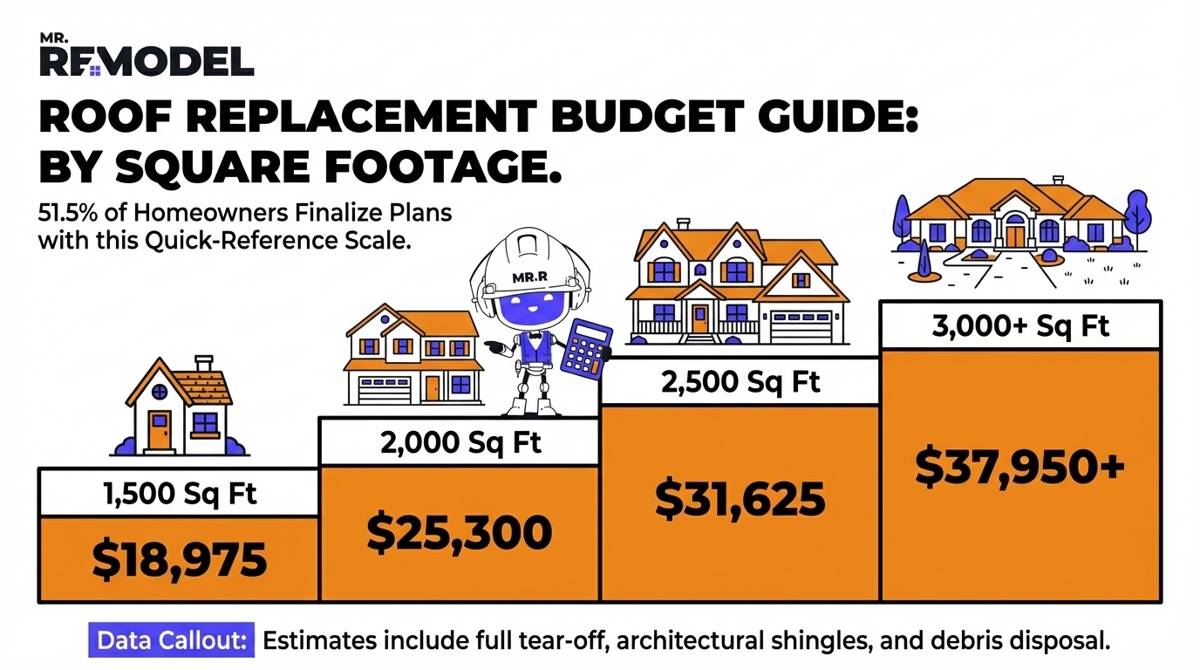
1,500 Sq Ft Roof Replacement ($18,975 Avg)
For many starter homes or older cottages, the 1,500 square foot tier is the standard size. According to historical data from the U.S. Census Bureau, older single-family homes often fall into this compact category. These projects are usually the most straightforward for a roofing crew to complete.
Most homes of this size feature walkable pitches that do not require specialized safety scaffolding. Because the geometry is simpler, contractors can often complete the work in a single day. This efficiency helps keep the labor portion of the bill manageable for the homeowner.
2,000 Sq Ft Roof Replacement ($25,300 Avg)
The 2,000 square foot home is considered the national sweet spot for modern residential construction. This size aligns perfectly with our raw data, showing an average investment of $25,307.08. This tier represents the most common project handled by our network of pre-screened contractors.
At this size, homeowners often find the best balance of cost and performance. Modern upgrades like premium synthetic underlayment or high-profile ridge vents provide a high proportional return on investment.
2,500 to 3,000+ Sq Ft Estates ($31k to $37k+)
As homes grow in size, the complexity of the roofing project tends to increase at a faster rate. A 3,000 square foot home rarely has a simple, rectangular roof. These larger estates often feature multiple peaks, valleys, and dormers that require intricate flashing and waterproof detailing.
The U.S. Department of Housing and Urban Development (HUD) notes that larger rehabilitation projects often face higher costs due to these structural complexities. Labor teams must spend more time on detail work, which naturally increases the total quote. These homes are where expert craftsmanship becomes most visible.
See Related: Roof Replacement Cost by Material (Asphalt, Metal, Tile, Slate)
Factors That Increase Total Surface Area
It is a common mistake to assume that if your home is 2,000 square feet, your roof is also 2,000 square feet. Data from the National Renewable Energy Laboratory (NREL) explains that roof pitch and overhangs significantly increase the total surface area. You must account for the slope to get an accurate material count.
- Pitch Multiplier: A steep roof requires more shingles and underlayment than a flat one.
- Garage Footprint: Attached garages add significant surface area that is not included in the living space.
- Eave Overhangs: The edges of your roof extend beyond your walls, increasing the total square footage.
- Porch Roofs: Covered entries and wraparound porches must be included in the total material order.
- Waste Factor: Professionals add about 10% to 15% to the order to account for cuts and overlaps.
Living Space vs. Roofing Square Footage
Your living space is measured by the interior floor area, but your roof covers the entire structural footprint, including the walls. When you factor in a standard 6/12 pitch, the roof surface area is already 12% larger than the flat footprint. Steeper roofs can push this difference much higher.
The Complexity Premium for Large Estates
Large homes often have cut-up roofs with many different angles. Every time a roof changes direction, the crew must install specialized metal flashing to prevent leaks. This high-level detail work requires more hours and more expensive materials than a simple gable roof on a smaller home.
Interestingly, our data show an occasional anomaly in which a simple metal installation on a mid-size home costs less than a complex shingle job on a massive estate. The layout of your roof is often just as important as the total square footage when it comes to the final price.
Secure your home today by requesting a free quote from a top-rated local professional who can accurately measure your roof.
Understanding Logistical and Structural Add-Ons
While size is the biggest factor, other elements will influence whether you land at the high or low end of our averages. Your contractor will assess your entire property to identify any logistical challenges that might affect labor time.
- Accessibility: If a house is close to trees or other buildings, moving materials safely takes longer.
- Multiple Layers: Removing two or more layers of old shingles requires more labor and higher disposal fees.
- Structural Damage: Any rot found in the wooden deck during the tear-off must be repaired immediately.
- Climate Needs: Homes in storm-prone areas may require all-weather roofing upgrades.
- Ventilation: Upgrading your attic fans or ridge vents during a replacement is a cost-effective strategy.
Full Tear-Off vs. Simple Overlay
A full tear-off involves removing all old layers of roofing before starting the new installation. While this costs more than a simple overlay, it is the only way to inspect the underlying structure for damage. Most experts recommend a full tear-off to ensure your new manufacturer's warranty remains valid for its full term.
Disposal and Site Preparation
Removing an old roof creates a massive amount of heavy waste that must be hauled away to a local landfill. Fees for dumpster rentals and disposal are standard parts of a professional roofing quote. Local contractors manage these logistics so that your driveway and yard remain clean and safe throughout the process.
See Related: Step-by-Step Roof Installation Process Explained
Frequently Asked Questions
How do I calculate my roof's square footage from the ground?
You can multiply the ground footprint of your home by a pitch factor. A common multiplier for a standard slope is 1.25, but a very steep roof might require a multiplier of 1.50 or higher.
Is a bigger roof always more expensive per square foot?
Not necessarily, but larger roofs often have more complex designs that require more labor. However, some contractors offer a slight volume discount on materials for very large residential projects.
Does the cost include the garage and shed?
Typically, a full roof replacement quote will include any attached structures, like a garage. If you have a detached shed or barn, specify whether you want it included in the project.
Why is there a waste factor in my estimate?
Shingles must be cut and overlapped to create a waterproof barrier, especially in valleys and along the edges. A waste factor ensures the crew has enough material to finish the job without delays.
Can I save money by measuring the roof myself?
While you can provide measurements for a rough estimate, a professional must verify the dimensions. They are responsible for ordering the correct amount of material and ensuring the roof is safe.
Finalize Your Budget with Local Expertise
Understanding the relationship between your home size and your roofing budget is the first step toward a successful renovation. By using our data-backed baseline of $12.65 per square foot, you can enter the planning phase with a clear financial roadmap.
Remember that a roof is a long-term investment in the safety of your family. Choosing the right partner to handle the installation is just as important as the materials you select. High-quality work pays for itself through increased home value and reduced maintenance costs over the years.
Don't let the complexity of a large project hold you back from protecting your home. Get started today by requesting a free quote from Mr. Remodel.