1-855-QUOTEMR

Table of Contents [hide]
Who This Is For:
Homeowners comparing contractors and payment options for multi-window replacement projects.
Key Takeaways:
- Compare Separate Documents: Review the window replacement quote and financing agreement independently.
- Check the APR: Compare the interest rate, APR, fees, loan term, and total repayment.
- Review Promotional Terms: Understand deferred-interest deadlines, minimum payments, and conditions.
- Match Equal Projects: Compare financing only after aligning product and installation scopes.
- Protect Your Schedule: Separate financing approval from product ordering, delivery, and installation dates.
Window replacement financing can make a larger project payable over time, but the monthly payment does not show the complete cost. Based on Mr. Remodel data, the median installation inquiry involved five windows, making clear project and financing terms important for multi-window work.
When comparing window replacement contractors with financing, treat the project quote and credit agreement as separate decisions. Confirm the products, installation methods, finish work, warranties, and exclusions. Then evaluate the APR, fees, repayment term, monthly payment, promotional conditions, and total amount repaid.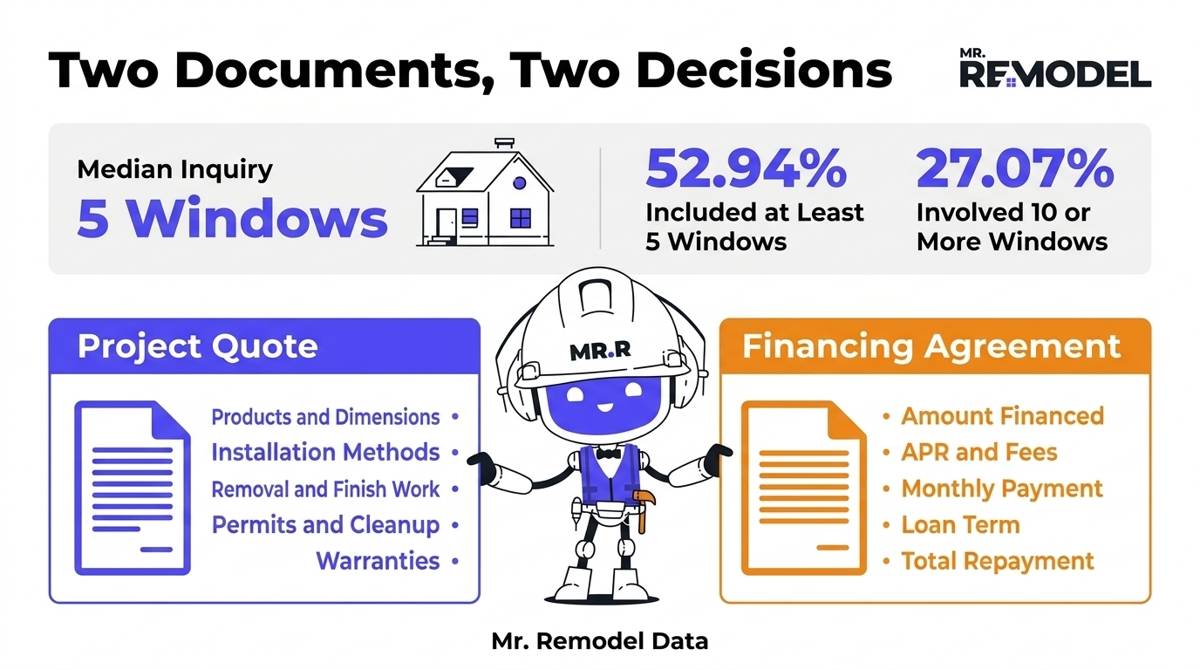
How Window Replacement Financing Works
Contractor financing usually involves a contractor working with a third-party lender or financing provider. The homeowner applies for credit, reviews the offered terms, and decides whether to use the financing for the project.
The project quote should identify what the window replacement includes. The financing agreement should separately explain:
- Amount financed
- Interest rate
- Annual percentage rate
- Loan term
- Monthly payment
- Finance charges
- Origination or administrative fees
- Promotional conditions
- Late-payment terms
- Total repayment
- Prepayment provisions
Financing terms can depend on the lender, borrower, credit profile, project amount, and selected program. Approval should not be treated as authorization to order products until the homeowner has approved the project scope.
Contractor Financing Versus Other Payment Options
Contractor-arranged financing can be convenient because the project and application begin through one company. Convenience should still be evaluated alongside the complete credit terms.
Other payment options may include:
- Personal savings
- A personal loan
- A home equity loan
- A home equity line of credit
- A credit card
- Financing from another lender
Each option can involve different rates, fees, collateral requirements, repayment terms, and credit effects. Compare the same amount and repayment period whenever possible.
The Federal Trade Commission advises homeowners not to agree to contractor financing without shopping around and comparing loan terms. The contractor quote should remain understandable even if you select another payment method.
See Related: Financing Window Replacement
Rates, APRs, Terms, Fees, and Monthly Payments
The interest rate and APR describe related but different borrowing costs. The interest rate represents the cost charged for borrowing the principal. The APR includes the interest rate and certain additional loan fees, providing a broader measure for comparing offers.
The Consumer Financial Protection Bureau recommends comparing APRs because an advertised interest rate and an APR are not interchangeable.
Review these figures together:
- Interest Rate: The percentage charged for borrowing the principal
- APR: A broader annual measure incorporating the interest rate and certain fees
- Loan Term: The period over which payments are scheduled
- Monthly Payment: The required payment under the agreement
- Fees: Charges that may increase the cost of borrowing
- Total Repayment: The complete amount scheduled to be paid
- Prepayment Terms: Conditions that apply if the balance is paid early
A lower monthly payment may result from a longer repayment period. Compare total repayment and fees alongside the monthly amount.
Deferred Interest and Promotional Financing
Promotional offers require careful review because similar advertising phrases can describe different terms.
A true 0% APR promotion generally does not charge interest during the promotional period. Interest may begin on the remaining balance afterward, depending on the agreement.
Deferred-interest financing may use language such as “no interest if paid in full” by a stated deadline. Interest accrues during the promotional period. If the balance is not fully paid by the deadline, the accrued interest may be added according to the agreement.
The CFPB’s deferred-interest guidance warns that minimum payments may not clear the promotional balance before it expires.
Before accepting an offer, identify:
- The promotional period
- The regular APR
- Whether interest accrues during the promotion
- The balance that must be paid by the deadline
- Required minimum payments
- Consequences of late or missed payments
- How payments are allocated
- The amount needed each month to finish early
Comparing the Project Quote and Financing Agreement
Financing should be compared only after contractors have quoted equivalent projects. Mr. Remodel data shows that 52.94% of installation inquiries involved at least five windows, while 27.07% involved 10 or more. Larger scopes can magnify differences in products, labor, exclusions, and financing costs.
The project quote should identify:
- Window quantity and dimensions
- Manufacturer and product line
- Frame, glass, finish, and hardware
- Installation method for each opening
- Removal and disposal
- Flashing, insulation, and sealing
- Interior and exterior trim
- Permits and inspections
- Cleanup
- Product and workmanship warranties
The financing agreement should identify the amount financed, APR, fees, monthly payment, term, and total repayment. A favorable financing offer does not compensate for an incomplete project scope.
See Related: Window Costs and Value
Ready to compare a project-specific quote and available payment options? Get a free window replacement quote today.
Questions to Ask Before Applying
Ask the contractor and financing provider:
- Who is the lender?
- Will checking available terms involve a soft or hard credit inquiry?
- What interest rate and APR apply?
- Are there origination, administrative, or other fees?
- What is the repayment term?
- What is the total scheduled repayment?
- Is the offer true 0% APR or deferred interest?
- What happens when a promotional period ends?
- Can the balance be paid early?
- When does the first payment become due?
- When may the contractor order the windows?
- What happens if financing is declined or canceled?
- Does the project contract remain valid if financing changes?
- How are refunds or loan adjustments handled after a change order?
Request written answers when the terms affect the project price, financing cost, product order, or installation schedule.
Choosing a Contractor for a Financed Project
Financing should be one part of the contractor comparison. Evaluate the contractor’s products, measurements, installation plan, supervision, cleanup, warranties, and change-order procedures independently.
The contractor should provide a complete written project agreement before requesting approval to proceed. It should explain how financing interacts with deposits, product orders, project changes, cancellations, and completion payments.
Mr. Remodel data shows that 95.07% of installation prospects wanted to begin within 30 days. Financing approval, product availability, measurements, permitting, and crew scheduling should still be treated as separate project stages.
See Related: Choosing a Window Replacement Contractor
Compare Product and Workmanship Warranties
Financing does not replace the warranties attached to the project. Review manufacturer and workmanship coverage separately from the credit agreement.
A manufacturer warranty may cover eligible defects involving the window, glass, frame, finish, seals, or hardware. A workmanship warranty addresses covered installation concerns.
Compare:
- Coverage periods
- Covered products and labor
- Exclusions
- Registration requirements
- Transferability
- Claim procedures
- Service responsibilities
Ask what happens to active warranties after the financing balance is paid. Warranty responsibilities should remain clear regardless of the payment method.
FAQ About Window Replacement Financing
Do window replacement contractors offer financing?
Some contractors offer financing through third-party lenders or financing partners. Available programs, terms, and eligibility vary. Request the lender’s disclosures and compare the offer with other payment options before approving the project.
Does checking financing affect your credit?
It depends on the lender and application stage. A preliminary check may use a soft inquiry, while a formal application may involve a hard inquiry that can affect your credit. Ask which type will occur before authorizing it.
What is the difference between an interest rate and APR?
The interest rate represents the cost charged for borrowing the principal. APR generally combines the interest rate with certain additional fees, making it a broader measure for comparing the annual cost of loan offers.
How does deferred-interest financing work?
Interest accrues during the promotional period but may be waived if the qualifying balance is paid in full by the deadline. If the conditions are not met, accrued interest may be charged under the agreement.
Can financing approval delay window installation?
Financing approval and installation scheduling are separate. Final measurements, product ordering, manufacturing, delivery, permits, and crew availability can each affect the schedule. Ask when the contractor can place the order and schedule installation.
How many windows are commonly included in a financed project?
The median installation inquiry in Mr. Remodel data involved five windows. Ten windows was the most frequently selected quantity, accounting for 26.65% of installation inquiries. Financing needs depend on the final project scope and selected terms.
Get a Quote and Review Your Payment Options
Choose the project before choosing the financing. A complete comparison should align the window products and installation scope, then evaluate the APR, fees, loan term, promotional conditions, monthly payment, and total repayment.
Ready to explore your window replacement project and available payment options? Get your free, no-obligation quote from window replacement contractors with financing today.