1-855-QUOTEMR

Table of Contents [hide]
Who This Is For:
This guide is for U.S. homeowners evaluating window replacement in an older, historically designated, or architecturally significant home. It covers condition assessments, historic review, architectural matching, sensitive removal, installation, scheduling, and warranty coverage.
Key Takeaways:
- Assess Before Replacing: Require an opening-by-opening evaluation of window conditions and available treatment options.
- Check Review Requirements: Determine whether local historic approval is necessary before selecting or ordering products.
- Match Defining Details: Document proportions, profiles, muntins, materials, operation, finishes, and installation depth.
- Protect Original Materials: Establish how the crew will handle casing, trim, plaster, masonry, and surrounding finishes.
- Plan Every Opening: Use photographs, measurements, specifications, and installation notes to maintain consistency.
Window work on a historic home affects the building’s function and architectural character. Decisions involving the sash, frame, glass, trim, installation depth, and surrounding materials can change how each opening relates to the original design.
Based on Mr. Remodel data, installation accounted for 98.30% of detailed window inquiries, highlighting strong interest in complete replacement services. When comparing historic home window replacement contractors, focus on condition assessment, preservation experience, architectural matching, careful installation, documentation, and project-wide consistency.
Start With a Window-by-Window Assessment
An experienced contractor should inspect every opening before recommending a treatment. The assessment should cover:
- Frame and sash condition
- Window operation
- Joints and connections
- Glass and glazing compound
- Locks and other hardware
- Weatherstripping
- Evidence of moisture
- Interior and exterior trim
- Sill condition
- Previous repairs
- Opening dimensions
The contractor should document whether each window is being considered for repair, selective component replacement, upgrading, or full replacement. Recommendations should address the individual opening instead of relying solely on the home’s age, visible wear, drafts, or peeling paint.
The National Park Service advises evaluating existing historic windows before choosing a treatment. Its historic-window evaluation guidance considers the materials, design, condition, craftsmanship, and contribution of the windows to the building’s character.
How to Compare Historic Home Window Replacement Contractors
Use the same criteria for every contractor so that you can compare their assessment, documentation, installation, and finish responsibilities.
1. Review Comparable Work
Request examples involving similar architectural periods, window types, frame materials, and surrounding walls. Ask how the contractor handled distinctive profiles, irregular openings, sensitive finishes, and multi-window coordination.
2. Evaluate the Assessment Process
Confirm that the contractor documents recommendations opening by opening. The record should include photographs, measurements, condition notes, treatment recommendations, and any components proposed for retention.
3. Check Historic-Review Experience
Ask how the contractor prepares product information, photographs, drawings, samples, mockups, and revisions for review. The agreement should identify which documents the contractor supplies and who submits the application.
4. Document Architectural Details
Record the sash proportions, muntin profiles, meeting rails, frame depth, operating style, glass appearance, trim, finishes, and setback within the opening. These details should appear in the approved product schedule.
5. Define Removal Methods
The written scope should explain how the crew will protect original casing, plaster, masonry, siding, decorative surrounds, and interior finishes. It should also identify materials being retained or reused.
6. Verify Measurements and Orders
Identify who takes the final measurements, reviews the complete order, and handles incorrect dimensions or specifications. Each delivered window should be matched with its assigned opening before removal begins.
7. Compare Warranty Coverage
Review warranties for the product, glass, finish, hardware, and installation workmanship separately. Ask which company handles each claim and what labor provisions, exclusions, and coverage periods apply.
See Related: Choosing a Window Replacement Contractor
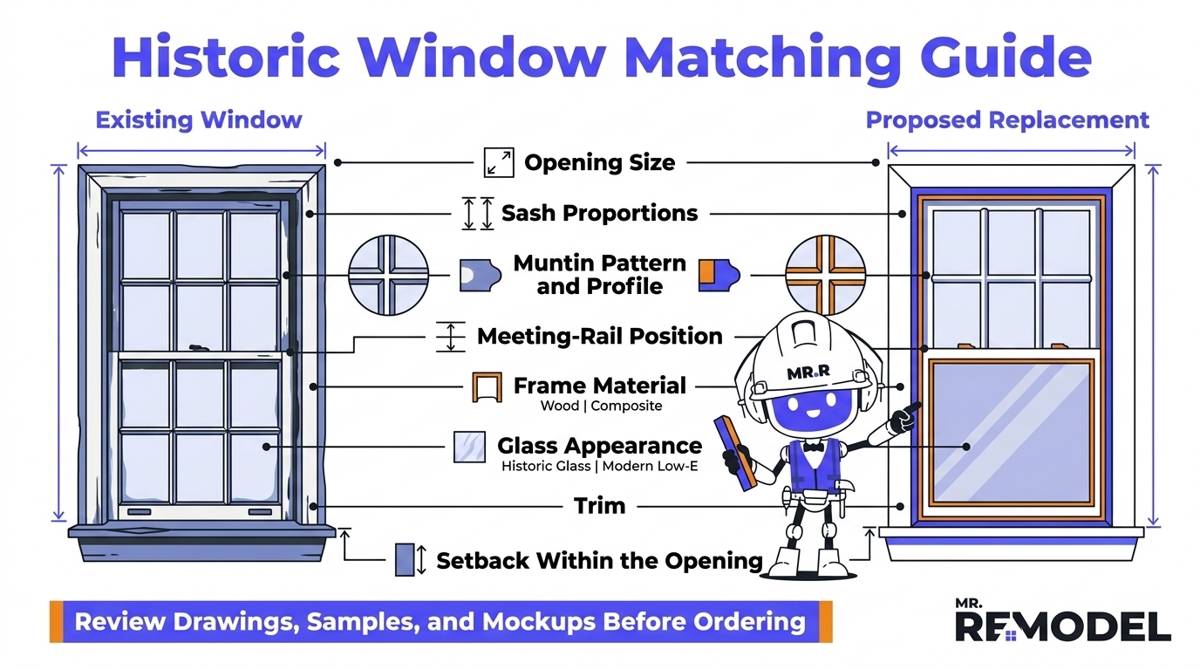
Match the Home’s Architectural Character
A general product photograph may not show whether a proposed window matches the details visible on the house. Compare the existing and proposed units using:
- Opening size
- Sash configuration
- Frame and sash proportions
- Muntin pattern and profile
- Meeting-rail position
- Operating style
- Frame material
- Exterior finish
- Glass appearance
- Screen placement
- Interior and exterior trim
- Setback within the opening
Request product drawings, cross sections, material samples, finish samples, or mockups when needed. If several window styles or product lines are required, the project schedule should identify where their profiles and details differ.
The National Park Service explains that replacement features should match historic features in design, color, texture, and other visual qualities when replacement is necessary. Its replacement-window guidance also recognizes that visibility and location can affect the required level of matching.
See Related: Window Frame and Material Options
Planning a sensitive window project? Explore historic-home window replacement services and connect with local professionals.
Protect Original Trim, Masonry, and Finishes
Window removal can affect more than the existing sash and frame. The estimate should state how the crew will handle:
- Interior casing
- Exterior trim
- Plaster
- Masonry
- Stone or brick sills
- Siding
- Decorative surrounds
- Existing hardware
- Historic glass retained for reuse
- Paint-ready or completed finishes
Require the contractor to identify the installation method for each opening. A pocket replacement installs a new unit within the retained frame, while a full-frame replacement removes the window and frame to expose more of the opening. These methods create different protection and finish requirements.
The appropriate method depends on the window condition, proposed product, surrounding construction, and project requirements. The estimate should identify what will remain, what will be removed, and how disturbed materials will be restored.
See Related: Pocket vs. Full-Frame Window Replacement
Plan Historic Review Before Ordering
Before approving a product order, determine whether the property:
- Is individually designated
- Contributes to a historic district
- Is subject to local design review
- Is covered by a preservation agreement
- Participates in a program with separate standards
Local authorities may request photographs, elevations, sections, product drawings, muntin profiles, material samples, or other documentation. Ask the contractor what it will provide, who communicates with the reviewing authority, and how requested revisions will be incorporated into the order.
Mr. Remodel data shows that 95.07% of installation prospects wanted to begin within 30 days. Starting the assessment and review conversation early provides more time to coordinate documentation, product selection, final measurements, manufacturing, and installation.
Custom manufacturing should begin after the required product and architectural details complete the applicable review process.
Coordinate Several Historic Windows Consistently
Mr. Remodel data shows that the median installation inquiry involved five windows. Approximately 52.94% of inquiries included at least five windows, while 27.07% involved 10 or more.
Multi-window projects require consistent documentation across visible elevations, secondary elevations, and interior spaces. Assign every opening a unique identification number and maintain a project schedule containing:
- Elevation and room photographs
- Existing-condition notes
- Final measurements
- Treatment recommendations
- Product specifications
- Approved drawings
- Material and finish samples
- Installation methods
- Protection requirements
- Final inspection results
The schedule should track each opening from assessment through review, ordering, delivery, installation, and closeout. This gives the homeowner, contractor, supplier, and reviewing authority one consistent reference.
Compare Estimates, Schedules, and Warranties
A complete estimate should identify:
- Proposed treatment for every opening
- Product and architectural specifications
- Final measurement responsibility
- Historic-review documentation
- Removal and installation methods
- Protection of retained materials
- Flashing, insulation, and sealing
- Trim and finish restoration
- Disposal and retained components
- Manufacturing and installation schedules
- Change-order procedures
- Product, finish, and workmanship warranties
Compare proposals using equivalent products, matching requirements, protection methods, and finish responsibilities. The schedule should separate assessment, historic review, final measurements, ordering, manufacturing, delivery, installation, and closeout.
FAQ About Historic Home Window Replacement
Can windows in a historic home be replaced?
Replacement may be possible, but the appropriate treatment depends on the window’s condition, architectural significance, property designation, visibility, and applicable review requirements. A replacement may need to match defining details found in the original window.
Does an old home automatically count as historic?
Age alone does not establish an official historic designation. A property may be individually listed, contribute to a historic district, receive local recognition, or have older architectural features that the homeowner wants to preserve.
Should historic windows be repaired or replaced?
The decision should follow a condition assessment. Preservation guidance generally prioritizes retaining repairable, character-defining features. Severely deteriorated, missing, or unsuitable windows may require a compatible replacement treatment.
What details should replacement windows match?
Important details can include the opening size, sash configuration, frame proportions, muntin pattern and profile, meeting rails, operating style, material, color, texture, glass appearance, trim, and setback within the opening.
How many windows are commonly included in a replacement inquiry?
The median installation inquiry in Mr. Remodel data involved five windows. Ten windows was the most frequently selected quantity, accounting for 26.65% of installation inquiries. Projects of this size benefit from opening-by-opening documentation and coordinated specifications.
Plan a Sensitive Historic-Home Window Project
The right contractor should assess every existing window, document the home’s defining details, and coordinate required approvals before products are ordered. A complete plan should protect surrounding materials and maintain consistent specifications throughout installation.
Ready to plan window replacement for your historic or architecturally significant home? Get your free, no-obligation historic-home window replacement quote today.