1-855-QUOTEMR

Table of Contents [hide]
Who This Is For:
This guide is for U.S. homeowners planning a coordinated replacement project involving many window openings. It explains how to compare contractors based on product consistency, measurement control, installation capacity, scheduling, estimates, cleanup, and warranty coverage.
Key Takeaways
- Confirm Contractor Capacity: Choose a contractor with a clear plan for coordinating crews, deliveries, and daily installation targets.
- Standardize the Products: Record the style, material, glass, finish, hardware, and installation method for every opening.
- Compare Project Approaches: Evaluate completing the house in one project against following a planned, phased schedule.
- Require a Complete Scope: Include removal, installation, trim, permits, cleanup, substitutions, and change-order procedures.
- Inspect Every Window: Use an opening-by-opening checklist to test and document the completed work.
Replacing windows throughout a house requires one coordinated plan for measurements, products, deliveries, room access, installation, and inspections. Treating every opening as part of the same construction project helps maintain consistent specifications and responsibilities.
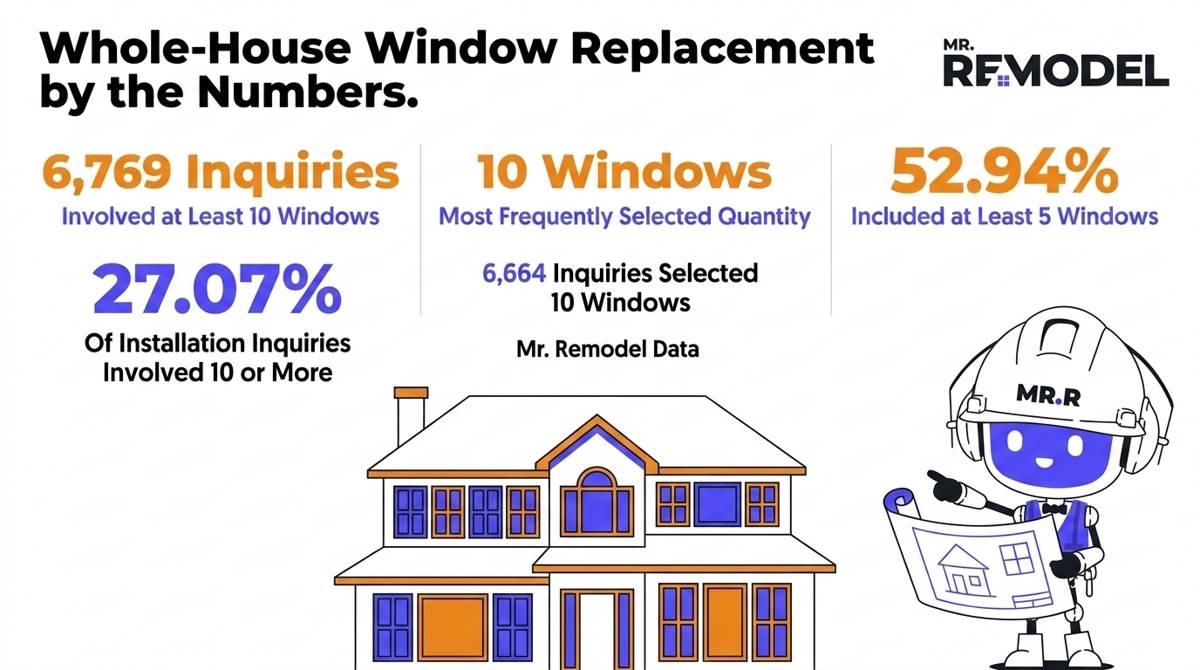
Based on Mr. Remodel data, installation accounted for 98.30% of detailed window inquiries. Large projects were also common, with 6,769 inquiries, or 27.07%, involving at least 10 windows. When choosing a whole-house window replacement contractor, compare crew capacity, measurement controls, product specifications, scheduling, and quality checks across the complete project.
What Counts as a Whole-House Window Replacement Project?
There is no fixed number of windows that defines a whole-house replacement because homes vary in size, layout, and window configuration. A project may include several operating styles and dimensions while following one coordinated product, installation, and finish plan.
Mr. Remodel data shows that 6,769 installation inquiries involved at least 10 windows. Ten windows were the most frequently selected quantity, appearing in 6,664 inquiries. Approximately 52.94% of all installation inquiries involved at least five windows.
These project sizes require contractors to coordinate more than installation labor. Final measurements, product orders, deliveries, storage, room access, opening protection, trim, cleanup, and inspections must remain organized from the first window through project closeout.
How to Compare Whole House Window Replacement Contractors
Use the same criteria for every contractor so that you can compare equivalent products, services, and project-management plans.
1. Review Similar Projects
Ask about experience coordinating replacement projects involving 10 or more openings. Relevant examples can show how the contractor manages different window types, occupied rooms, deliveries, finish work, and opening-by-opening inspections.
2. Confirm Measurement Control
Identify who takes the final measurements, reviews the complete order, and approves it for manufacturing. The agreement should explain how incorrect dimensions, specifications, or quantities will be handled.
3. Create a Window Schedule
Every opening should have an identification number and assigned room. The schedule should list its size, operating style, manufacturer, product line, frame material, finish, glass package, screens, grilles, locks, handles, and other selected features.
4. Define Installation Methods
Record whether each opening will receive pocket or full-frame replacement. The scope should explain what will be removed, retained, installed, sealed, and finished at every location.
5. Review Crew Capacity
Ask about the expected crew size, on-site supervisor, daily installation target, opening-protection plan, and end-of-day cleanup. The contractor should explain how the team will maintain quality while working in several rooms.
6. Plan Delivery and Storage
Determine how products will be counted, inspected, protected, stored, and matched to their assigned openings. Ask how damaged, missing, or incorrectly specified units will affect the installation sequence.
7. Require Final Inspections
Establish how each window will be tested and documented. The final inspection should cover operation, locks, screens, visible seals, glass, frames, trim, finishes, and cleanup.
See Related: Choosing a Window Replacement Contractor
Keep Products and Finishes Consistent
A large replacement project may combine double-hung, casement, sliding, picture, and specialty-shaped windows. Certain locations may also need tempered or other application-specific glass.
Approve one project-wide specification sheet before ordering. It should coordinate:
- Manufacturer and product line
- Frame material and profile
- Interior and exterior finish
- Glass package
- Grille pattern
- Screen color
- Locks and handles
- Trim details
- Installation method
When several product lines are required, the estimate should identify where their profiles, finishes, hardware, ratings, or sightlines differ. Ask the contractor to provide samples or product documents for the selected configurations before the order is approved.
You can also compare applicable ratings for each quoted product through the National Fenestration Rating Council. NFRC labels provide standardized whole-window measurements such as U-factor, solar heat gain coefficient, visible transmittance, and air leakage.
Replace Every Window at Once or Use Phases?
Completing every window through one coordinated project can provide one measurement process, product order, delivery plan, installation period, and closeout procedure. It may also simplify communication because one schedule governs the entire house.
A phased project allows homeowners to prioritize certain rooms, coordinate window work with other renovations, or limit disruption to selected parts of the home. Each phase should still follow a complete written plan.
If you are considering phases, ask the contractor to document:
- Which rooms belong to each phase
- How future product availability will be handled
- Whether finishes or product lines could change
- When separate warranties begin
- How measurements and specifications will be stored
- How later installations will coordinate with earlier work
Compare complete proposals for both approaches based on your project priorities, household schedule, and preferred installation sequence.
See Related: How Many Windows Should You Replace at Once?
Review the Daily Installation Plan
A whole-house project affects several interior rooms and exterior openings. Before work begins, request a daily plan that identifies:
- Expected crew size
- On-site supervisor
- Daily removal limit
- Rooms scheduled each day
- Furniture and floor protection
- Temporary protection for exposed openings
- Weather-delay procedures
- Access to occupied rooms
- Material and debris routes
- End-of-day cleanup
- Final inspection sequence
The contractor should explain how many openings the crew expects to remove before replacements are secured and how the home will be protected if weather or product concerns interrupt the schedule.
Mr. Remodel data shows that 93.12% of prospects with projects involving at least 10 windows wanted to begin within 30 days. Discuss measurements, permits, product availability, delivery, and crew scheduling early so the contractor can develop an organized project timeline.
See Related: Window Replacement Timeline
Compare Complete Estimates and Warranties
Each written estimate should identify:
- Window quantity and product specifications
- Installation method for every opening
- Removal and disposal
- Flashing, insulation, and sealing
- Interior and exterior trim
- Siding or other finish work
- Permit responsibility
- Product delivery and storage
- Manufacturing and installation schedules
- Product-substitution procedures
- Change-order requirements
- Payment schedule
- Cleanup and final inspection
- Manufacturer and workmanship warranties
The Federal Trade Commission recommends comparing written estimates that identify the work, materials, expected completion date, and price. Compare equivalent products and installation scopes rather than relying on total prices alone.
Review manufacturer and workmanship warranties separately. Confirm the coverage period, exclusions, transferability, labor provisions, and claim process for each. The proposal should also identify who coordinates product claims and who addresses covered installation concerns.
FAQ About Whole-House Window Replacement
How many windows are usually included in a large replacement project?
Mr. Remodel data includes 6,769 installation inquiries involving at least 10 windows. Ten windows was the most frequently selected quantity, appearing in 6,664 inquiries. The scope of a large project still depends on the home’s size, layout, and number of openings.
Should every window in a house be replaced at once?
The decision depends on existing window conditions, household scheduling, product availability, project coordination, and budget. When both approaches are practical, ask the contractor to provide complete scopes for a single coordinated project and a planned, phased replacement.
How long does whole-house window replacement take?
Timing depends on the window quantity, product availability, installation methods, crew size, permits, opening conditions, weather, and included finish work. Request a project-specific schedule separating measurement, ordering, delivery, installation, inspections, and completion.
How can homeowners keep every window consistent?
Use a written window schedule identifying the manufacturer, product line, frame material, glass, finish, hardware, grilles, screens, trim, and installation method for every opening. Review and approve the complete schedule before the contractor places the order.
What should a whole-house replacement estimate include?
A complete estimate should identify products, measurements, installation methods, removal, flashing, sealing, trim, disposal, permits, scheduling, payment terms, substitutions, change orders, cleanup, and warranties. It should also explain how products will be delivered, stored, inspected, and assigned to each opening.
Start Your Whole-House Window Replacement Project
The right contractor should have the capacity to coordinate many openings while maintaining consistent specifications across the house. A written plan for measurements, products, deliveries, installation, protection, cleanup, and inspection gives every participant the same expectations throughout the project.
Ready to replace the windows throughout your home? Get your free, no-obligation whole-house window replacement quote today.