1-855-QUOTEMR

Table of Contents [hide]
Who This Is For:
Homeowners planning to replace several windows, comparing contractors, gathering estimates, or trying to understand what separates a qualified window installer from an inexperienced or unreliable company.
Key Takeaways:
- Compare Several Companies: Do not choose based only on the lowest estimate.
- Check Qualifications First: Verify insurance, references, applicable licensing, and relevant installer experience.
- Compare Window Specs: Brand names matter less than model, glass package, performance ratings, and installation method.
- Review Both Warranties: Product warranties and installation warranties are not always the same.
- Get a Complete Estimate: The quote should clearly explain labor, removal, installation scope, flashing, trim, permits, cleanup, and warranties.
The right window company can make the difference between a smooth replacement and years of drafts, leaks, and warranty headaches. That is why comparing local window replacement companies should involve more than checking who offers the lowest price.
The goal is simple: find a qualified contractor who serves your area, offers the right window products, explains the installation clearly, and gives you a detailed written estimate.
Start With Companies That Actually Serve Your Area
A window company should understand the homes, climate, and local requirements in your market. That does not mean a small local company is automatically better than a regional or national company.
It means the contractor should have relevant experience in your area. Local experience can affect permitting and inspection requirements, common home construction practices, weather conditions, energy performance needs, and installation challenges.
Mr. Remodel data shows window demand varies widely by location. Florida, Texas, Indiana, California, and New York were among the top states for installation or replacement inquiries. Top cities included Las Vegas, San Antonio, Memphis, Houston, and Fort Wayne.
That kind of variation matters because window needs differ across regions. A homeowner in Las Vegas may care more about solar heat gain, while a homeowner in New York may care more about winter insulation and air sealing.
Check Qualifications Before Requesting an Estimate
Before comparing prices, check whether the company is qualified to do the work. At a minimum, homeowners should ask about applicable licensing, insurance, references, manufacturer training, and experience with the type of window being installed.
ENERGY STAR recommends seeking trained professionals, asking whether installers are certified to install the selected product, interviewing contractors, and checking references, as outlined in its Residential Windows, Doors, & Skylights guidance.
For homes built before 1978, ask about lead-safe practices. Window replacement can disturb old paint, so contractors should understand applicable lead-safety requirements.
Good companies should be willing to explain who performs the installation, whether work is subcontracted, what training installers have, and what happens if damaged framing is found.
Compare More Than the Price
Two window estimates can look similar but include very different products and installation scopes. A low price may not be a better deal if it leaves out flashing, trim, disposal, permit handling, or warranty coverage.
Use the estimate to compare the full project.
ENERGY STAR advises homeowners to make sure contracts identify the actual windows being installed and recommends including the U-factor and Solar Heat Gain Coefficient (SHGC) in the contract through its High Performing Windows or Storm Windows guidance.
Project size also affects how estimates should be reviewed. Among Mr. Remodel inquiries with window-count information, the median installation or replacement inquiry covered 5 windows, while the average was about 5.9 windows.
That is why homeowners should compare whole-project estimates rather than focusing only on an advertised price per window.
Ask How the Windows Will Be Installed
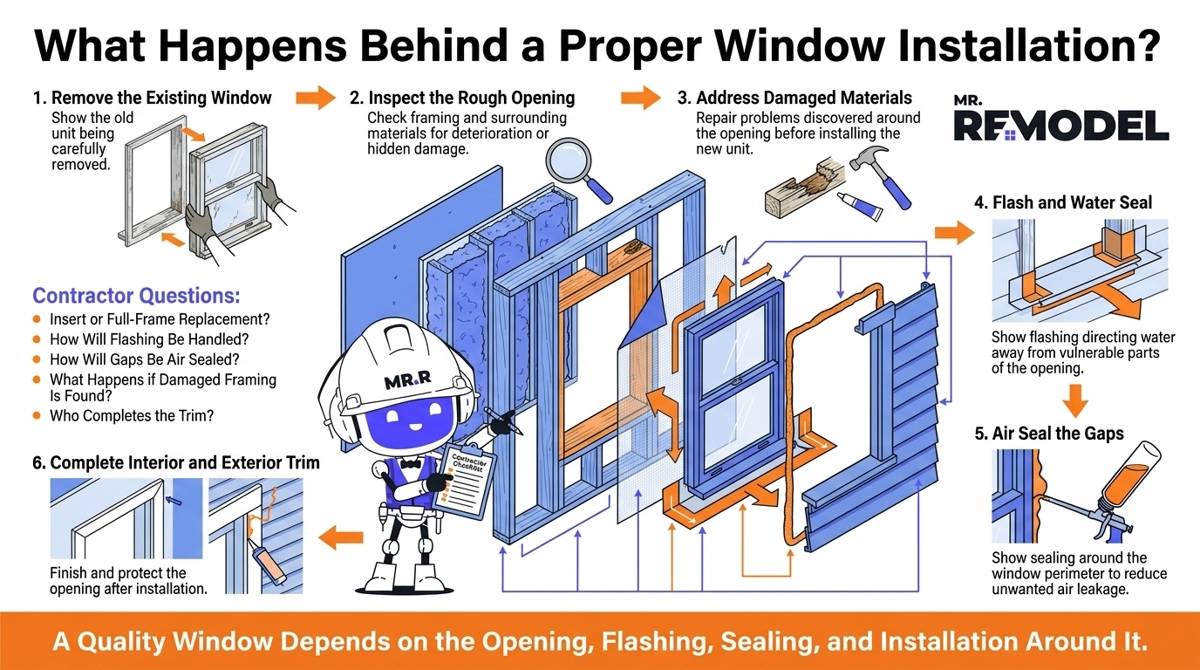
Installation quality deserves its own conversation. A good window is only as reliable as the opening, flashing, sealing, and trim work around it.
The United States (U.S.) The Department of Energy (DOE) Building America Solution Center explains that a complete window and frame replacement involves more than just installing a new unit in the wall. Proper replacement may involve inspecting the opening, addressing deteriorated materials, flashing, air sealing, and water sealing.
Ask each contractor:
- How will the existing window be removed?
- Will the rough opening be inspected?
- Is this an insert replacement or a full-frame replacement?
- How will flashing be handled?
- How will gaps be air-sealed?
- What happens if damaged framing is discovered?
- Who completes the interior and exterior trim?
The Building America Solution Center also explains why fully flashed windows and doors matter for water management. If an estimate does not explain flashing or sealing, ask for more detail before signing.
Comparing several contractors can make it easier to understand your options. Mr. Remodel helps homeowners connect with fully vetted local contractors for window replacement projects.
Compare Window Performance, Not Just Brands
Window brands can be useful, but performance ratings tell you more. Homeowners should compare the exact window model, glass package, U-factor, SHGC, and ENERGY STAR certification for their climate.
U-factor measures how well a window insulates. A lower U-factor generally means better insulation.
SHGC measures how much solar heat passes through the glass. The best choice depends on your climate and sun exposure.
ENERGY STAR explains that window performance needs vary by climate and recommends verifying that products are ENERGY STAR certified for the installation location in its window upgrade guidance.
Do not rely only on marketing terms like “premium,” “efficient,” or “high performance.” Ask for the actual ratings.
Review Product and Installation Warranties
Product warranties and installation warranties are separate. The window manufacturer may cover glass, seals, frames, or hardware, while the contractor may cover workmanship.
ENERGY STAR advises homeowners to ask about both product and installation warranties because coverage periods and terms can differ.
Before signing, ask what is covered, how long coverage lasts, whether labor is included, whether glass seal failure is covered, whether the warranty transfers to a future buyer, and who handles warranty claims.
A good company should explain warranty details clearly in writing.
Watch for Window Replacement Red Flags
Be cautious if a company pressures you to sign immediately, refuses to provide references, gives vague product details, or will not explain the installation method.
Other red flags include incomplete written estimates, unclear warranty terms, large unexplained price changes, or sales claims that do not match the contract.
ENERGY STAR cautions consumers against signing documents before they are ready and recommends avoiding pressure from same-day signing offers.
Questions to Ask a Window Replacement Company
Before choosing a contractor, ask these questions:
- What exact window model are you quoting?
- Who will perform the installation?
- What installation method will you use?
- Is removal and disposal included?
- How will the opening be flashed and sealed?
- What happens if damaged framing is discovered?
- Are permits included if required?
- What product warranty applies?
- What installation warranty applies?
- Can you provide recent references?
Clear answers make it easier to compare companies fairly.
Frequently Asked Questions
How do I find reputable window replacement companies near me?
Start by checking qualifications, applicable licensing, insurance, references, product options, installation procedures, and written estimates. A reputable company should explain the exact window model, installation method, warranty coverage, and what happens if hidden damage is found.
How many window replacement estimates should I get?
It is smart to compare multiple detailed estimates rather than relying on a single quote. Make sure each estimate covers similar products, window counts, installation methods, warranties, trim work, removal, disposal, and permit handling where required.
What should a window replacement estimate include?
A window replacement estimate should include product specifications, quantity, installation method, removal, flashing, sealing, trim work, labor, permits (where applicable), cleanup, warranties, and the total price. Vague estimates are harder to compare fairly.
Should I hire a local or national window company?
Company size alone does not determine quality. Relevant local experience, installation quality, product options, warranties, contractor qualifications, and service matter more than whether the company is local, regional, or national.
What should I check before signing a window replacement contract?
Before signing, check the exact products, performance ratings, complete scope of work, payment terms, timeline, warranty coverage, permit responsibilities, cleanup details, and what happens if hidden damage is discovered.
Local Window Replacement Companies: Final Takeaway
The best company is not always the one with the lowest estimate. Homeowners should compare the complete project, including window specifications, installation method, flashing, sealing, trim, warranties, cleanup, and contractor qualifications.
Before signing, make sure the estimate clearly explains what will be installed and how the work will be completed. To compare qualified options, get a free quote, and connect with fully vetted local window contractors through Mr. Remodel.