1-855-QUOTEMR

Table of Contents [hide]
Who This Is For:
Homeowners preparing to sign a window replacement contract who want to verify whether a company has the licensing, insurance, certifications, permits, and other credentials appropriate for their project and location.
Key Takeaways:
- Licensing Rules Vary: Window contractor licensing requirements depend on the state, county, city, project value, and scope of work.
- Licensed Does Not Always Mean Insured: A contractor license, liability insurance, and workers’ compensation are separate protections.
- Older Homes May Need Lead-Safe Credentials: Covered work in pre-1978 homes may require Environmental Protection Agency (EPA) or authorized state certification.
- Permits Are Separate From Licenses: A contractor may be licensed, but the project may still need a local permit.
- Verify Everything Independently: Do not rely only on ads, sales materials, or a license number printed on an estimate.
Hiring licensed window replacement contractors sounds simple. Ask if they are licensed, hear “yes,” and move forward.
But that answer is only the beginning. A license may be required, but it does not automatically prove that the contractor has insurance, permits, manufacturer training, lead-safe certification, or a workmanship warranty.
Mr. Remodel window data shows that installation or replacement represents about 92% of window inquiries in the supplied dataset. Among those installation or replacement inquiries, 24,841 came from homeowners, or about 99.3%.
For homeowners planning a multi-window project, it's worth checking credentials before signing, not after problems arise.
Does a Window Replacement Contractor Need a License?
There is no single nationwide rule for contractor licensing for ordinary residential window replacement. Requirements can vary by state, county, municipality, project value, license classification, and whether the work changes the structure.
Some areas may require a general contractor license. Others may have specialty licenses, registration rules, or different requirements based on the project scope.
The Federal Trade Commission (FTC) recommends considering contractors who are licensed and insured and confirming license status with the appropriate state or county government through its home improvement scam guidance.
What This Means for Homeowners
Do not ask only, “Are you licensed?” Ask, “What license is required for this work in my area, and how can I verify yours?”
That keeps the conversation specific to your location and project.
How to Verify a Contractor License
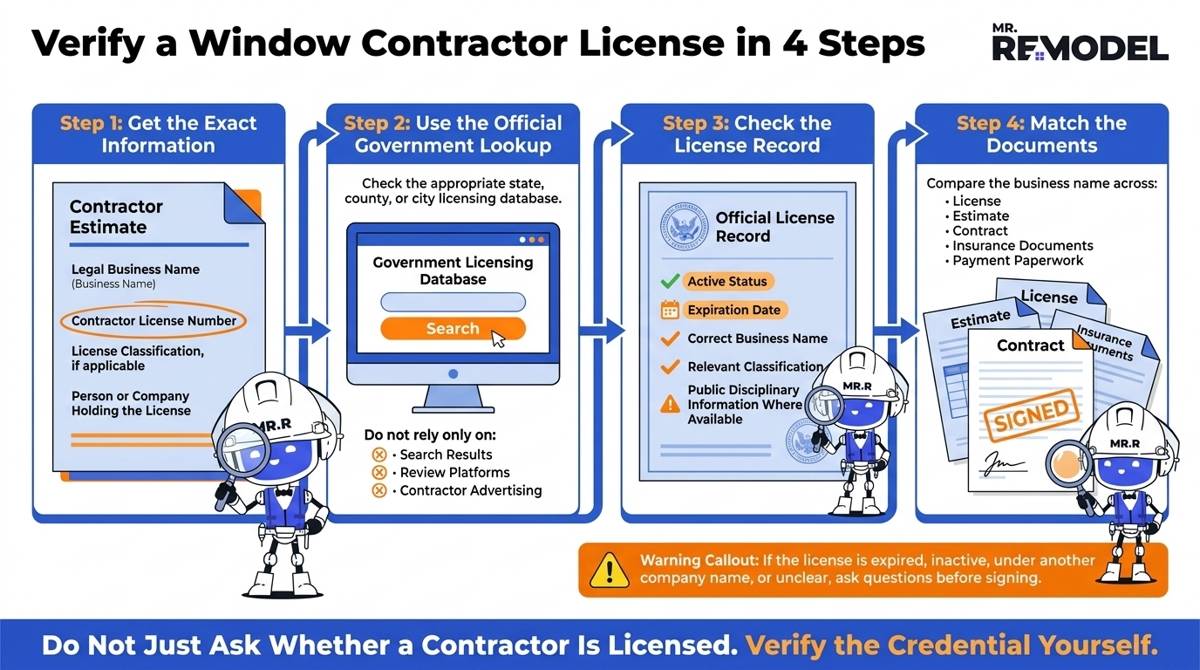
A license number on a proposal is helpful, but it should still be checked. Verification usually takes a few minutes through the official state, county, or city licensing website.
Step 1: Ask for Exact License Information
Request the contractor’s:
- Legal business name
- Contractor license number
- License classification, if applicable
- Name of the person or company holding the license
The legal name matters because the company signing your contract should match the credential being presented.
Step 2: Use the Official Government Lookup
Search the official contractor licensing database for your state, county, or city. Avoid relying only on search results, review platforms, or the contractor’s website.
As one example, California’s Contractors State License Board offers a public Check a Contractor License tool. This is only an example of how state-level verification can work, not a national rule.
Step 3: Check the Status
Look for:
- Active status
- Expiration date
- Correct business name
- Relevant license classification
- Public disciplinary information where available
If the license is expired, inactive, under a different company name, or unclear, ask for an explanation before moving forward.
Step 4: Match It to the Contract
The business name on the license, estimate, contract, insurance documents, and payment paperwork should make sense together.
If one company sells the job and another signs the contract, ask who is legally responsible for the work.
Licensed Does Not Automatically Mean Insured
A contractor license is not the same as insurance. A company can advertise as “licensed and insured,” but homeowners should still ask for proof.
The FTC recommends asking contractors for proof of insurance in addition to checking applicable licensing.
What to Ask For
Ask for a current certificate of insurance. Confirm the company name, policy dates, and coverage type.
For worker injury coverage, ask about workers’ compensation where required in your state.
Do not assume a license protects you from every risk.
Check Whether a Permit Is Required
A contractor license and a building permit are not the same thing. Licensing is about whether the contractor is allowed to perform certain work. A permit is approval for a specific project where local rules require it.
Permit requirements may depend on your municipality, replacement method, structural changes, opening modifications, and local code enforcement.
Questions to Ask Before Signing
Ask:
- Is a permit required for this project?
- Who obtains the permit?
- Is the permit fee included?
- Who schedules inspections?
- Will I receive final approval documentation?
If a contractor says permits are never needed, verify that with your local building department.
See Related: Window Replacement Permits & Inspections Guide | Mr. Remodel
Credential checks are easier when homeowners start with qualified professionals. Mr. Remodel connects homeowners with fully vetted local window contractors so they can compare options for their replacement project.
Older Homes May Require Lead-Safe Certification
If your home was built before 1978, credential checks should include lead-safe requirements. Window replacement can disturb painted surfaces.
The Environmental Protection Agency (EPA) says its Renovation, Repair and Painting (RRP) Rule applies to covered paid renovation work that disturbs painted surfaces in pre-1978 housing and child-occupied facilities. EPA specifically lists window replacement as a covered activity through its RRP Program for Contractors.
Importantly, EPA notes that window replacement is covered when the rule applies, even though some other minor repair activities depend on disturbed square footage.
What Lead-Safe Credentials Can Include
Affected firms may need:
- Firm certification
- A certified renovator
- Lead-safe work practices
- Required occupant education
- Proper containment and cleanup
- Documentation
EPA administers the program in many areas, while some states operate EPA-authorized programs of their own. EPA’s Lead Renovation, Repair and Painting Program explains how program administration can vary.
This is separate from an ordinary contractor license.
Manufacturer Certification Is Different Too
Manufacturer training or certification can be valuable, but it is not the same as a government contractor license.
ENERGY STAR recommends seeking trained professionals and asking whether installers are certified to install the selected product through its Residential Windows, Doors, & Skylights guidance.
Some manufacturers may require installation according to their instructions or by approved installers for warranty coverage.
Why It Matters
Manufacturer credentials may show:
- Product-specific installation training
- Familiarity with required methods
- Knowledge of warranty conditions
- Experience with that window line
Still, manufacturer certification does not replace a contractor license where one is legally required.
See Related: Understanding Manufacturer Warranty vs Installation Warranty
What Should You See Before Signing?
Before signing a window replacement contract, gather the basic proof. A qualified contractor should not make this difficult.
Homeowner Verification Checklist
Ask for or verify:
- Applicable contractor license
- Insurance documentation
- Exact legal company name
- Written scope of work
- Permit responsibility
- Manufacturer and product information
- Lead-safe certification where applicable
- Workmanship warranty
- Start and completion expectations
- Payment schedule
The FTC recommends a written contract that identifies the contractor, relevant license number, estimated timing, scope, materials, and other promises made about the job.
See Related: Choosing A Window Replacement Contractor | Vetting Guide
Do Not Let a Fast Start Date Replace Proper Vetting
When a window is broken, leaking, drafty, or hard to open, it is natural to want the project started quickly. Still, urgency should not replace credential checks.
Mr. Remodel data shows that 8,074 installation or replacement inquiries requested a start within 7 days, while 23,771 requested a start within 30 days. These figures reflect desired homeowner timing, not actual project start or completion dates.
Before you sign, confirm licensing, insurance, permit responsibilities, lead-safe requirements, and warranty terms. The FTC also warns consumers to be careful with contractors who pressure them into immediate decisions.
See Related: Questions to Ask Window Installers: Hiring Guide
Credential Red Flags
A single issue does not always prove fraud, but it should make you slow down and verify.
Watch for These Warning Signs
Be cautious if:
- The license number cannot be verified
- The license belongs to a different company
- The credential is expired or inactive
- The contractor refuses proof of insurance
- The company says permits are always unnecessary
- The contractor asks you to obtain a permit without explaining why
- A pre-1978 home contractor cannot explain lead-safe requirements
- Manufacturer certification is presented as a government license
If something does not match, ask for clarification and verify through official sources.
See Related: 7 Red Flags When Hiring Window Companies
Frequently Asked Questions
Do window replacement contractors have to be licensed?
Licensing requirements vary by state and local jurisdiction. Homeowners should use their state or county licensing authority to determine whether a license is required and verify its current status, as the FTC recommends confirming contractor licensing with the appropriate government agency.
How do I verify a window contractor’s license?
Ask for the company’s legal name, contractor license number, and license classification if applicable. Then check that information through the official state or local licensing database rather than relying only on the contractor’s website, ad, or estimate.
Is a licensed contractor automatically insured?
No. Licensing and insurance are different credentials. A contractor may have a license where required, but homeowners should still request proof of liability insurance and workers’ compensation where applicable.
Does replacing windows in an older home require EPA certification?
For covered paid work in pre-1978 housing, EPA’s Renovation, Repair and Painting Rule can apply when painted surfaces are disturbed. EPA specifically identifies window replacement as a covered activity, with EPA or an authorized state program administering certification requirements.
Is manufacturer certification the same as a contractor license?
No. Manufacturer certification generally relates to training or authorization for particular products, while a contractor license is issued by a government authority where required. ENERGY STAR recommends asking whether installers are trained or certified for the selected product.
Licensed Window Replacement Contractors: Final Takeaway
Hiring a licensed window replacement contractor starts with understanding what licensing your jurisdiction actually requires. From there, homeowners should separately verify insurance, permits, EPA or authorized-state lead-safe credentials where applicable, manufacturer training, and workmanship warranty responsibility.
A fast quote or confident sales pitch should never replace proper verification. To compare qualified options, get a free quote from fully vetted local window contractors through Mr. Remodel.