1-855-QUOTEMR

Table of Contents [hide]
Who This Is For:
Homeowners preparing to hire a window installer who want to understand contractor insurance, verify coverage, and avoid assuming that a license, certification, or company advertisement automatically proves the right protection is in place.
Key Takeaways:
- Ask for Proof Before Work Starts: Do not rely only on a “licensed and insured” claim in an ad or sales pitch.
- Liability and Workers’ Compensation Are Different: These cover different types of risk and should not be treated as interchangeable.
- Insurance Is Not a License: Licensing, insurance, bonding, manufacturer certification, and lead-safe credentials are separate.
- Check the Company Doing the Work: Coverage should match the business actually performing or managing the installation.
- Do Not Rush Verification: Project urgency should never replace insurance checks.
Hiring insured window installation contractors is about more than checking a box. When crews remove windows, carry glass, use ladders, and work inside your home, you need to know what protection the contractor actually has.
Insurance does not guarantee every problem will be covered. Coverage depends on the policy, exclusions, limits, and circumstances. Still, asking for proof before work begins is one of the simplest ways homeowners can reduce avoidable risk.
Mr. Remodel window data shows that installation or replacement accounts for about 91.6% of window inquiries in the supplied dataset. Among those installation or replacement inquiries, 24,841 came from homeowners, or about 99.3%.
Why Contractor Insurance Matters During Window Installation
Window installation can be more involved than it looks from the outside. A crew may remove old frames, handle glass, use power tools, carry materials through the home, work from ladders, and temporarily expose wall openings.
That creates practical risks around property, people, and the worksite.
The Federal Trade Commission (FTC) recommends considering contractors who are licensed and insured and specifically tells homeowners to ask for proof of insurance.
Why This Matters in a Multi-Window Project
Among Mr. Remodel installation or replacement inquiries with recorded window counts, the median project involved 5 windows, and the average was about 5.9 windows.
Larger residential projects can involve workers entering several rooms, furniture and flooring near work areas, ladders, old glass, temporary wall openings, debris, cleanup, and landscaping near the work zone.
That is why insurance questions matter before several windows are removed at once.
General Liability Insurance Explained
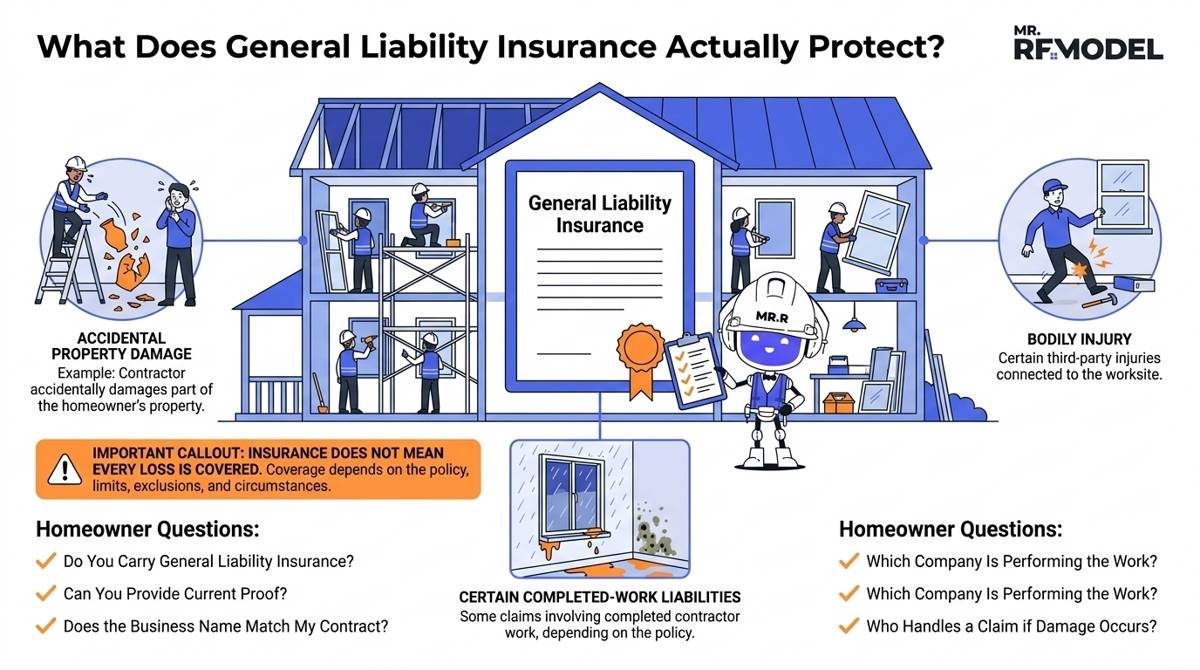
General liability insurance is one of the most common types of contractor insurance homeowners hear about.
In simple terms, it can protect the contractor for covered third-party claims involving issues such as accidental property damage, bodily injury, or certain completed-work liabilities.
Example Scenario
A contractor accidentally damages part of your property while installing windows. General liability insurance may be relevant, depending on the policy and situation.
That does not mean every loss is automatically covered. Homeowners should avoid assuming that one insurance document answers every risk question.
What to Ask
Ask the contractor:
- Do you carry general liability insurance?
- Can you provide current proof?
- Does the business name match the contract?
- What company will actually perform the work?
- Who handles a claim if damage occurs?
See Related: Choosing A Window Replacement Contractor | Vetting Guide
Workers’ Compensation Is Different
Workers’ compensation is not the same as general liability. It generally relates to workplace injuries involving employees.
Requirements vary by jurisdiction and business structure, so homeowners should not assume every company is subject to the same rule. A company using employees may handle coverage differently than a company using subcontractors.
The Occupational Safety and Health Administration (OSHA) has explained that a typical homeowner who hires independent contractors is generally not treated as the employer of those contractors’ workers under the federal Occupational Safety and Health Act. That does not answer every insurance or state workers’ compensation question, but it helps explain why the contractor’s business structure matters.
Questions to Ask About the Crew
Ask:
- Do you carry workers’ compensation where required?
- Are the installers employees or subcontractors?
- Who employs the crew performing the work?
- Who carries coverage for the crew?
- Who is responsible if a worker is injured?
Keep the answer in writing when possible. If anything is unclear, ask the contractor or insurer to explain it.
Insurance Is Not the Same as Licensing
A contractor may truthfully say they are licensed without proving insurance. They may also be manufacturer-certified without carrying the insurance coverage you expected.
These credentials are different.
|
Environmental Protection Agency (EPA) Renovation, Repair and Painting (RRP) Certification |
Lead-safe qualification for applicable renovation work |
A license does not replace liability insurance. Insurance does not replace a permit. Manufacturer certification does not replace either one.
Insurance is only one part of choosing a qualified installer, but it is an important one to verify before work begins. Mr. Remodel helps homeowners connect with fully vetted local window contractors for residential window projects.
How to Ask for Proof of Insurance
You do not need to become an insurance expert. You just need to ask for current documentation and make sure the basic details make sense.
Ask Before Signing
Request proof of applicable insurance coverage before signing or before work begins. The FTC’s home repair scams guidance also advises homeowners to check that contractors have licenses and insurance before beginning home repairs.
Check the Business Name
The name on the insurance documentation should match the company entering the contract or clearly explain the relationship.
If one company sells the project and another installs the windows, ask who carries coverage and who is responsible for the work.
Check Policy Dates
Make sure the document has current effective and expiration dates. An expired certificate does not help you verify current coverage.
Look at the Coverage Type
Do not assume one document proves every type of insurance. A general liability certificate does not automatically prove workers’ compensation coverage.
Ask for Clarification
If the document is confusing, ask the contractor or insurer to clarify. Avoid trying to interpret complex policy language on your own.
What Is a Certificate of Insurance?
Contractors may provide documentation showing insurance information, often called a certificate of insurance.
A certificate can help you see reported details such as the named insured, insurer, policy type, effective date, expiration date, and listed limits.
Important Limitation
A certificate is evidence of reported insurance information. It is not the insurance policy itself and does not guarantee that a specific incident will be covered.
Avoid choosing a contractor based only on a certificate. Use it as one verification step.
Does Homeowners Insurance Protect You Instead?
Your homeowners insurance and a contractor’s business insurance are not the same thing.
The National Association of Insurance Commissioners (NAIC) explains that homeowners insurance generally protects the structure, personal property, and certain personal-liability risks, subject to the policy.
That does not mean your own policy should replace contractor insurance. Contractor business insurance and homeowners insurance serve different purposes.
If you have questions about how renovation-related damage would be handled, contact your insurer before work begins.
Ask Who Is Actually Performing the Work
The company selling the project may not directly employ the installers. Subcontractors may be involved, and that can affect your insurance questions.
Ask:
- Is the installation crew employed by your company?
- Are subcontractors used?
- Who carries insurance for the crew?
- Who is responsible for the work?
- Who handles a claim if damage occurs?
- Who should I contact if there is a problem?
ENERGY STAR recommends interviewing installers, requesting references, and asking whether installers are trained or certified for the selected product through its Residential Windows, Doors, & Skylights guidance.
See Related: Questions to Ask Window Installers: Hiring Guide
Do Not Let a Fast Start Override Insurance Checks
Many homeowners want window work done quickly. That is understandable when a window is leaking, cracked, drafty, or difficult to operate.
Mr. Remodel data shows that 8,074 installation or replacement inquiries indicated a desired start within 7 days, and 23,771 indicated a desired start within 30 days. These figures reflect desired timing, not actual contractor start or completion dates.
Even with a near-term goal, ask for proof of insurance before crews arrive. The FTC also warns homeowners about contractors who pressure them into immediate decisions.
Insurance Red Flags
Insurance red flags do not automatically prove fraud, but they do mean you should slow down and verify.
Watch for These Issues
Be cautious if:
- The contractor refuses to provide proof of insurance
- The company name does not match the contract
- The documentation has expired
- The contractor says licensing automatically proves insurance
- The contractor says your homeowners insurance makes contractor coverage unnecessary
- No one can explain who employs the installation crew
- Subcontractor responsibility is unclear
- The contractor avoids written answers
If something does not add up, ask more questions before signing.
See Related: 7 Red Flags When Hiring Window Companies
Frequently Asked Questions
What insurance should a window contractor have?
Common contractor protections include general liability insurance and workers’ compensation where applicable, but requirements differ by jurisdiction and business structure. Homeowners should request proof of insurance and verify applicable local requirements before work begins.
Is a licensed window installer automatically insured?
No. Licensing and insurance are separate. A contractor may have a valid government license where required, without that license alone proving current insurance coverage.
How do I verify that a window contractor is insured?
Ask for current insurance documentation, confirm the insured business name and policy dates, identify the type of coverage shown, and seek clarification from the contractor or insurer if anything is unclear.
Does homeowners insurance cover damage caused by a contractor?
It depends on the homeowner’s policy and the circumstances. Homeowners insurance can cover certain property and liability losses, but it should not be treated as a substitute for verifying contractor insurance.
Should subcontractors be insured too?
Homeowners should ask who employs the installers, which company carries applicable coverage for the workers, and who is responsible for the work. Do not assume the sales company’s insurance automatically answers every subcontractor's question.
Insured Window Installation Contractors: Final Takeaway
Hiring insured window installation contractors means doing more than looking for “licensed and insured” in an advertisement. Homeowners should ask for proof, understand which coverage is being shown, check current dates and business names, and separately verify other credentials.
Do not let urgency or a polished sales pitch replace basic insurance checks. To compare qualified options, get a free quote from fully vetted local window contractors through Mr. Remodel.