1-855-QUOTEMR

Table of Contents [hide]
Who This Is For:
Homeowners who have already found a few local window installers and now need to figure out which one is most likely to deliver a clean, consistent, weather-tight installation.
Key Takeaways:
- A Good Installer Explains the Work: They should walk you through measuring, flashing, sealing, finishing, and cleanup.
- Installation Quality Matters More Than Ads: The best installer is not always the cheapest, closest, or fastest.
- Flashing and Air Sealing Are Big Clues: These details help protect against leaks, drafts, and wall damage.
- Consistency Matters Across Every Window: Multi-window jobs require the same care from the first opening to the last.
- Final Inspection Protects You: Check the operation, locks, trim, sealant, cleanup, and warranty documents before making the final payment.
Searching for the best window installers near me can feel like a quick online task. You check reviews, compare a few websites, and call the company that looks most polished.
But window installation is one of those projects where the most important work is often hidden. You may not see the flashing, air sealing, opening repairs, or manufacturer-required steps once the trim goes back on.
That is why the best installer is not simply the company with the most stars or the fastest appointment. The best installer is the one that can prove they know how to protect your home before, during, and after installation.
Mr. Remodel window data shows strong residential demand for installation and replacement work. About 99.3% of installation or replacement inquiries came from homeowners. The dataset combines new installations and replacements.
Start With Proof, Not Promises
A smooth sales pitch is not the same thing as skilled installation. Before you hire anyone, look for signs that the installer has a repeatable process and knows how to handle the details that affect long-term performance.
What Proof Looks Like
Ask for examples that show real workmanship, not just general claims.
Good signs include:
- Recent project photos
- References from similar homes
- Manufacturer training or certification
- A written workmanship warranty
- Clear product documentation
- A detailed installation process
- A plan for hidden damage
- A final quality-control step
ENERGY STAR recommends interviewing contractors, asking for references, and seeking trained installers. Its Residential Windows, Doors, & Skylights guidance also notes that some manufacturers may require certified installers for warranty coverage.
What a Vague Answer Tells You
A strong installer should be comfortable explaining the work. If they rush past your questions, only talk about the brand, or say “we do this all the time” without details, pause before signing.
See Related: Questions to Ask Window Installers: Hiring Guide
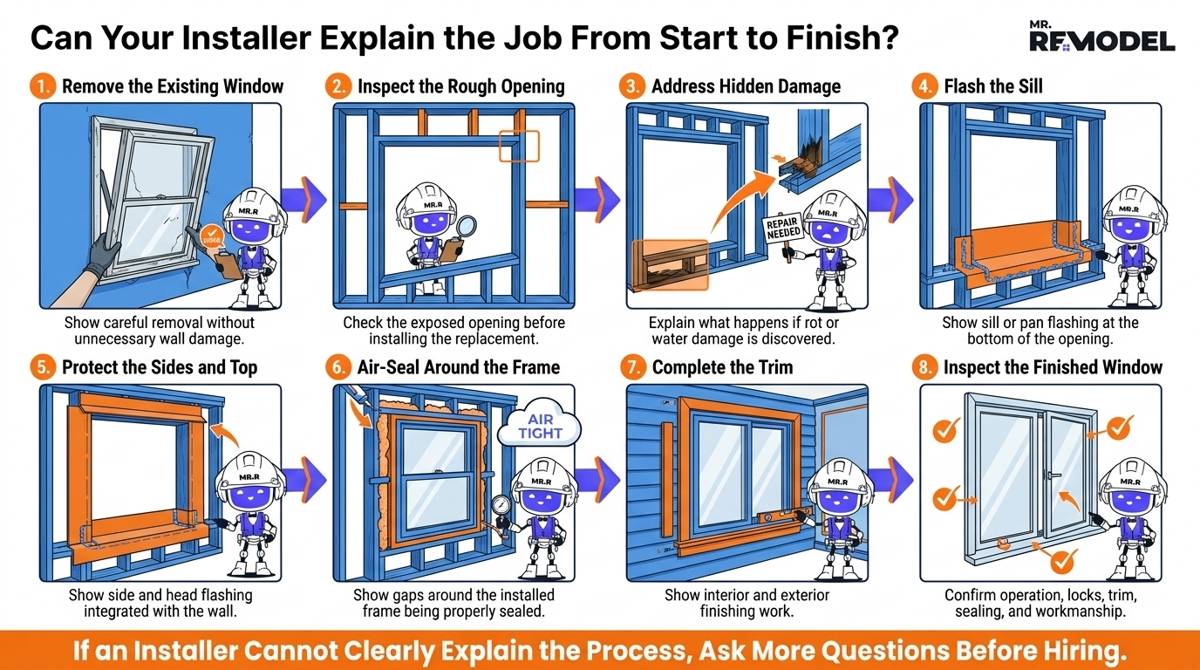
Ask Them to Explain the Installation Like a Story
One of the easiest ways to spot a quality installer is to ask them to walk you through installation day from start to finish.
You do not need a technical lecture. You need a clear sequence that shows they understand the full scope of the job.
The Story Should Include These Steps
A good installer should explain:
- How the existing window will be removed
- Whether the rough opening will be inspected
- What happens if rot or water damage appears
- How the sill will be flashed
- How the sides and top will be protected
- How gaps around the frame will be air-sealed
- What trim work is included
- Who checks the finished work
The Department of Energy (DOE) Building America Solution Center explains that complete window and frame replacement should address existing wall conditions, flashing, water sealing, and air sealing. In plain terms, window installation is about more than putting a new unit into an old hole.
Listen for Specifics
The best answers sound practical. They explain what will happen if the opening is damaged, how the crew protects your home, and what is included in the finished look.
Weak answers sound general. They skip flashing, sealing, and cleanup, and they don't specify who is responsible if something goes wrong.
Flashing Is Where Quality Often Shows Up
Flashing is not the most exciting part of window replacement, but it is one of the most important. A window interrupts the wall, and water needs a way to move out and away rather than sit inside the opening.
Why Flashing Matters
Poor flashing can allow water to reach areas you cannot see. Over time, that can contribute to staining, rot, wall damage, or mold concerns.
The Building America Solution Center explains that windows and doors should be fully flashed, including sill or pan flashing, side flashing, head flashing, and connection to the wall’s drainage layer.
What to Ask
You do not need to inspect hidden flashing yourself. Instead, ask:
- Will you use sill or pan flashing?
- How will the sides and top be flashed?
- How will the flashing connect with the wall system?
- Can you show photos before the trim covers the work?
- What sealants will be used outside?
A quality installer should not dismiss these questions. If someone says flashing is unnecessary without explaining why, that is a warning sign.
Look for Consistency Across Every Window
Installing one window well is important. Installing several windows with the same care is what separates a strong installer from an average one.
Among Mr. Remodel installation or replacement inquiries with recorded window counts, the median project involved 5 windows. The largest single recorded group was 10-window inquiries, with 6,664 inquiries.
That means many homeowners are not hiring for one small opening. They are hiring someone to repeat good workmanship across several rooms.
What Consistency Looks Like
Across the project, look for consistency:
- Measurements
- Alignment
- Window operation
- Spacing
- Trim work
- Caulk lines
- Flashing approach
- Air sealing
- Cleanup
Ask About Quality Control
A good installer should be able to answer:
- Does the same crew complete the whole job?
- Who supervises the work?
- Is every window checked before the crew leaves?
- What happens if one window does not operate correctly?
- Who handles service after installation?
Finding installers is easy. Knowing which one will install your windows correctly is harder. Mr. Remodel helps homeowners connect with fully vetted local window contractors so they can compare qualified options in their area.
Local Experience Should Mean More Than a Nearby Address
A local installer should bring more to the table than a local phone number. Real local experience means understanding what windows face in your area.
Climate Changes the Conversation
Different regions create different installation concerns. For example:
- Hot, sunny areas may need more focus on solar heat gain.
- Cold climates may need extra attention to air leakage.
- Coastal areas may need stronger water-management planning.
- Windy or storm-prone regions may require more careful product and installation choices.
- Older housing areas may have unusual trim or framing, or lead-safe concerns.
Mr. Remodel data shows installation or replacement demand across a wide range of states, including Florida, Texas, California, New York, Nevada, and Michigan. These markets can involve very different window performance and installation needs.
That is why local conditions should be part of the conversation before hiring an installer.
See Related: Window Replacement Permits & Inspections Guide
Fast Availability Is Helpful, But It Is Not Proof of Quality
When a window leaks, sticks, cracks, or fogs between the panes, it is normal to want the project done quickly. Still, the fastest installer is not always the best installer.
Mr. Remodel recorded 8,074 installation or replacement inquiries requesting a start within 7 days and 23,771 requesting a start within 30 days. These numbers reflect desired homeowner timing, not actual installation timelines.
A Realistic Schedule Usually Has Steps
A reliable installer may need time for:
- In-home measurement
- Product selection
- Custom ordering
- Permit review, when required
- Crew scheduling
- Weather planning
- Installation-day preparation
Be wary if an installer promises immediate installation without first measuring your windows, identifying the exact product, or checking the condition of the openings.
A good installer gives you a realistic schedule, not just the fastest answer.
Know Who Will Actually Do the Work
The person selling the job may not be the person installing the windows. That is not always a problem, but you should know who will be in your home.
Questions About the Crew
Ask:
- Are installers employees or subcontractors?
- How are crews trained?
- Who supervises the project?
- Does the same crew complete the full job?
- Who handles problems found during removal?
- Who performs the final quality check?
ENERGY STAR recommends asking whether installers are trained or certified to install the chosen product. That matters because some manufacturers may connect warranty coverage to proper installation.
Why Accountability Matters
If there is a leak, draft, damaged trim, or warranty question later, you need to know who is responsible. A good company should explain that before work begins.
See Related: Understanding Manufacturer Warranty vs Installation Warranty
Older Homes Need Extra Care
If your home was built before 1978, window installation may disturb painted surfaces. That can make lead-safe work practices part of the hiring decision.
The Environmental Protection Agency (EPA) states that window replacement that disturbs paint in covered pre-1978 housing falls under its Renovation, Repair and Painting (RRP) Rule. Certified firms must follow applicable lead-safe practices under the EPA’s Renovation, Repair and Painting Program.
What to Ask in an Older Home
Ask:
- Is your firm EPA-certified where required?
- Who is the certified renovator?
- How will the work area be contained?
- How will dust and debris be cleaned?
- Will painted trim or frames be disturbed?
This is not just paperwork. It helps protect your home during a messy part of the project.
Inspect the Work Before Final Payment
The final walkthrough is your chance to slow down and check the visible work. Do not feel rushed through it.
What to Check
Before final payment, confirm that:
- Every window opens and closes smoothly
- Locks work properly
- Screens fit correctly
- Glass is clean and undamaged
- Trim looks complete
- Visible caulk lines are neat
- Work areas are clean
- Old materials have been removed
- Warranty documents are provided
- Product information is included
You should not remove trim or inspect concealed flashing yourself. Instead, ask the installer to explain any hidden work and provide photos if they took them during installation.
Warning Signs an Installer May Not Be the Best Choice
Some red flags show up before the first window is removed.
Be cautious if an installer:
- Cannot explain the flashing process
- Dismisses water management
- Refuses references
- Gives vague product details
- Cannot say who performs installation
- Offers no clear workmanship warranty
- Promises unrealistic timing before measurement
- Has no plan for hidden damage
- Pressures you to sign before you are comfortable
One warning sign does not always mean the installer is unqualified. But several warning signs together should make you slow down.
See Related: 7 Red Flags When Hiring Window Companies
Frequently Asked Questions
How do I know if a window installer is good?
A good window installer should have training, references, a clear installation process, proper flashing and sealing practices, workmanship coverage, and specific answers to technical questions. They should also explain who performs the work and what happens if hidden damage is found.
Should window installers be certified?
Certification requirements vary, but ENERGY STAR recommends seeking trained professionals and asking whether installers are certified to install the selected products. Some manufacturers may also connect warranty coverage to approved installation practices.
How important is local experience for window installation?
Local experience can help installers understand climate, housing construction, permitting, and weather-related installation challenges. However, location alone does not prove workmanship quality, so homeowners should still ask about training, flashing, sealing, references, and warranty coverage.
How long should I wait for a good window installer?
Schedules vary based on measurement timing, product availability, custom manufacturing, permits, crew availability, and weather. Mr. Remodel data shows that many homeowners want projects started within 30 days, but the desired timing does not reflect actual installation timelines.
What should I inspect after new windows are installed?
Check that windows open and close smoothly, locks work, screens fit, glass is undamaged, trim is complete, visible sealant is neat, work areas are clean, and warranty documents are provided. Ask the installer to explain any concealed flashing or repair details completed during the job.
Best Window Installers Near Me: Final Takeaway
The best window installer is not just the closest company, the cheapest bid, or the fastest appointment. The best choice is the installer who can explain the work clearly, protect your home from water and air leaks, install every window consistently, and stand behind the finished project.
Before hiring, ask about flashing, sealing, crew training, local experience, warranty coverage, and final inspection. To compare qualified options, get a free quote, and connect with fully vetted local window contractors through Mr. Remodel.