1-855-QUOTEMR

Table of Contents [hide]
Who This Is For
This guide is for homeowners who are ready to invest in a major renovation but want to ensure their investment is fully protected against future disasters. If you are comparing quotes and feeling confused by big-box marketing claims of lifetime guarantees, this breakdown is for you. We strip away the complex legal jargon so you can easily understand what your contract actually covers.
Key Takeaways
- Two Separate Policies: Every project has two warranties. The manufacturer covers the physical materials, and the contractor covers the actual installation labor.
- The Waterproofing Gap: The most critical part of your shower is the waterproof seal. This is covered by the workmanship warranty, not the material warranty.
- Avoid Split Coverage: Do not let different subcontractors point fingers at each other if a leak happens. Always demand a single-point warranty from one responsible company.
- Transferable Value: A warranty that passes to the next homeowner is a major selling point that protects your property's resale value.
- State Protections: High-volume remodeling states legally require contractors to fix hidden construction defects for several years after the job is finished.
Having bathroom remodel warranties explained before you sign a contract is the absolute best way to protect your home. When you are preparing to spend upwards of $18,000 on a luxury upgrade, you are making a massive financial commitment. You need to know exactly who will pick up the phone and pay the bill if a pipe bursts behind your brand-new tile six months from now.
According to data from Mr. Remodel, many homeowners fall victim to aggressive sales pitches that promise lifetime coverage without reading the actual fine print. These vague promises often exclude the most expensive point of failure: the underlying waterproof seal. By understanding how modern building contracts are structured, you can easily digest the legal details and secure a rock-solid guarantee for your home.
The Two Halves of a Remodeling Warranty
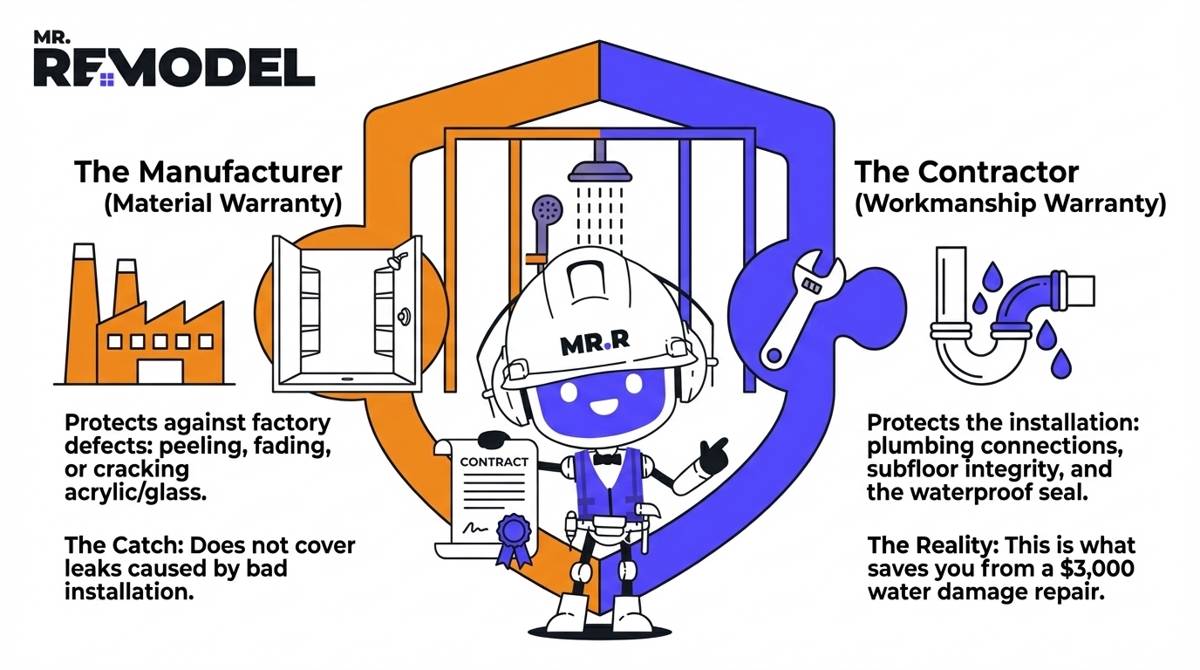
To truly protect your investment, you must understand that your project is not covered by one magic safety net. The Federal Trade Commission (FTC) notes that home improvement warranties are always divided into two distinct parts.
1. The Manufacturer Warranty (Covers Materials)
This coverage is provided directly by the factory that built your products. Whether you bought a high-efficiency toilet or custom acrylic wall panels, the manufacturer guarantees that the physical item is free from factory defects. If your acrylic walls prematurely fade or a glass door hinge snaps under normal use, the manufacturer will provide replacement parts.
2. The Workmanship Warranty (Covers Labor)
This is the most important coverage you can get. The workmanship warranty is provided by the local contractor who actually installed the materials. It guarantees that the plumbing connections are tight, the floor is structurally sound, and the waterproofing membrane is properly sealed.
If your contractor installs a perfect, defect-free shower pan but fails to seal the drain correctly, water will leak and rot your subfloor. The manufacturer will reject your claim because their shower pan did not fail. You will be entirely dependent on your contractor and their workmanship warranty to pay for the massive structural repair.
See Related: Choosing a Bathroom Remodeling Contractor
The Wet-Area Risk and Project Costs
Understanding where your money goes helps you understand where your biggest risks lie. Our 2026 data shows that 53% of all bathroom projects focus entirely on the wet area, such as a targeted shower upgrade or a tub-to-shower conversion.
A premium tub-to-shower conversion currently averages $18,310. Because this project involves capping old drains, moving water lines, and building a completely new waterproof base, the workmanship warranty is your absolute top priority. If the installation fails, the resulting water damage can cost thousands of dollars to fix.
Conversely, a complete room remodel averages $15,155. Because this budget is spread across multiple trades, such as electrical, plumbing, and drywall, you face a different risk called split coverage. You must ensure the company you hire offers a single-point warranty, meaning one primary contractor takes full financial responsibility for the entire room. If you do not have single-point coverage, the plumber and the tile setter will simply blame each other when a leak occurs.
See Related: Questions to Ask Bathroom Remodelers
Warranty Red Flags to Avoid
When reading your contract, you must look out for sneaky language designed to protect the contractor rather than your home. The Better Business Bureau (BBB) warns consumers to identify and avoid these specific warranty traps.
- Pro-Rated Coverage: A pro-rated warranty loses financial value over time. If a product fails in year five of a ten-year prorated warranty, the company will pay only half of the replacement cost. You should always demand full, non-prorated coverage.
- DIY Voiding Clauses: The Energy Star program explicitly notes that high-efficiency fixtures and smart ventilation fans require certified professional installation. If you attempt to install these items yourself to save money, the manufacturer will instantly void your product warranty.
- Short-Term Labor Guarantees: Be highly suspicious of any contractor who offers only a 30- or 90-day labor guarantee. A high-quality professional should guarantee their plumbing and waterproofing work for 1 to 5 years.
See Related: Red Flags When Hiring Bathroom Contractors
2026 State Laws and Transferable Value
You do not always have to rely solely on your contractor's goodwill. Many states have enacted strict legal standards to protect you from faulty construction.
For example, the California Contractors State License Board (CSLB) enforces SB 800. This law legally forces contractors to provide a one-year warranty for general workmanship, a four-year warranty for hidden plumbing defects, and a massive ten-year warranty for major structural failures.
Similarly, the Florida Legislature enforces Statute 553.837, which mandates a one-year builder's warranty for construction defects that automatically transfers to a new owner if you sell the house.
The ROI of a Transferable Warranty
Our data shows that 44.5% of remodeling leads are highly meticulous, thirty-day planners who care deeply about real estate value. If you fall into this category, a lifetime transferable warranty is your ultimate tool for return on investment.
When you invest $18,310 in a premium shower conversion, a transferable warranty ensures that your comprehensive protections pass directly to the next owner of your house. This provides incredible peace of mind to potential buyers and significantly boosts your home resale value.
You can secure this high-level protection today by connecting with verified professionals through Mr. Remodel. Get a free quote for your bathroom remodel to find local specialists who offer single-point, lifetime transferable warranties on their installations.
Frequently Asked Questions
What does a workmanship warranty cover?
A workmanship warranty is a legally binding guarantee provided by your installation contractor. It covers the quality of the actual labor, ensuring that all materials were installed in accordance with local building codes. If a pipe leaks because it was improperly tightened or a tile falls off because the mortar was mixed incorrectly, the workmanship warranty covers the repair.
Are lifetime warranties actually for a lifetime?
In the construction industry, a lifetime warranty usually refers to the expected functional lifespan of the specific product being installed, not the homeowner's lifespan. For high-grade acrylic showers, this typically means the product is guaranteed not to crack, fade, or peel for as long as you own the home.
Can DIY installation void my warranty?
Yes. Almost all premium building materials and high-efficiency plumbing fixtures require installation by a licensed professional. If a manufacturer determines that a product failed because you installed it incorrectly yourself, they will completely void your warranty and deny your claim.
What is a transferable warranty?
A transferable warranty is a premium coverage policy that can be legally transferred from the current homeowner to the next owner of the house. This provides the new buyer with incredible peace of mind and significantly boosts your property's resale value.
Protect Your Home Equity
Navigating the fine print of a construction contract is the only way to ensure your renovation budget stays within budget. A beautiful new shower is completely worthless if a hidden plumbing leak destroys your subfloor and your contractor refuses to answer the phone.
Mr. Remodel takes the risk out of remodeling by partnering exclusively with top-tier professionals. We connect you with verified local contractors who stand behind their work with robust, industry-leading warranties.
Secure a fully protected and worry-free installation today.