1-855-QUOTEMR


Table of Contents [hide]
Who This Is For
This guide is for homeowners currently staring at a foggy window pane, feeling a cold draft, or wiping up a puddle of water on their sill. If you are frantically searching for a quick DIY fix or wondering if you can just replace the glass without ripping out the frame, this article is for you. It provides a realistic look at what can be fixed, what must be replaced, and why the cheap fix often costs more in the long run.
Key Takeaways
- The 98% Rule: Our data from over 27,000 projects reveals that 98.3% of homeowners seeking repairs eventually choose full replacement because modern thermal performance cannot be restored with a patch.
- Batch Failure is Real: Windows installed at the same time fail at the same time. If one seal goes, the average homeowner replaces 5.5 windows shortly after.
- Leaks are Urgent: Water intrusion is not a glass problem. It is usually a flashing problem. You have 24 to 48 hours to stop it before mold growth begins.
- Fog vs. Condensation: Moisture on the glass is normal humidity. Moisture between the glass is a permanent seal failure that cannot be reversed.
- Geography Matters: High altitude in Denver causes pressure cracks, while extreme heat in Las Vegas cooks vinyl seals. Your location dictates your failure mode.
When you discover a puddle of water on your windowsill or realize you can no longer see through your kitchen window due to fog, your first instinct is likely to look for a repair kit. You might search for window problems and solutions, hoping to find a $20 tube of caulk or a magic defogging spray that will resolve the issue.
The internet is full of articles promising easy DIY hacks. However, these articles often ignore the structural reality of modern windows. A double-pane window is a pressurized, sealed system. Once that system is breached, no amount of silicone or hair dryer heat can restore its insulating properties.
At Mr. Remodel, we analyze data from thousands of homeowners facing these exact issues. The numbers tell a harsh truth. While 33% of our users initially enter the market looking for a repair, a staggering 98.3% of them end up proceeding with a replacement. They do not do this because they want to spend more money. They do it because they realize that paying $300 to "fix" a 20-year-old window that will fail again in six months is a bad investment.
This guide serves as your triage center. We will help you identify whether your issue is a cosmetic annoyance or a structural emergency. We will explain the physics behind why seals fail and why fixing just one window might be a mistake.
The 98% Rule: Why Repair Is Often a Myth

The concept of window repair is a holdover from a different era. Fifty years ago, windows were single panes of glass held in wood frames with putty. If the glass broke, you scraped out the putty and put in a new sheet of glass. It was simple.
Modern energy-efficient windows are fundamentally different. They are complex technological units comprised of two or three panes of glass, spacer systems, gas fills (Argon or Krypton), and microscopic Low-E coatings.
The Integrity of the Seal
The performance of the window relies entirely on the perimeter seal. This seal holds the gas inside and keeps moisture out. Once that seal is compromised, the window is technically totaled. You can replace the glass unit (the sash), but you cannot repair the seal itself.
The Cost-Benefit Analysis
According to industry data, the average cost to replace a thermal sash (the glass part) ranges from $150 to over $400 per window, depending on size. This does not include the frame.
If you have a vinyl window that is 20 years old, the frame itself is likely brittle and warped. Spending $300 to put new glass into a warped frame is like putting a new engine in a car with a rusted-out chassis. This is why our data shows the massive pivot to replacement. Homeowners realize that for a little more money, they can get a brand new frame, a new warranty, and tax-credit-eligible efficiency.
See Related: Broken Window Seals Explained
Problem 1: Foggy Windows (The Silent Killer)
The most common complaint we see is foggy glass. You wake up one morning, and it looks like there is a cloud trapped inside your window. You try to wipe it off from the inside, but it won't budge. You try from the outside, but it is dry. The moisture is inside the unit.
The Physics of Seal Failure
This is known as a blown seal. The Energy Star website clearly distinguishes between condensation and seal failure.
- Condensation: This is surface water. It means your windows are doing their job by keeping cold air out, but your home is too humid.
- Seal Failure: This is internal water. It means the desiccant (a moisture-absorbing material inside the spacer) is fully saturated.
Solar Pumping
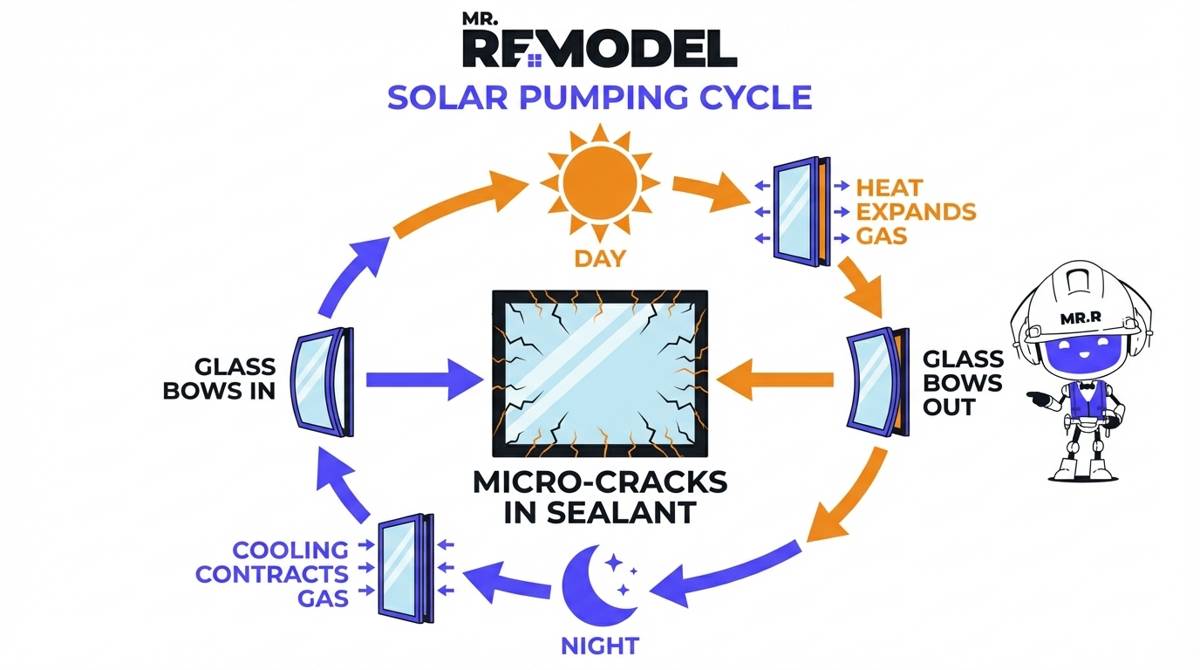
Why did the seal fail? It is likely due to a phenomenon called Solar Pumping.
During the day, the sun beats down on your window. The air or gas inside the panes heats up and expands. This pushes outward on the glass and the seals. At night, the temperature drops. The gas contracts and pulls the glass inward.
According to the Efficient Windows Collaborative, this daily cycle of expansion and contraction happens thousands of times over the life of the window. Eventually, the material fatigues, and a microscopic gap opens up. Moisture from the air gets sucked in during the contraction phase. Once inside, it condenses and turns into fog.
Regional Insight: Las Vegas and Phoenix
In extreme heat markets like Las Vegas and Phoenix, we see this happen much faster. The thermal stress is higher, causing the vinyl and the sealants to degrade prematurely. This is not a defect. It is simply physics winning over chemistry.
See Related: Why Are My Windows Foggy
Problem 2: The 5-Window Rule (Batch Failure)
One of the most critical insights from Mr. Remodel's data is the concept of Batch Failure.
Homeowners often view a broken window as an isolated incident, similar to a flat tire. You fix the flat and move on. However, windows are installed in batches. If you live in a tract home built in 2005, every window in your house was manufactured in the same month, shipped on the same truck, and installed by the same crew.
The Ticking Clock
If the seal on your kitchen window fails today, the seals on your living room and bedroom windows are statistically likely to fail within the next 12 to 24 months. They have all been subjected to the exact same environmental stresses.
The Economic Reality
Our data shows the average replacement project involves 5.5 windows. This is because homeowners realize that calling a contractor out five separate times is inefficient.
- Labor Costs: Contractors charge a minimum trip fee. You pay for setup, cleanup, and travel time. Doing one window five times costs significantly more than doing five windows once.
- Matching Issues: Window models change. If you replace one window today, you might not be able to find a matching frame style for the adjacent windows two years from now.
If you have one failure, inspect the rest of the house immediately. You are likely facing a systemic issue.
Problem 3: Drafts and Energy Loss
Drafts are the invisible thief of your bank account. You might not see a draft, but you certainly feel it.
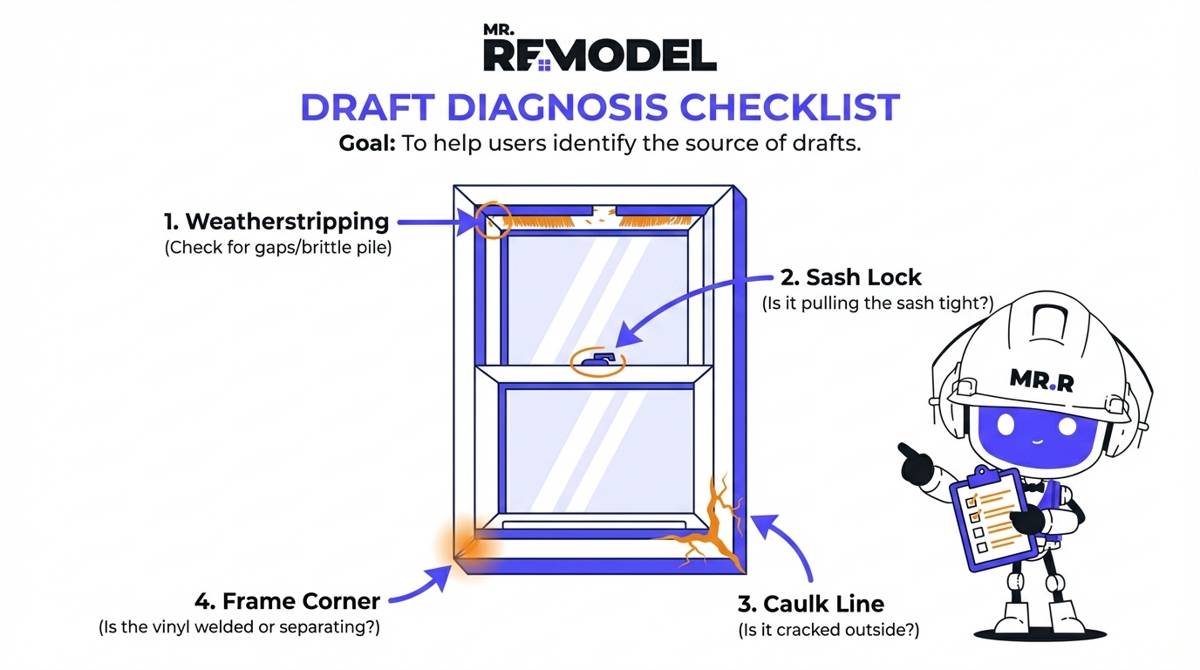
Causes of Drafts
- Weatherstripping Decay: The fuzzy material (pile) or rubber gaskets that seal the sash to the frame eventually wear out. They get compressed, brittle, or simply fall off.
- Frame Warping: Vinyl is a plastic. Over 20 years of hot summers and cold winters, it can warp or bow. If the frame bows away from the sash, it creates a gap that no amount of locking can close.
- Settling House: As your house foundation settles, the rough opening around the window can shift. The window frame gets squeezed or pulled out of square, breaking the air seal.
The Seasonal Spike
Our traffic data shows massive spikes in searches for "drafty windows" in January and September.
- September: The first cool breeze of autumn alerts you to the problem. This is the best time to act.
- January: The problem is now an emergency because your heating bill has doubled.
The Warning: If you feel a draft in September, do not ignore it. By January, lead times for new windows will be longer, and installation in freezing temperatures is more difficult. Fix the leak before the snow falls.
See Related: Drafty Windows Causes
Problem 4: Water Leaks (The Emergency)
While fog and drafts are annoying, water is dangerous. A water leak around a window is rarely a problem with the window itself. It is almost always a failure of the installation.
The Flashing Failure
Windows rely on flashing tape and proper integration with the home's water-resistive barrier (house wrap) to shed water. If the installer skipped the flashing tape or lapped it incorrectly (putting the top layer under the bottom layer), water will find its way in.
The 24-Hour Timeline
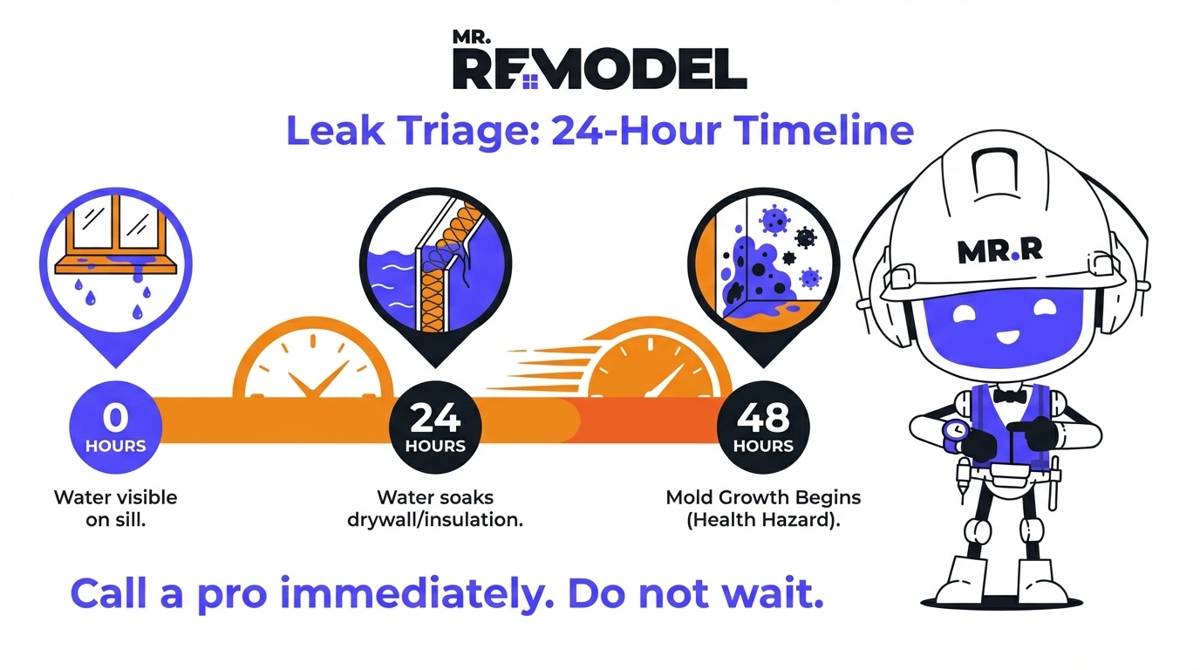
According to FEMA, mold can begin to grow on damp drywall and wood within 24 to 48 hours.
If you see water pooling on your sill or staining the drywall below the window, you cannot wait. This is not a "wait and see" situation.
Regional Insight: Florida & The South
In hurricane-prone areas, wind-driven rain can push water uphill. We see a high volume of leak reports in Florida, where standard "caulk and pray" installations fail during tropical storms. In these cases, 33% of our leads report needing help immediately. This is structural triage.
See Related: Water Leaks Around Windows
Problem 5: Physical Operation (The Safety Hazard)
Windows are also functional exits. In the event of a fire, a bedroom window must be openable to provide an escape route (egress).
Stuck Sashes
Double-hung windows use a balance system (either a spiral rod or a block-and-tackle pulley) to help lift the heavy glass. When these break, the window slams shut like a guillotine or refuses to open at all.
Broken Cranks
Casement window cranks utilize gears that can strip over time. If the gears strip while the window is closed, you cannot open it. If they strip while it is open, you cannot close it.
The Safety Imperative
While you might tolerate a foggy window, a stuck window is a code violation and a safety risk. InterNACHI (International Association of Certified Home Inspectors) notes that functional egress is a primary checkpoint during home inspections. If you are planning to sell your home, stuck windows will be flagged immediately.
Regional Nuances: The Climate Stress Factor
Your location determines how your windows will fail. Understanding your climate stress can help you choose a better solution for the replacement.
Denver and High Altitude: Pressure Cracks
In high-altitude areas like Denver or Salt Lake City, the atmospheric pressure is lower than at sea level. However, windows are manufactured at sea level and sealed with argon gas. When that window travels up the mountain, the gas inside wants to expand because the outside pressure is lower.
This can cause the glass to bow outward and eventually shatter. This is called a pressure crack. If you live in the mountains, your new windows must have capillary tubes or breather tubes installed to equalize the pressure.
The North: Freeze/Thaw Cycles
In the Midwest and Northeast, the danger is the freeze/thaw cycle. Water gets into small cracks in the caulk during the day. At night, it freezes and expands, widening the crack. Over a few winters, this destroys the exterior seal. This is why we recommend composite or fiberglass frames in the North, as they are more stable than vinyl.
The Coast: Salt Corrosion
If you live within 5 miles of the ocean, salt spray is your enemy. We frequently see aluminum windows in coastal areas that have pitted and corroded to the point where they can no longer operate. In these zones, vinyl or fiberglass with stainless steel hardware is the only viable option.
Cost Analysis: Repair vs. Replace
Let's look at the numbers. Is it ever worth it to repair?
The Repair Scenario:
You hire a handyman to defog two windows and replace the balances on a third.
- Defogging (drilling holes and cleaning): $200 per window.
- Balance Replacement: $150.
- Total Cost: $550.
- Result: You still have 20-year-old frames with low energy efficiency. The fog will likely return because the seal is still compromised.
The Replacement Scenario:
You replace those three windows with modern Energy Star Version 7.0 vinyl units.
- Cost: Approximate $600 to $800 per window installed.
- Total Cost: $2,100.
- Tax Credit: You get 30% back (up to $600).
- Net Cost: $1,500.
- Result: You have brand new windows, a lifetime warranty, lower energy bills, and increased home value.
While the upfront cost is higher, the repair money is essentially thrown away. It delays the inevitable. This is why 98% of people eventually choose the replacement path.
Frequently Asked Questions
Can I use a hair dryer to remove condensation?
If the condensation is on the surface (inside your room), a hair dryer will temporarily evaporate it. However, this does not solve the root problem, which is high humidity in your home. You need a dehumidifier. If the condensation is between the panes, a hair dryer will do nothing. The seal is broken, and the window needs to be replaced.
Is it safe to just caulk over a leak?
No. Caulking over a leak is like putting a band-aid on a bullet hole. If water is getting in, it is likely coming from behind the siding or through the top flashing. If you seal the bottom weep holes with caulk, you trap the water inside the wall, which accelerates rot and mold growth. You must identify the source of the water, which often requires removing the exterior trim.
My windows are only 10 years old. Why are they failing?
Builder-grade windows (the kind used in mass-market new construction) are designed to last about 10 to 15 years. They often use lower-grade sealants and thinner glass to save costs. It is frustrating, but it is common to see failures at the 10-year mark, especially in harsh climates.
Does home insurance cover broken window seals?
Generally, no. Insurance covers sudden, accidental damage (like a baseball through the glass or a storm breaking the window). It does not cover "wear and tear" or maintenance issues like seal failure. However, if the window was broken by a specific storm event, you should check your policy.
Stop Putting Band-Aids on Broken Bones
If you are dealing with window problems and solutions, the most honest advice we can give you is to look at the long game.
- If you have fog: The seal is dead. Plan for replacement.
- If you have a leak: It is an emergency. Call a pro immediately to save your drywall.
- If you have drafts: Your energy bills are bleeding money. Upgrade to modern standards.
Do not fall into the trap of spending hundreds of dollars on temporary fixes that will fail again next season. Join the 98% of smart homeowners who choose to invest in the solution rather than the symptom.
Mr. Remodel is ready to help you take the next step. We can connect you with local experts who can assess your specific situation and provide a quote for a permanent fix.
Stop the leaks and clear the fog today.