1-855-QUOTEMR


Table of Contents [hide]
Who This Is For
This guide is for homeowners who are annoyed by a hazy or milky window that they cannot clean. If you have tried vinegar, glass cleaner, and a squeegee but the fog remains, this article explains the physics of seal failure. It is designed to move you from the frustration of trying to clean it to the clarity of deciding whether to repair or replace the unit.
Key Takeaways
- It Is Not Dirt: If you cannot wipe the moisture off, it is inside the glass. This is a permanent failure of the factory seal.
- The Repair Myth: Our data shows that 98.3% of homeowners eventually choose replacement over repair. Defogging services are often cosmetic fixes that do not restore the window's insulation.
- Solar Pumping: Windows fail because the sun heats the gas inside, causing it to expand and push against the seal. Over 15 to 20 years, this constant expansion and contraction snaps the seal.
- The Domino Effect: Windows installed at the same time usually fail at the same time. If one window fogs up, the others are likely to follow. This is why the average project size is nearly 6 windows.
- Life Expectancy: According to InterNACHI, the standard life of a double-pane window is 15 to 20 years. Fog is simply a sign of natural expiration.
You wake up in the morning and look out the window, but the view is blurry. You grab a paper towel to wipe off the condensation, but the glass is dry to the touch. The moisture is trapped inside.
This is the most common and frustrating complaint we hear from homeowners. It is not a cleaning issue. It is a structural failure of your Insulating Glass Unit (IGU).
In the past, windows were just single panes of glass. Today, they are complex technologies. Two or three panes of glass are sealed together with a spacer bar, and the gap is filled with Argon or Krypton gas to stop heat transfer. When you see fog, it means that the vacuum seal has popped. The insulating gas has escaped, and standard air carrying moisture has been sucked in.
The Diagnostic Test: Is It Humidity or Failure?
Before you panic, you must confirm where the water is. ENERGY STAR provides a simple way to diagnose the issue.

1. Surface Condensation (Fixable)
Run your finger over the fog. Is the glass wet?
- If inside the house: Your indoor humidity is too high. Run a dehumidifier or a bath fan.
- If outside the house: This is actually a good sign. It means your windows are insulating well and the exterior glass is cold (dew point).
2. Seal Failure (Permanent)
Run your finger over the fog. Is the glass dry?
- If the moisture, haze, or white mineral deposits are trapped between the two panes of glass, you have a broken seal. No amount of cleaning will fix this.
The Science: Why Seals Break
Windows do not just break for no reason. They fail due to a phenomenon called Solar Pumping.
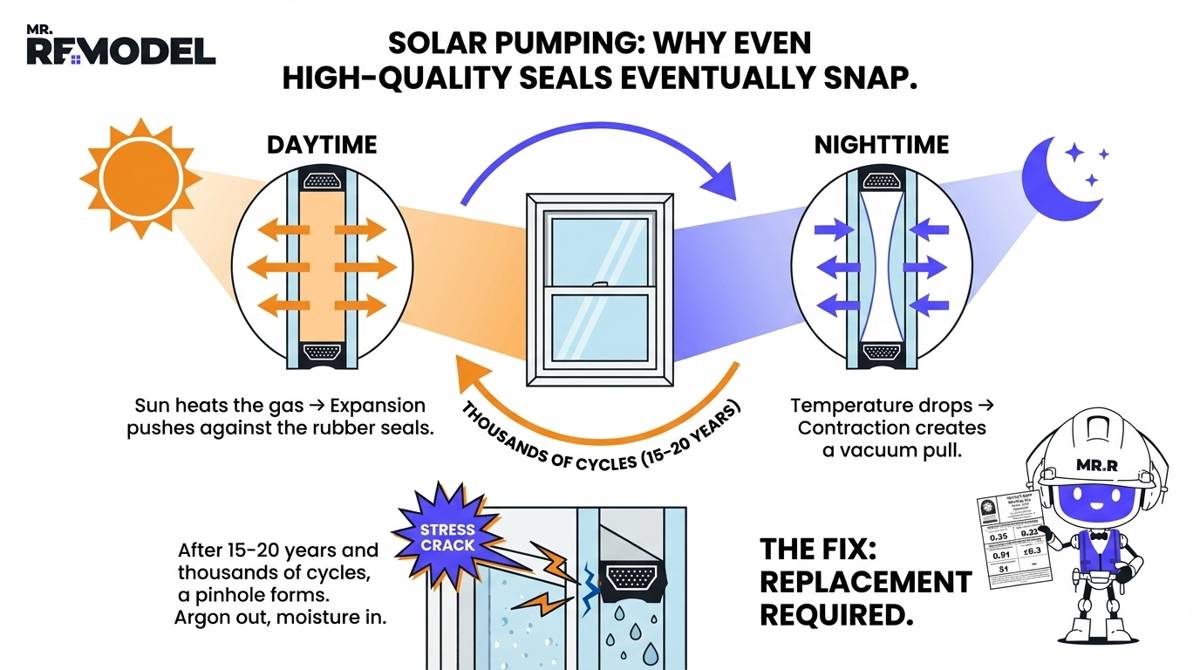
According to building science research from the University of Massachusetts Amherst, double-pane windows act like a lung.
- Daytime: The sun hits the window. The gas inside heats up and expands. This pushes outward against the rubber seals.
- Nighttime: The temperature drops. The gas contracts. This pulls inward, creating a vacuum effect.
Over the course of 15 to 20 years, this daily cycle stresses the material thousands of times. Eventually, the seal creates a microscopic pinhole. Once that happens, the Argon gas leaks out, and moist air is drawn in. When that air cools down at night, it condenses into the fog you see.
The Repair vs. Replace Debate
When homeowners realize the seal is broken, their first instinct is to fix it. They search for defogging kits or repair services.
However, Mr. Remodel data reveals a stark reality. Only 1.7% of our users successfully pursue a repair option. The overwhelming majority (98.3%) choose replacement.
Why Repair Fails
The Fenestration & Glazing Industry Alliance (FGIA) explains that an IGU is a factory-sealed system. Defogging involves drilling holes in the glass, spraying in a cleaning solution, and installing little vents to let the moisture dry out.
- Pros: It might look better cosmetically.
- Cons: It does not put the Argon gas back in. It does not restore the R-Value. You still have a window with zero insulation value. It essentially turns a double-pane window into two single panes with dirt in the middle.
See Related: When Repairs Are Not Worth It
The Domino Effect: Why Windows Fail in Batches
You might think you only have one bad window. But windows are like lightbulbs. If you installed them all on the same day, they will likely expire around the same time.
Our data shows the average replacement project size is 6 windows. Homeowners rarely stop at just the foggy one. They realize that the seal failure in the kitchen is a warning sign for the living room and bedroom.
According to InterNACHI, the estimated life expectancy of a double-pane window is 15 to 20 years. If your home was built in 2005, your windows are reaching their natural end of life. Replacing them in a batch is often cheaper per window than calling a contractor out six separate times over two years.
Regional Differences
Your climate dictates how fast this process happens.
- Florida and Texas: The extreme heat creates violent expansion in the solar pumping cycle. Windows here often fail faster (10 to 15 years) if they are not high-quality.
- Northern Climates: The stress comes from the freeze/thaw cycle. Ice forming on the seal can wedge it open over time.
According to the Efficient Windows Collaborative, durability depends on the quality of the spacer bar. Cheaper aluminum spacers conduct heat and fail faster than modern "warm edge" foam spacers.
See Related: Window Problems and Solutions
Cost Analysis: Is Replacement Worth It?
If you cannot repair the seal, you have two replacement options.
- Glass-Only Replacement: A glazier measures the glass unit and swaps it out, leaving the vinyl or wood frame in place. This is cheaper but assumes your frame is in perfect condition.
- Full Window Replacement: You replace the entire unit (frame and glass).
According to industry data, the average cost for a replacement window is between $600 and $1,000. While a defogging repair might cost $200 to $300, it offers zero return on investment regarding energy savings. A new window restores your energy efficiency and comes with a new 20-year warranty on the seal.
See Related: Window Replacement Methods
Frequently Asked Questions
Can I fix a foggy window myself?
No. The fog is trapped between two sealed panes of glass. You cannot take the panes apart to clean them. Once the seal is compromised, the only way to permanently fix the view and the insulation is to replace the glass unit or the entire window.
Does a foggy window mean I am losing heat?
Yes. The fog indicates that the insulating Argon gas has escaped and has been replaced by regular air. Moist air conducts heat much faster than dry Argon. This means your window has lost its thermal efficiency, and your furnace or AC is working harder.
Will my warranty cover seal failure?
It depends on the age of the window. Most major manufacturers offer a 10-year or 20-year warranty on seal failure. If you are the original owner and the window is within this timeframe, the manufacturer may provide a replacement glass unit for free (though you usually have to pay for labor). Check the label on the top of the window frame to find the serial number.
Why do my brand-new windows have condensation?
If your new windows have condensation on the inside surface (room side), it is not a defect. It actually means they are working too well. Old windows were drafty and let dry outside air in. New windows are airtight, trapping your household's humidity. You need to lower your indoor humidity by using fans or a dehumidifier.
Conclusion: Don't Fight the Fog
A foggy window is a sign of a dead window. While it might be tempting to look for a quick fix, the data proves that seal failure is a terminal condition for the glass unit.
For 98.3% of homeowners, the solution is replacement. This restores the view, the energy efficiency, and the value of the home.
Mr. Remodel can help you assess the rest of your windows. If one seal has failed, others are likely close behind. We connect you with local professionals who can inspect your home and provide a quote for batch replacement.
Get a quote to clear up your view.