1-855-QUOTEMR

Table of Contents [hide]
Who This Is For:
Homeowners replacing aging siding, building a new home, comparing multiple siding materials, or trying to find the best long-term value for their budget, climate, maintenance goals, and home style.
Key Takeaways:
- There Is No One Best Siding: The right choice depends on climate, budget, maintenance, durability, and design goals.
- Vinyl Leads Tracked Demand: Vinyl generated 4,057 Mr. Remodel siding inquiries, or about 69% of tracked siding inquiries.
- Replacement Is a Major Decision Point: Installation accounts for 5,462 inquiries, or about 92% of siding demand.
- Long-Term Costs Matter: Maintenance, repainting, repairs, and lifespan can change the true value of each material.
- Quotes Should Be Detailed: Compare materials, labor, warranties, house wrap, flashing, trim, cleanup, and hidden repair terms.
Choosing new siding is not just about picking a color. It affects your home’s curb appeal, weather protection, maintenance needs, energy performance, and long-term value.
For many homeowners, learning how to choose the best siding starts with one important truth: there is no single best material for every home. The best siding depends on your climate, budget, home style, maintenance expectations, and how long you plan to stay in the house.
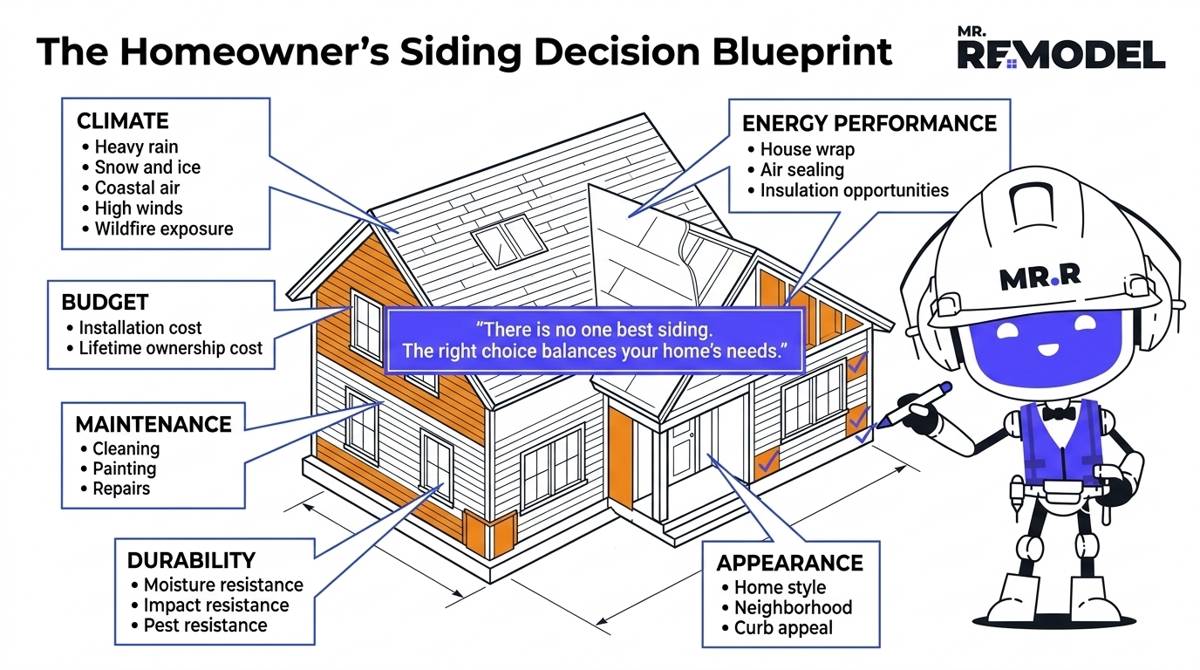
Factors to Consider Before Choosing Siding
Before comparing siding materials, start with the conditions that matter most for your home. A material that works well in one region may be a poor fit somewhere else.
Climate
Climate should be one of your first filters. Rain, humidity, heat, freezing weather, salt air, hail, and wildfire risk can all affect siding performance.
The Federal Emergency Management Agency (FEMA) explains siding and exterior wall considerations for coastal, high-wind, and severe-weather areas in its Home Builder’s Guide to Coastal Construction. Homeowners in harsh climates should ask contractors how each material performs locally.
Budget
Your budget should include more than the first installation price. A cheaper material may cost less today but require more repairs or replacement later.
A higher-cost material may be worth it if it lasts longer, needs less maintenance, or improves curb appeal.
Maintenance
Some siding materials need regular painting, staining, sealing, or caulking. Others mostly need cleaning and inspection.
Be honest about how much maintenance you want to manage. Low-maintenance siding is usually better for homeowners who do not want regular exterior upkeep.
Durability
Durability depends on material quality, installation, climate, and maintenance. Strong siding should resist the problems most common in your area, such as moisture, pests, impact, sun exposure, or fire risk.
The National Association of Home Builders (NAHB) Life Expectancy of Home Components can help homeowners think about exterior materials as long-term home components instead of one-time purchases.
Appearance
Siding should match the home’s architecture. A historic home may need wood or a wood-look product. A modern home may look better with metal, fiber cement panels, or mixed materials.
Do not choose siding only because it looks good on another house. It should fit your home’s shape, neighborhood, trim, roof, and windows.
Energy Efficiency
Siding alone is not an insulation system, but siding replacement can be a good time to review the wall assembly. House wrap, air sealing, insulation, flashing, and moisture control can all affect comfort.
The United States Department of Energy’s Energy Saver design guidance explains how exterior upgrades fit into a home’s broader energy performance.
Compare the Most Popular Siding Materials
Most homeowners compare siding by cost, lifespan, maintenance, and appearance. Use this table as a starting point before getting local quotes.
These are industry planning ranges, not guarantees. Actual cost and lifespan depend on product quality, installation, climate, maintenance, and local labor.
Which Siding Material Fits Your Priorities?
Instead of asking, “What is the best siding?” ask, “What is the best siding for my goal?” That makes the decision easier.
Best for Affordability
Vinyl is often the most practical choice for affordability. It is widely available, usually costs less than premium materials, and does not need painting.
That helps explain why vinyl generated 4,057 inquiries in the Mr. Remodel dataset. It is the most requested tracked siding material by a wide margin.
See Related: Types of Siding
Best for Low Maintenance
Vinyl and metal are often among the lowest-maintenance options. They still need cleaning and inspection, but they do not require the same routine painting or staining as wood.
Fiber cement and engineered wood can also be manageable, but they may need repainting or finish care over time.
Best for Durability
Fiber cement and metal are often strong choices when durability matters. Fiber cement may appeal to homeowners who want a wood-like look with fire resistance and rot resistance.
James Hardie’s Why Hardie resource explains fiber cement performance and durability from a manufacturer's perspective. Homeowners should still compare multiple products and contractor recommendations before deciding.
Best for Natural Appearance
Natural wood offers the most authentic look. It has real grain, warmth, and character that manufactured products try to copy.
The United States Department of Agriculture (USDA) Forest Products Laboratory’s Wood Handbook explains wood durability, moisture behavior, and decay considerations, which are important when choosing wood siding.
Best for Wood-Like Appearance With Less Upkeep
Fiber cement and engineered wood are often the main options to compare. Fiber cement is heavier and often more fire-resistant. Engineered wood is lighter and may offer a warmer, more natural texture.
Both need proper installation and maintenance.
Best for Severe Climates
The best siding for severe climates depends on the specific risk.
For wildfire-prone areas, fiber cement, stucco, and metal may be worth comparing. For coastal regions, moisture management and wind resistance are critical. For cold climates, freeze-thaw performance matters.
Local contractor experience is especially important in harsh climates.
Planning a siding replacement? Get a free quote from fully vetted local siding contractors.
Common Mistakes When Choosing Siding
A siding project is too important to choose based on price alone. The lowest quote may leave out key details, and the most expensive material may not be the best fit for your home.
Choosing Only by Price
A low price can be attractive, but it may not include removal, repairs, house wrap, flashing, trim, disposal, or cleanup.
Always ask what is included.
Ignoring Climate
Climate affects siding more than many homeowners realize. A material that performs well in a dry area may struggle in wet, coastal, or freeze-thaw conditions.
Ask contractors what they install most often in your region and why.
Overlooking Maintenance
Wood can look beautiful, but it requires regular upkeep. Fiber cement and engineered wood may need repainting. Vinyl and metal are usually lower maintenance, but they still need inspections.
Choose a material that matches the upkeep you are willing to handle.
Not Comparing Warranties
Product warranties and labor warranties are different. A strong product warranty may not cover poor installation.
Ask what is covered, how long coverage lasts, and what can void the warranty.
Ignoring the Home’s Architecture
The siding should fit the home’s design. A material can be durable and still look wrong if it does not match the home’s style.
Hiring Without Multiple Estimates
A single quote does not give enough context. Compare at least a few estimates to understand the price, scope, material options, and installation details.
How to Compare Siding Quotes
Once you narrow your siding choices, compare contractor quotes carefully. Two quotes can look similar at first but include very different work.
Compare Material Details
Ask for the exact siding product, profile, color, thickness, finish, trim package, and warranty.
Do not accept a vague quote that only says “vinyl siding” or “fiber cement siding.”
Compare Labor and Preparation
Ask whether the quote includes the removal of old siding, disposal, wall inspection, sheathing repairs, flashing, trim work, and cleanup.
Hidden damage can change the final cost. A good contractor should explain how those repairs are handled.
Compare Weather Protection
Ask about house wrap, flashing, drainage, caulking, and clearances. These details help protect the wall system behind the siding.
Good siding can fail early if the wall assembly is not handled correctly.
Compare Energy and Comfort Options
Some homeowners add insulation, air sealing, or other exterior upgrades during siding replacement.
These upgrades may not be necessary for every home, but they are worth discussing when old siding is already being removed.
Compare Warranty Coverage
Ask for both the manufacturer's warranty and the contractor’s workmanship warranty. Make sure you understand what is covered and what maintenance is required.
See Related: Siding Replacement Guide
Why Most Homeowners Choose Siding During Installation
Most homeowners choose siding materials during larger installation or replacement projects. That matches Mr. Remodel data.
The dataset includes 5,462 installation inquiries and 445 repair inquiries. Installation accounts for about 92% of siding demand.
This shows that material selection typically occurs when homeowners make a larger exterior investment.
That is the right time to compare cost, durability, maintenance, style, and long-term value.
Frequently Asked Questions
What is the best siding for a house?
The best siding depends on your climate, budget, maintenance goals, and home style. Vinyl is often best for affordability, fiber cement for durability, engineered wood for wood-like texture, natural wood for authentic character, metal for modern strength, and stucco for certain warm or dry climates.
Which siding lasts the longest?
Metal, fiber cement, stucco, brick veneer, and well-maintained wood can all last for decades. Actual lifespan depends on installation quality, product quality, moisture control, climate, and regular maintenance.
What is the lowest-maintenance siding?
Vinyl and metal are often among the lowest-maintenance siding options because they do not require routine painting like wood. Fiber cement and engineered wood may also be manageable, but they can require repainting or finish care over time.
Which siding offers the best value?
Vinyl often offers strong value for budget-conscious homeowners because it is affordable and low-maintenance. Fiber cement, engineered wood, metal, and wood may offer better value for homeowners who prioritize curb appeal, durability, or long-term performance.
How do I know which siding is right for my climate?
Start by identifying your biggest local risks, such as moisture, heat, cold, salt air, hail, wind, or wildfire exposure. Then compare materials based on those risks and ask local siding contractors which products perform best in your area.
How to Choose the Best Siding: Final Takeaway
There is no universally best siding for every home. Vinyl is popular because it is affordable and low-maintenance. Fiber cement offers premium durability. Engineered wood gives homeowners a wood-like look. Natural wood offers authentic character. Metal and stucco can work well in the right homes and climates.
The best choice depends on your budget, climate, maintenance expectations, home style, and contractor quality. To compare siding materials and installation options, connect with fully vetted local siding contractors.