1-855-QUOTEMR

Table of Contents [hide]
Who This Is For
This guide is for homeowners, real estate investors, and property managers who need a data-driven breakdown of window replacement costs. It is specifically designed for those weighing the upfront investment against long-term energy savings and resale value.
Key Takeaways
- Average Resale Recovery: Modern window replacements typically recoup between 60% and 75% of their cost at the time of a home sale.
- Energy Efficiency Gains: Upgrading to high-performance units can reduce annual heating and cooling costs by 12% to 33%.
- Investment Benchmarks: The median project cost stands at $13,548.50, though regional factors in states like Colorado or Nevada cause significant variance.
- Tax Incentives: Federal tax credits can provide an immediate return on investment by offsetting a portion of the installation costs.
According to the U.S. Department of Energy, heat gain and heat loss through windows are responsible for roughly 25% to 30% of residential heating and cooling energy use. This staggering statistic highlights why window replacement is more than an aesthetic choice. It is a fundamental financial decision for your household.
Homeowners often view new windows as a massive expense. However, when you analyze the data, the perspective shifts from a sunk cost to a strategic capital improvement. This guide uses market data and internal metrics to explain exactly how that math works.
Understanding the True ROI of Window Replacement
Return on Investment (ROI) for home improvements is measured in two ways. First, there is the immediate reduction in monthly utility bills. Second, there is the increase in your home equity or final sales price.
Most industry reports suggest that homeowners recover a significant portion of their costs. While 60% to 75% is the national average, your specific return depends on the materials you choose and the climate where you live.
The Immediate Return: Energy Savings and Tax Credits
Energy efficiency is the most consistent contributor to window ROI. High-quality windows create a tighter thermal envelope. This means your HVAC system does not have to work as hard to maintain a comfortable temperature.
Scientific research from the Lawrence Berkeley National Laboratory shows that advanced glazing and frames significantly reduce thermal transfer. These savings compound every month that you own the home.
Additionally, the ENERGY STAR program highlights available federal tax credits for window upgrades. These incentives provide an immediate financial kickback that reduces your effective initial investment. You should always check current federal limits before finalizing your purchase.
Breaking Down Your Window Investment
According to Mr. Remodel data, the average window replacement project currently costs $16,511.21. However, the average is often skewed by luxury installations. The median project cost of $13,548.50 is a more realistic benchmark for most American households.
The Unit Economics of Window Replacement
ROI is often calculated per house, but it is more accurate to look at it per unit. Our data shows that the average cost per window is $3,208.40. This figure includes both the high-quality materials and the professional labor required for a proper seal.
|
Project Scale |
Average 2025 Cost |
Strategic Impact on ROI |
|
Small (4 Units) |
$10,707 |
Lower entry cost; best for immediate repair needs. |
|
Medium (7 Units) |
$16,511 |
Balance of cost and energy performance. |
|
Large (10+ Units) |
$25,851 |
Highest total cost, but offers the best energy efficiency gains. |
How Project Scaling Impacts Your Financial Return
There is a common misconception that replacing windows one by one is cheaper. In reality, the ROI often improves when you scale the project. This is because fixed costs, such as labor mobilization and shipping, are distributed across more units.
As shown in the table above, a 10-unit project costs roughly $25,851. While the total is higher, the cost per unit and the resulting energy savings provide a faster path to breaking even. Replacing all windows at once also ensures a uniform look, which is vital for resale value.
If you are ready to see how these numbers apply to your specific home, you can get a professional assessment. Mr. Remodel provides free quotes and connects homeowners to local contractors who can provide detailed cost breakdowns for your specific project scale.
Regional Variance: Why Location Dictates ROI
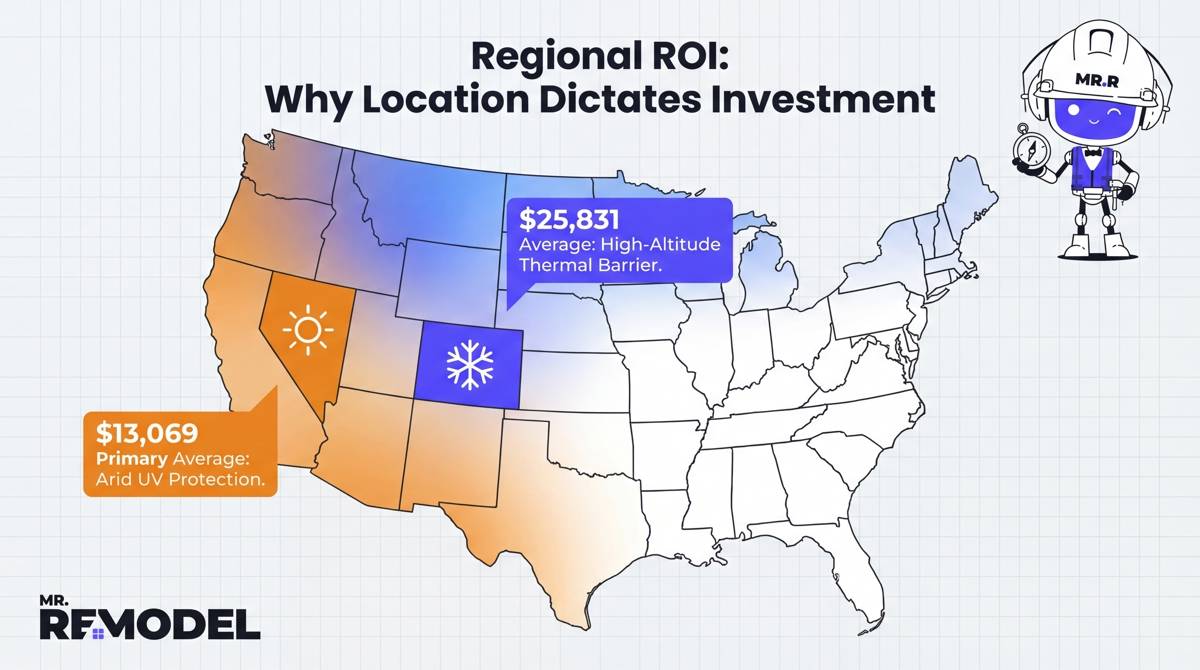
The value added by new windows is not the same in every state. Regional climates and local labor markets create "investment floors" that homeowners must navigate. Our data highlights a massive gap between different parts of the country.
High-Cost Markets: The Colorado Example
In Colorado, the average project cost is $25,831. This higher price point is driven by the need for windows that can withstand extreme temperature fluctuations and high altitudes.
While the upfront cost is higher, the ROI in Colorado is often faster. This is because the energy savings are more dramatic in climates with harsh winters. A high-efficiency window in a cold climate pays for itself much quicker than one in a temperate zone.
Low-Cost Markets: The Nevada Example
Conversely, our data shows that the average investment in Nevada is $13,069. Lower entry costs in states like Nevada make the value add to the home price more significant.
In these markets, a modest investment can lead to a higher percentage of cost recovery at resale. Buyers in hot, sunny climates prioritize windows that block UV rays and reduce cooling costs.
The Psychological ROI: The Joy Score
Data from the National Association of Realtors introduces a concept called the "Joy Score." This measures how much satisfaction homeowners get from a completed project. Window replacement consistently ranks high in this category.
New windows improve soundproofing, ease of operation, and interior lighting. While these factors do not appear on a balance sheet, they contribute to the overall desirability of the home. A home that feels quiet and bright will always sell faster than one that feels drafty and dated.
Maximizing Your ROI: Best Practices
To ensure you get the best possible return on your investment, follow these data-backed strategies:
- Prioritize Performance over Price: Choosing the cheapest window often leads to seal failure within five years. This destroys your long-term ROI.
- Look for Low-E Coatings: Low-emissivity (Low-E) glass reflects infrared light, keeping heat inside in the winter and outside in the summer.
- Check Installation Credentials: Even the most expensive window will fail if installed poorly. Professional installation is non-negotiable for maintaining the manufacturer's warranty.
- Bundle Your Improvements: If you are already doing siding or roofing, bundling window replacement can sometimes lower labor costs.
Frequently Asked Questions About Window ROI
1. How long does it take for new windows to pay for themselves?
The timeline varies based on your local utility rates and the efficiency of your old windows. Generally, most homeowners see a full breakeven point through energy savings and home value increases within 7 to 12 years.
2. Which window material offers the best ROI?
Vinyl windows currently offer the best balance of cost and performance. They are durable, require little maintenance, and have a lower upfront cost than wood or fiberglass, leading to a higher percentage of cost recovery.
3. Can I get a tax credit for window replacement?
Yes, windows that meet specific ENERGY STAR requirements are often eligible for federal tax credits. You should consult a tax professional or visit the ENERGY STAR website to see the current credit limits for your specific zip code.
4. How do I know if I am getting a fair price for my installation?
The best way to ensure a fair price is to compare multiple local bids. Platforms like Mr. Remodel help by matching you with contractors who are vetted for quality and price transparency in your local market.
5. Does replacing only a few windows still improve home value?
While any improvement helps, partial replacements often have a lower ROI than full-house upgrades. Home buyers prefer consistency. Having a mix of old and new windows can sometimes signal that the home has been maintained "piecemeal" rather than comprehensively.
Is the Investment Worth It?
The data is clear: window replacement remains one of the most reliable home improvements. With a median investment of $13,548.50 and an average resale recovery of up to 75%, the financial risks are well-mitigated by long-term gains.
When you factor in the 12% to 33% reduction in energy bills and the immediate benefit of federal tax credits, the decision becomes even more compelling. Whether you are in a high-cost market like Colorado or a more affordable area like Nevada, the key is professional installation and high-performance materials.
Ready to start your project? Mr. Remodel provides free quotes and connects homeowners to local contractors to ensure you get the best value for your investment. Don't leave your home's efficiency to chance.