1-855-QUOTEMR

Table of Contents [hide]
Who This Is For
This guide is for homeowners who want to modernize their bathroom while reducing their environmental footprint and monthly utility bills. If you are debating between a tub conversion and a standard renovation, or if you are looking for the latest 2026 rebate information for low-flow fixtures in your state, this comprehensive resource provides the financial and performance data you need.
Key Takeaways
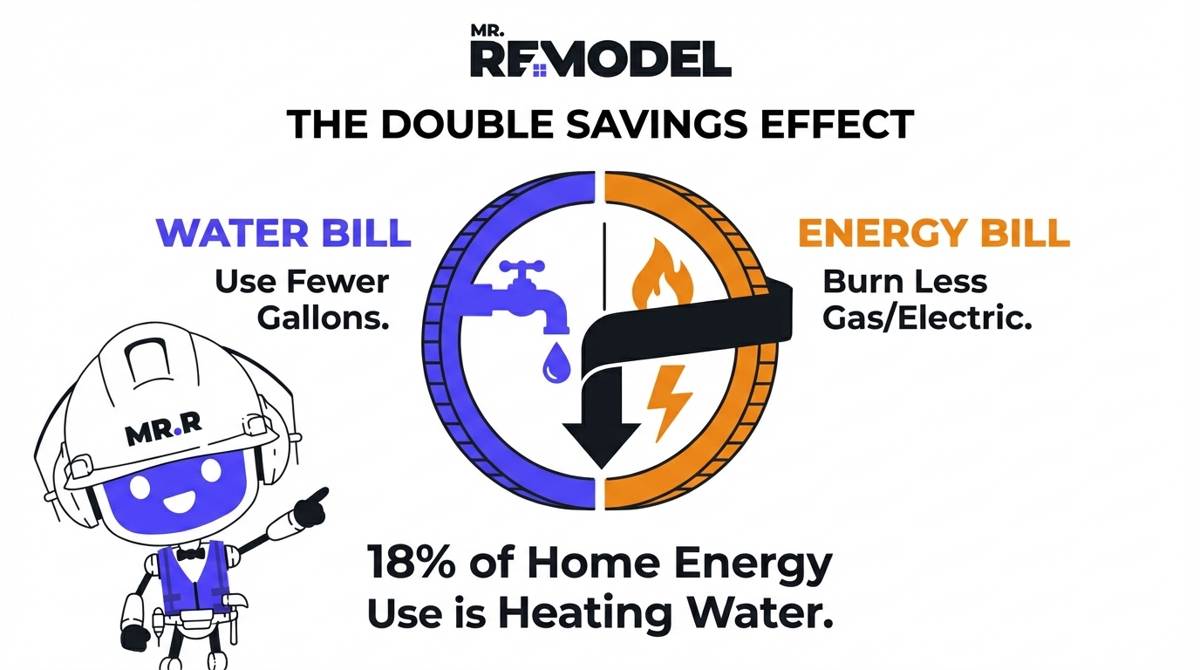
- Hot Water is Energy: Saving water is not just about the wet stuff. Heating water accounts for 18% of your home's energy usage, so efficient fixtures can significantly lower your gas or electric bill.
- Tub Conversions are Efficient: Converting a standard bathtub to a walk-in shower is a primary strategy for efficiency. A 10-minute low-flow shower uses less than half as much water as a standard bath.
- Performance Has Improved: The days of weak pressure are over. EPA WaterSense-labeled showerheads now use air-induction technology to maintain high pressure while cutting water use by 20%.
- Rebates are Local: While some federal incentives exist, the best financial rewards for toilets and fixtures are found at the municipal level, specifically in drought-prone areas like Denver and the Southwest.
- Ventilation Matters: An efficient bathroom requires proper moisture control. High-humidity environments force your HVAC system to work harder, negating other efficiency gains.
When most people think about energy-efficient bathroom remodeling, they immediately picture a low-flow toilet or perhaps a showerhead that trickles rather than sprays. This outdated image ignores the massive technological leaps the industry has taken in the last five years. Modern efficiency is no longer about sacrifice. It is about high-performance engineering that delivers a spa-like experience while silently reducing your utility consumption.
The bathroom is the largest water consumer in your home, but it is also a massive energy hog. According to the Department of Energy, water heating accounts for approximately 18% of your home's total energy use. This is the second largest energy expense in your house, right behind heating and cooling the air. Every time you turn on a hot tap, you are paying for both the water itself and the energy required to heat it.
Therefore, a truly efficient remodel attacks the problem from two angles. It reduces the volume of water used, and it reduces the demand on your water heater. Whether you are in the Pacific Northwest looking to lower electric bills or in the arid Southwest trying to navigate strict drought restrictions, the strategies in this guide will help you build a bathroom that pays you back.
The Hidden Cost: Why Hot Water Is the Real Target
The most common misconception in bathroom renovation is that you are only saving gallons of water. While conserving water is noble, the financial return on investment (ROI) comes primarily from energy savings.
The Double Savings Effect
When you install a high-efficiency showerhead, you achieve what we call the Double Savings Effect.
- Water Bill Reduction: You pay for fewer gallons of municipal water.
- Energy Bill Reduction: You pay for fewer therms of gas or kilowatts of electricity because your water heater has less work to do.
This is why focusing solely on the toilet (which uses cold water) gives you a partial victory. To maximize your ROI, you must focus on the hot water fixtures: the shower and the vanity faucet.
See Related: How Much Energy a Bathroom Remodel Can Save
Tub-to-Shower Conversions: The Modern Efficiency Standard
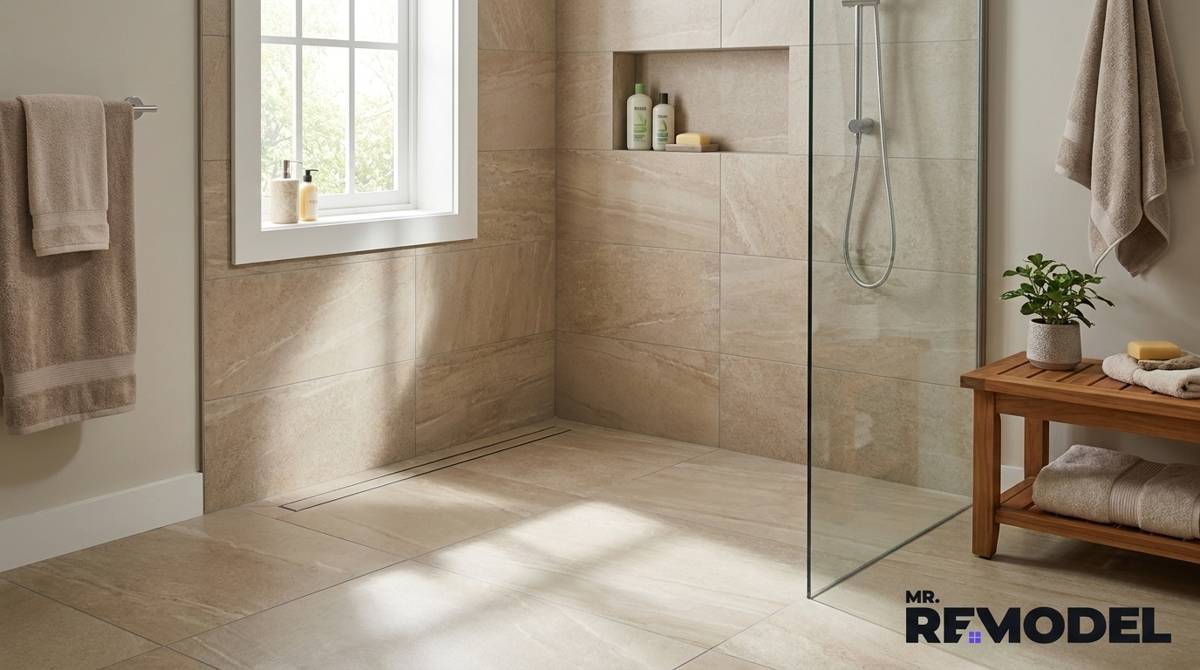
One of the most significant trends we see in Mr. Remodel data is the shift away from traditional bathtubs. In 2026, approximately 53% of our bathroom leads are specifically requesting tub-to-shower conversions. While many homeowners do this for accessibility or modern aesthetics, it is also one of the most effective energy moves you can make.
The Math Behind the Conversion
The U.S. Geological Survey (USGS) provides clear data on this comparison.
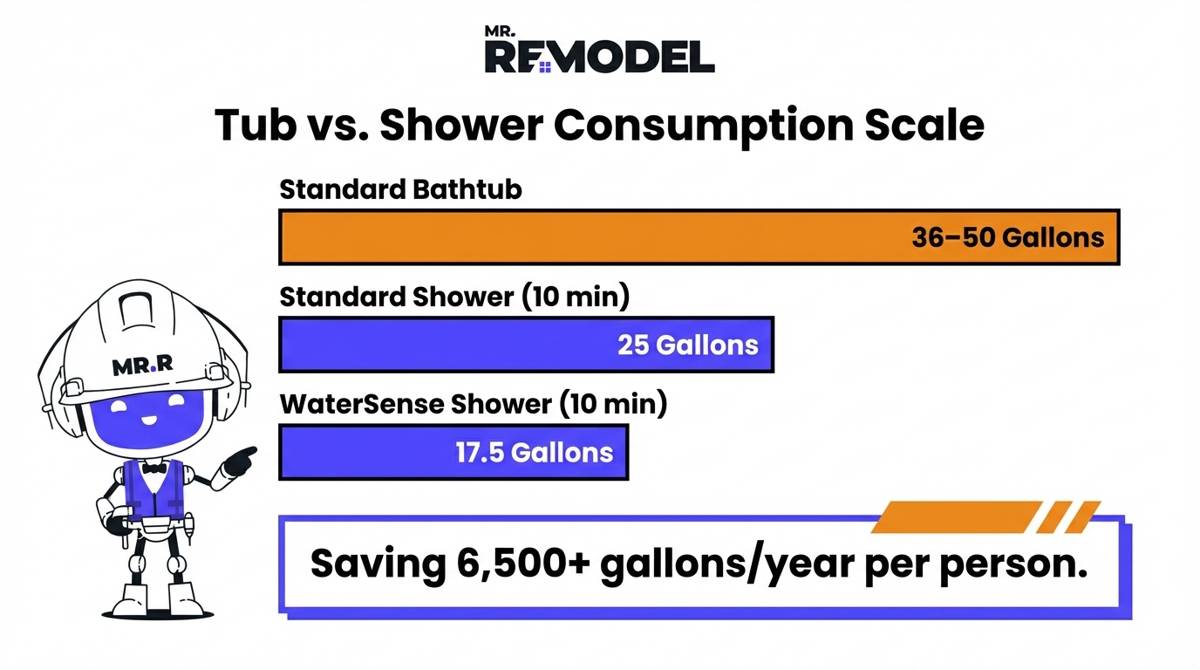
- Standard Bathtub: Requires 36 to 50 gallons to fill.
- Standard Shower (2.5 GPM): A 10-minute shower uses 25 gallons.
- WaterSense Shower (1.75 GPM): A 10-minute shower uses 17.5 gallons.
By converting a tub used daily to an efficient walk-in shower, a single person saves over 6,500 gallons of heated water per year. For a family of four, the savings are astronomical. This aligns perfectly with the aesthetic trends of 2026, where large, glass-enclosed showers are preferred over unused soaking tubs.
See Related: Energy Efficient Bathroom Remodel Ideas
Understanding WaterSense and Fixture Performance
Many homeowners fear that "efficient" is code for "weak." They worry that installing a low-flow showerhead means struggling to rinse shampoo out of their hair. This fear is based on technology from the 1990s. Today, the EPA WaterSense label guarantees both efficiency and performance.
The Performance Test
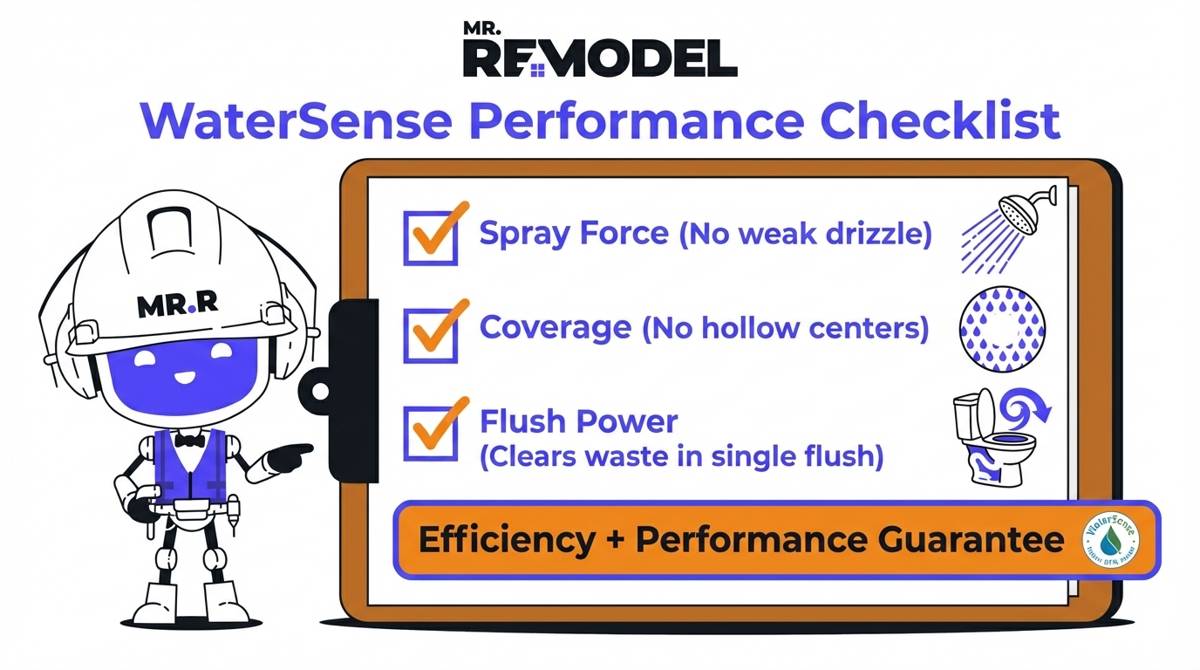
To earn the WaterSense label, a product must do more than just use 20% less water than the federal standard. It must also pass rigorous performance testing.
- Showerheads: Must prove they can provide adequate spray force and coverage. They are tested to ensure they do not mist or lose temperature before hitting your skin.
- Faucets: Must provide enough flow for washing hands and shaving without splashing.
- Toilets: Must clear a specific amount of waste in a single flush without clogging.
Air Induction Technology
The secret to this performance is air induction. Manufacturers now design showerheads that suck air into the water stream. This aerates the water, creating larger, heavier droplets that hit your skin with more force. You feel like you are standing under a deluge, but the actual volume of water passing through the pipes is significantly lower.
See Related: Water Saving Toilets and Fixtures Explained
Bath Showers: Choosing the Right Hardware
Once you commit to the shower, you must select the right hardware to maximize these savings without sacrificing pressure.
Standard High-Efficiency (2.0 GPM)
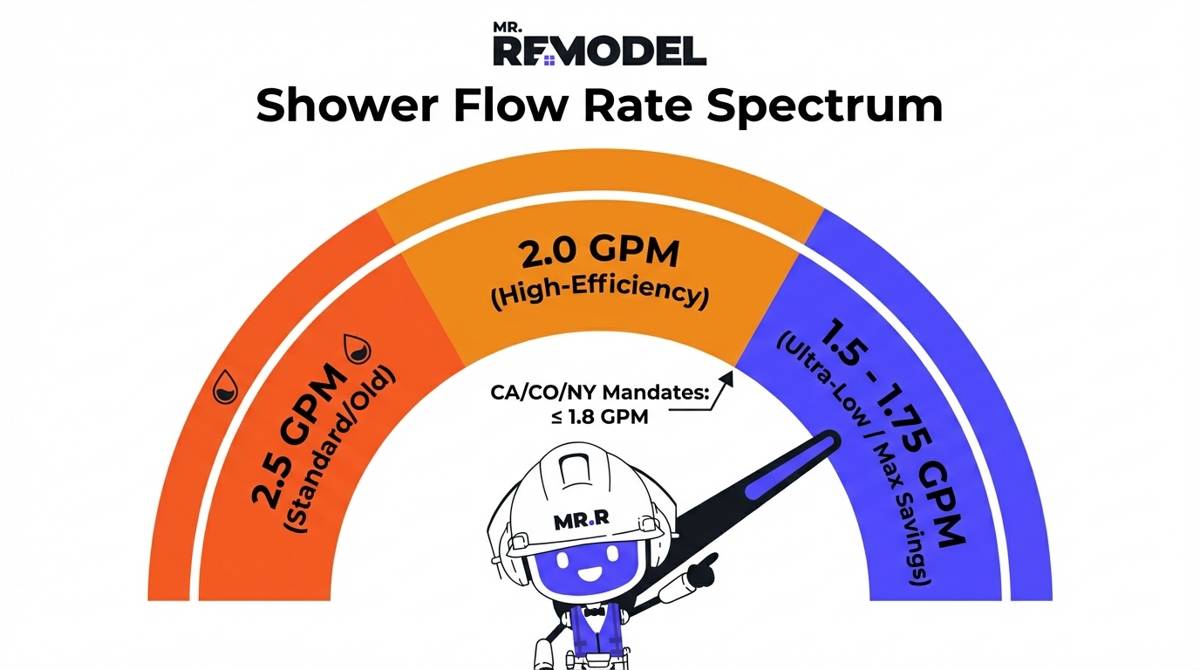
This is the new market baseline. Manufacturers like Kohler and Moen engineer these heads to feel exactly like older, wasteful models. They meet the code requirements for most of the country and offer a traditional, drenching spray pattern.
Ultra-Low Flow (1.5 to 1.75 GPM)
These are the true money savers. By dropping to 1.5 GPM, you maximize your energy ROI. These units rely heavily on air-induction technology (injecting air into the water stream) to increase the droplet size and velocity. This trick of physics makes the water feel "harder" and hotter, even though you are using less of it.
Regional Restriction Note: If you live in California, Colorado, or New York, you likely do not have a choice. State plumbing codes in these efficiency hotspots often mandate fixtures of 1.8 GPM or lower for all new installations. Always check your local code before falling in love with a massive rain shower head that might be illegal to install in your zip code.
See Related: Low Flow Showers vs Standard Showers
The Toilet Revolution: Beyond the Low Flow
The toilet is the workhorse of water conservation. Older toilets (pre-1994) can use up to 6 gallons per flush (GPF). The current federal standard is 1.6 GPF. However, the market has moved well beyond that.
Dual Flush Technology
Dual flush toilets offer two buttons: a partial flush (usually 0.8 or 1.0 GPF) for liquid waste and a full flush (1.28 or 1.6 GPF) for solid waste. This puts the control in your hands and can save the average family 4,000 gallons per year.
Ultra-High-Efficiency Toilets (UHET)
These units use 1.28 GPF or less for every flush. They are highly recommended for drought-prone regions. To achieve this without clogging, they often use a wider trapway (the pipe at the bottom of the bowl) and a glazed interior to reduce friction.
Mr. Remodel Data Insight: In the Mountain West region, specifically Utah and Colorado, we see a huge uptake in UHET installations. This is driven partly by environmental consciousness and partly by aggressive local rebates.
If you’re ready for an energy-efficient home update, let Mr. Remodel connect you with local contractors who understand the specific plumbing codes and efficiency opportunities in your zip code. Don't leave money on the table. Get your free quote from us today.
Ventilation: The Forgotten Efficiency Factor
You cannot have an energy-efficient bathroom without proper ventilation. This might seem counterintuitive. How does a fan save energy?
High humidity is the enemy of your home's thermal envelope. If moisture from your shower stays in the bathroom, it seeps into the drywall and insulation. Wet insulation loses its R-value (insulating power), making your home harder to heat and cool. Furthermore, high indoor humidity forces your air conditioner to work harder in the summer to remove that latent heat from the air.
The Solution: Humidity-Sensing Fans
Modern, efficient bath fans come equipped with humidity sensors. They turn on automatically when they detect a rise in moisture and turn off when the air is dry. This ensures you never leave the fan running all day (wasting electricity), but run it long enough to protect your home structure.
See Related: Ventilation and Moisture Control for Efficiency
2026 Rebates and Incentives
One of the most compelling reasons to upgrade now is the availability of financial incentives. While the federal tax credits for energy efficiency typically focus on insulation and windows, water districts are eager to pay you to upgrade your bathroom.
Local Water District Rebates
Water is a local resource, so rebates are hyper-localized. Here are some samples:
- Denver, Colorado:Denver Water has historically offered rebates of around $100 for replacing older toilets with 1.1 GPF models.
- Portland, Oregon: The Portland Water Bureau frequently updates its incentive list. In 2026, we are seeing a shift where some funds are moving toward outdoor irrigation, but indoor incentives for multifamily or low-income housing often remain.
- California: Various municipalities offer turf replacement and indoor fixture rebates.
How to Find Your Rebate
Do not guess. Use the DSIRE Database. This is the Database of State Incentives for Renewables & Efficiency. You can search by your zip code to find every active rebate for water heaters, fixtures, and energy upgrades in your area.
State Policy Scorecards
If you are wondering why your contractor is insisting on a specific flow rate, check the Alliance for Water Efficiency State Scorecard. This ranks states based on their plumbing codes. If you live in a Tier 1 state like Texas or Georgia, your options for fixtures will be strictly limited by law to the most efficient models available.
Regional Strategy: Customizing Your Efficiency
One size does not fit all. Mr. Remodel data shows distinct regional preferences that align with local climate needs.
The Pacific Northwest Strategy
Locations: Oregon, Washington, Idaho
The Goal: Reduce electric/gas bills without freezing.
The Fix: Thermostatic Shower Valves.
Homeowners in Portland and Seattle are eco-conscious (75% shower focus) but deal with cold winters. A thermostatic valve pre-mixes the water to your exact desired temperature instantly. This stops you from letting the shower run for two minutes while fiddling with the handle to find the right heat, saving thousands of gallons of wasted warm-up water.
The Mountain West Strategy
Locations: Utah, Colorado, Nevada
The Goal: Drought defense.
The Fix: The 0.8 Gallon Flush.
In Salt Lake City and Denver, water scarcity is a daily reality. The focus here is heavily on the toilet. Marketing the upgrade as a civil duty resonates well here. We also see high interest in greywater systems, where shower water is diverted to water the landscape, though this requires a more complex permit process.
The Southern Strategy
Locations: Texas, Arizona, Florida
The Goal: Cooling load reduction.
The Fix: Ventilation and Heat Rejection.
In these hot climates, a long hot shower adds unwanted heat to the home interior. Efficient ventilation is critical here to vent that heat outside immediately so the AC doesn't have to fight it.
Frequently Asked Questions
Do water-saving showerheads have weak pressure?
Not anymore. Older low-flow heads simply restricted water flow, leading to a weak drizzle that frustrated users. Modern EPA WaterSense-certified showerheads use air-induction technology to mix air with water. This creates larger droplets and a powerful spray velocity that feels like a standard 2.5 GPM shower while using only 1.75 GPM or less.
How much money can an energy-efficient bathroom remodel save?
The average family can save nearly $200 per year in water and energy costs by switching to WaterSense fixtures. Since water heating accounts for about 18% of your home's energy bill, reducing hot water usage with efficient faucets and showers lowers both your water and gas/electric bills simultaneously.
Are there rebates for replacing my toilet in 2026?
Yes, but they are highly localized. Cities like Denver, CO, and Atlanta, GA often offer rebates (typically around $100) for replacing older toilets with 1.1 GPF or 0.8 GPF Ultra-High-Efficiency models. In the Pacific Northwest, many utilities are shifting funds to outdoor irrigation rebates, so it is important to check your local water bureau's active list for 2026.
Does converting a bathtub to a shower save water?
Generally, yes. A standard bathtub requires 36 to 50 gallons of water to fill, according to USGS data. In contrast, a 10-minute shower with a water-saving head uses only 15 to 18 gallons. Unless you take showers longer than 20 minutes, a walk-in shower conversion is significantly more water and energy-efficient than a traditional tub.
What is a dual flush toilet?
A dual flush toilet gives you a choice every time you flush. It has two buttons on the tank. One button delivers a smaller volume of water (usually 0.8 gallons) for liquid waste. The second button delivers a full flush (1.28 or 1.6 gallons) for solid waste. This simple design change allows a family of four to save thousands of gallons of water annually without changing their habits.
Start Your Energy-Efficient Home Upgrade
The era of the wasteful bathroom is ending. Whether driven by environmental concern, rising utility costs, or simply the desire for a modern aesthetic, the move toward energy efficiency is the smartest investment you can make in your home.
By focusing on the double savings of hot water conservation, capitalizing on the tub-to-shower trend, and utilizing 2026 rebates, you can create a space that is luxurious, responsible, and financially savvy.
Don't navigate the complex world of plumbing codes and rebates alone. Let Mr. Remodel connect you with professionals who specialize in high-performance bathroom renovations.
Ready to start your efficient remodel?