1-855-QUOTEMR

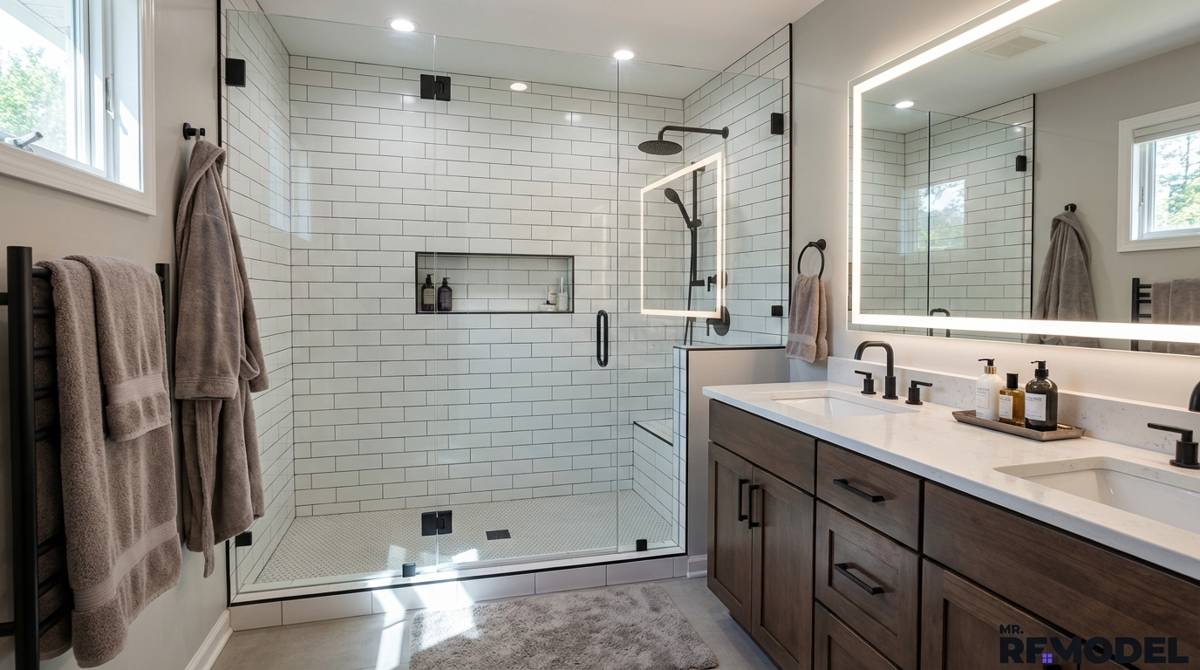
Table of Contents [hide]
Who This Is For
This guide is for homeowners who dislike their current bathroom but feel overwhelmed by the construction choices available. If you are debating between a total gut renovation or a surgical wet area update, or if you are weighing the cost of a luxury tile shower against the speed of a one-day acrylic system, this article provides the data you need. It is specifically designed for those balancing budget constraints with the need for high-impact changes.
Key Takeaways
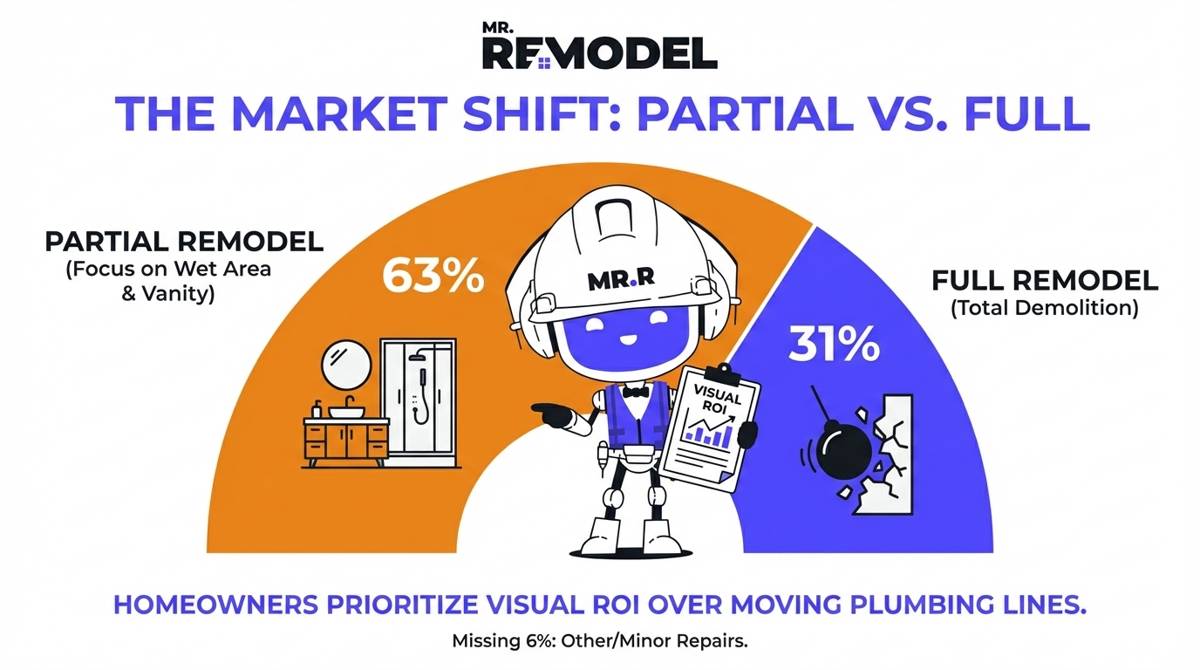
- Partial is the New Standard: Mr. Remodel data shows that 63% of homeowners choose a Partial Remodel (focusing on the wet area and vanity) over a Full Remodel to maximize ROI and minimize disruption.
- The Tub-to-Shower Reality: Converting a tub to a walk-in shower is the most requested upgrade (17% of volume) but often has the highest ticket price ($18k+) due to complex drain relocation requirements.
- Speed is Available: For the 40% of homeowners who need immediate results, One-Day Remodels using custom acrylic systems offer a code-compliant solution without the weeks of messy demolition.
- Drain Size Matters: The cost difference between a simple swap and a conversion often comes down to plumbing code; changing a tub to a shower requires upsizing the drain from 1.5 inches to 2 inches.
- ROI Favorability: Focusing your budget on high-traffic fixtures often yields a better return than spreading a thin budget across an entire room renovation.
Navigating the landscape of bathroom remodeling options and methods in 2026 can feel like walking through a minefield of conflicting advice. You might have a contractor pushing for a $40,000 complete tear-out, while a television commercial promises you a brand new bathroom for pennies in just one day. The truth, as usual, lies somewhere in the middle.
A bathroom remodel is not a binary choice between cheap and expensive. It is a strategic decision about where to deploy your capital to get the most daily satisfaction and long-term value. According to Mr. Remodel’s data, the market has shifted away from the all-or-nothing approach. Homeowners are becoming surgical in their renovations. They are prioritizing the wet area (the shower and tub) where 90% of the water damage and daily usage occurs.
Whether you are looking to age in place with a safe walk-in shower, modernize a guest bath before the holidays, or completely overhaul a master suite, understanding the structural and financial differences between these methods is critical. This guide breaks down the five main paths (Full, Partial, Shower Only, Conversion, and One-Day Remodels) to help you decide which route aligns with your home and your wallet.
The Core Decision: Full vs. Partial Remodel
The first fork in the road is determining the scope of your project. Do you need to strip the room down to the studs, or can you achieve your goals by focusing on specific zones?
The Full Remodel
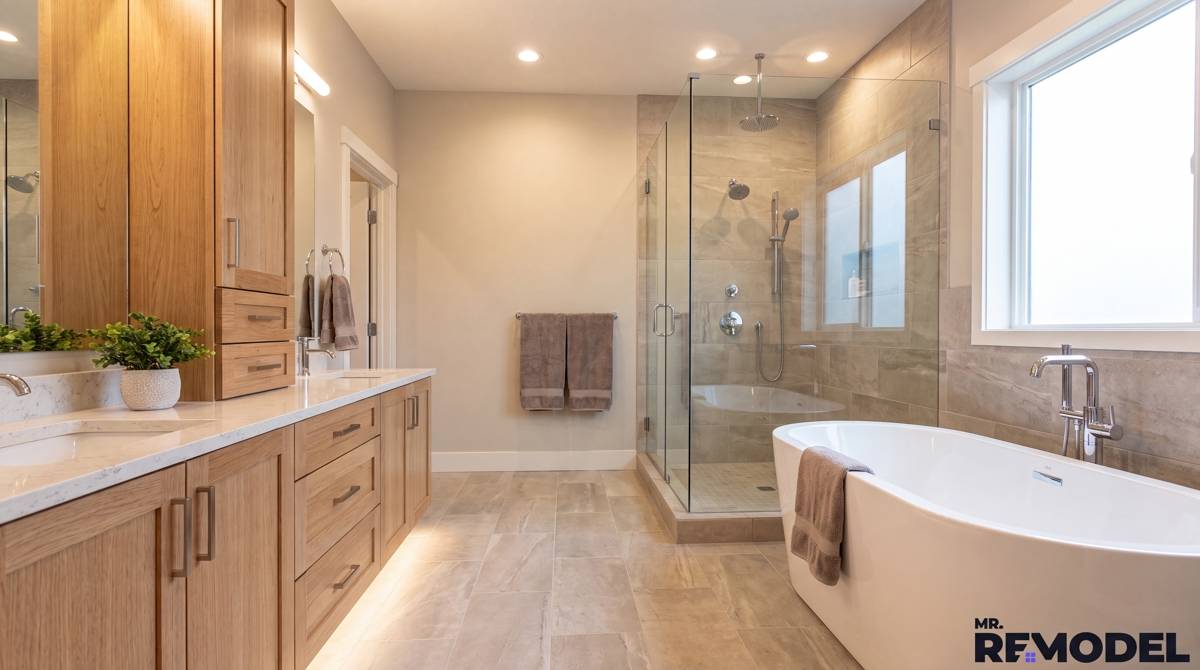
A Full Remodel involves total demolition. Everything goes: the flooring, the drywall, the lighting, the vanity, the toilet, and the tub/shower. This is the choice for 31% of homeowners in our dataset.
When It Is Required:
- Layout Changes: If you want to move the toilet to the other side of the room or expand the footprint of the bathroom, you need a full remodel. Moving waste lines requires opening up the floor joists.
- Water Damage: If you have rot in the subfloor that extends beyond the shower area, you likely need to gut the room to remediate mold.
- Total Aesthetic Shift: If your floor tiles are from 1980 and clash with your modern vision, they have to go.
The Reality Cost:
Full remodels are expensive and time-consuming. You are paying for multiple trades: plumbers, electricians, tile setters, and drywall finishers. The timeline is typically 3 to 6 weeks.
The Partial Remodel
This is the modern standard. A Partial Remodel focuses the budget on the wet area (tub/shower) and the vanity. You keep your existing layout, your flooring (if it is in good shape), and your lighting.
Why 63% Choose This:
Our data indicates that nearly two-thirds of homeowners opt for this method. Why? Because it offers a higher Visual ROI. Instead of spending $5,000 on moving plumbing lines and hanging new drywall, which are things you cannot see, you put that money into a luxury shower system and a high-end quartz vanity.
Cost vs. Impact:
By avoiding the labor costs of total demolition, you can often afford higher-quality fixtures. A $15,000 Partial Remodel usually looks more high-end than a $15,000 Full Remodel, where the budget was spread too thin.
See Related: Full Bathroom Remodel vs Partial Remodel
The Wet Area Strategy: Shower Only Remodel
For many homeowners, the bathroom is fine, except for the shower. The fiberglass is cracked, the grout is moldy, or the door track is rusted shut. In these cases, a Shower Only remodel is the most efficient use of funds.
The System Update Approach
According to industry research, over 50% of renovation activity is driven by the desire to upgrade old systems rather than change the footprint. By isolating the renovation to the shower enclosure, you minimize dust and disruption to the rest of the home.
Wet Area Options
- Acrylic Liners: These are custom-molded sheets that fit over your existing tub or walls. They are the cheapest option, but merely cover up potential problems rather than fixing them.
- Wall Surround Systems: These are solid surface panels (acrylic, composite, or stone) installed directly onto the studs after the old tile is removed. This ensures any rot behind the wall is addressed.
- Tiled Showers: The traditional route. It offers infinite design flexibility but requires significant maintenance to keep grout lines clean.
See Related: Shower Only Remodel vs Full Bathroom Remodel
Tub-to-Shower Conversions: The Structural Shift
This is the fastest-growing segment in the industry. According to the NKBA Design Trends Report, removing bathtubs to create large, walk-in showers is the number one design shift in residential bathrooms. However, it is also one of the most misunderstood in terms of cost.
Why It Costs More ($18k Average)
Homeowners often assume that taking out a tub and putting in a shower should be cheaper because there is "less material." In reality, Mr. Remodel’s data shows these projects have the highest average ticket price at over $18,310.
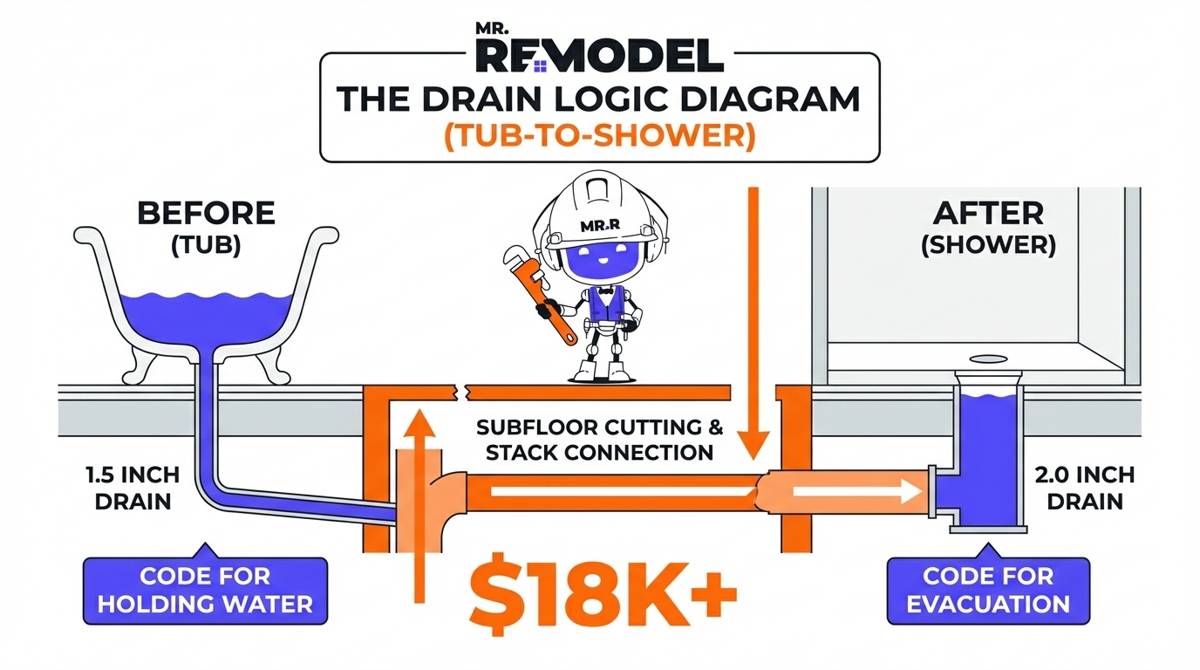
The Drain Logic Explanation:
You cannot simply plug a shower into a bathtub drain.
- Bathtub Drain: Typically 1.5 inches in diameter.
- Shower Drain: Required by code to be 2.0 inches in diameter.
Bathtubs hold water, so a slow drain is fine. Showers must evacuate water immediately to prevent flooding. To convert, the plumber must cut into your subfloor, remove the old 1.5-inch P-trap, and run a new 2-inch line to the main stack. This is major structural plumbing work.
The Accessibility Factor
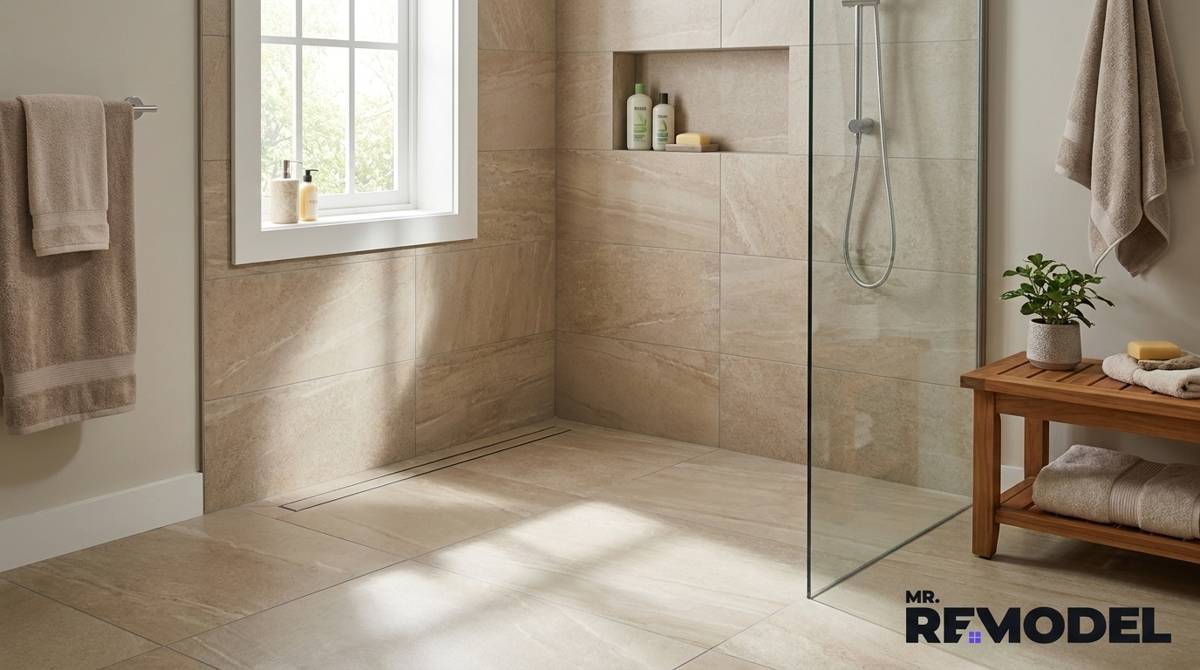
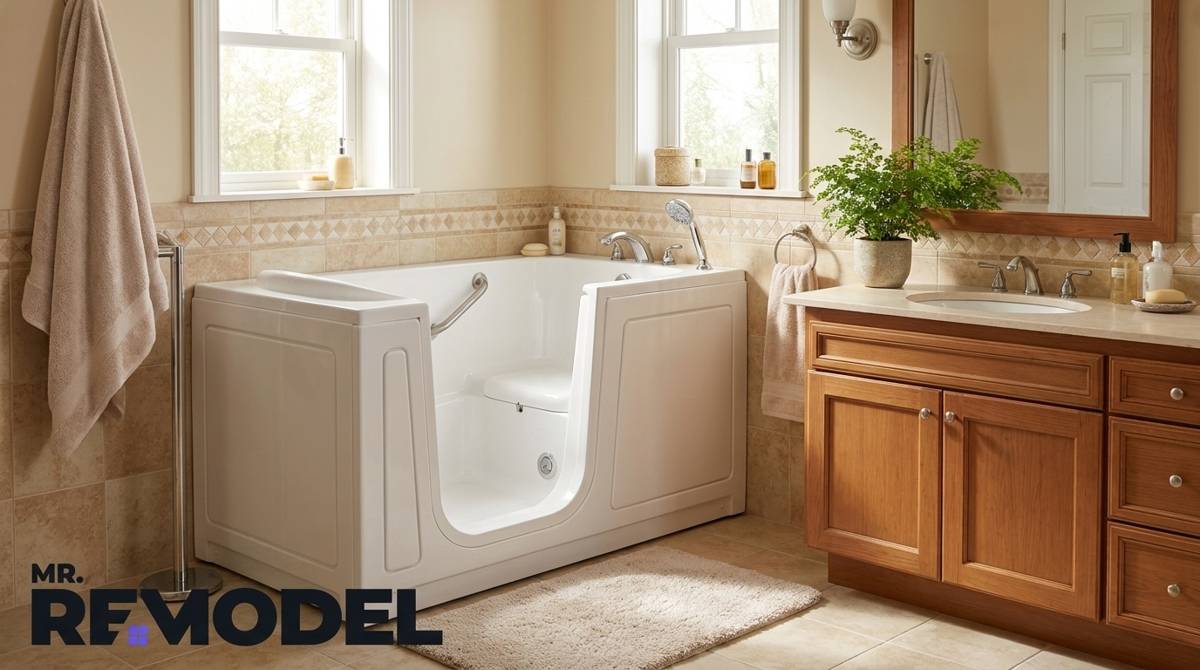
This renovation is often driven by the "Aging in Place" movement. The National Association of Home Builders (NAHB) highlights curbless showers as a critical safety upgrade. Eliminating the 15-inch step-over of a bathtub reduces fall risk significantly. For the 17% of our buyers in this category, the cost is an investment in safety and independence.
See Related: Tub-to-Shower Conversion Options
The One-Day Bathroom Remodel Explained
For 40% of our customers, time is the primary constraint. They only have one bathroom in the house, or they have guests arriving in a week. They cannot afford a month-long construction zone. This demand has given rise to the "One-Day Remodel."
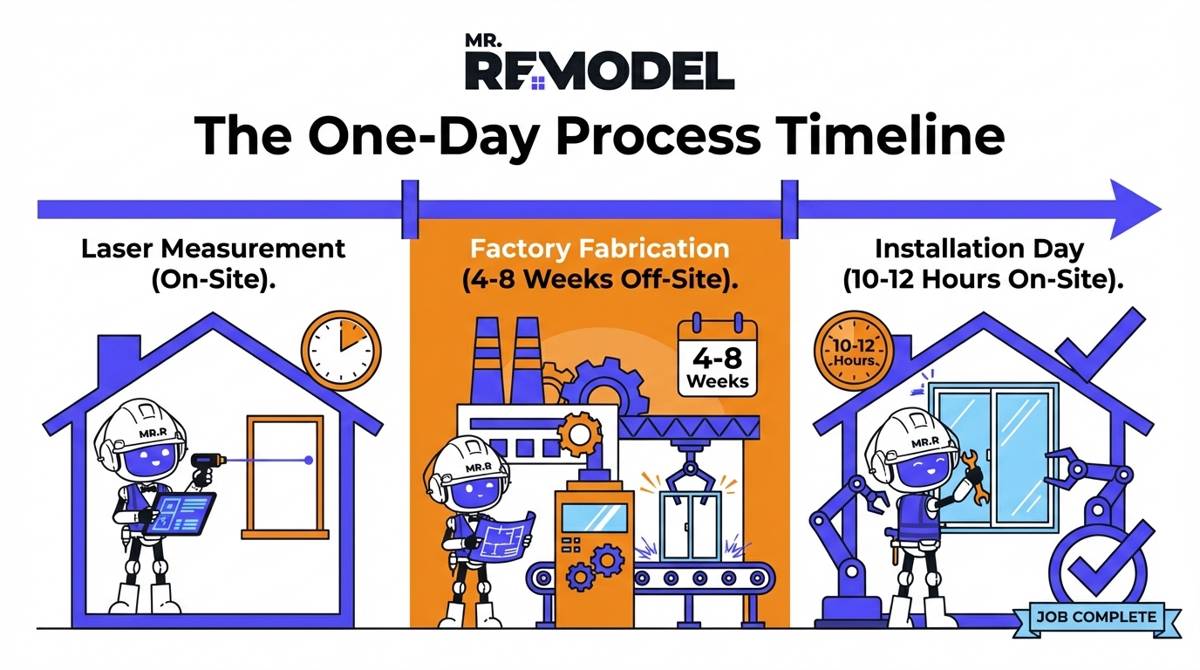
How Is It Possible?
Many people are skeptical of the "One Day" claim. Is it a scam? No, it is a logistical strategy.
- Measurement: A technician uses laser tools to measure your space down to the millimeter.
- Off-Site Fabrication: The wall panels and shower base are custom-manufactured in a factory to those exact dimensions.
- Installation: On install day, the crew arrives with the finished materials. Because there is no tile to cut and no grout to dry, they can demolish the old unit and install the new system in a single 10-12 hour shift.
Code Compliance
It is crucial to note that reputable One-Day installers still follow the Uniform Plumbing Code (UPC). They replace the valve and the drain connection; they just use materials that install faster than tile. This method is ideal for standard-sized bathrooms but may not work for complex, custom layouts.
See Related: One-Day Bathroom Remodel Explained
Timeline Expectations: Managing Your Schedule
The duration of your project depends entirely on the method you choose. Misunderstanding the timeline is the number one cause of homeowner frustration.
The Breakdown
- One-Day/Acrylic System: 1 to 2 days on-site. (Note: Lead time for manufacturing can be 4 to 8 weeks.
- Partial Remodel (Tile): 5 to 10 days. Tile requires drying time for thin-set and grout.
- Full Remodel: 3 to 6 weeks. This involves multiple inspections (rough-in plumbing, electrical, framing) that can pause work for days at a time.
The Phantom Wait Time
Remember that the clock starts when you sign the contract, not when the hammer swings. Permit approval and material ordering can add weeks to the front end of any project.
See Related: Bathroom Remodel Timeline Explained
Cost Analysis and ROI: Spending Smart in 2026
Budgeting for a remodel is difficult because prices vary wildly by region. However, understanding the "Cost vs. Value" dynamic helps you make smart choices.
The ROI of "Mid-Range" Updates
According to the 2025 Cost vs. Value Report by The Journal of Light Construction, a mid-range bathroom remodel (focusing on fixtures and finishes rather than moving walls) often recoups a higher percentage of its cost than an upscale remodel.
This is largely because future buyers appreciate a clean, modern shower and a new vanity. They rarely pay a premium for moved walls or heated floors. By sticking to a Partial Remodel (approx. $15,000 to $18,000), you keep your investment in the sweet spot of home value.
Mr. Remodel Data Insight
- Average Tub/Shower Project: $15,800
- Average Full Remodel: $28,000+
- Tub-to-Shower Conversion: $18,310
If your primary goal is resale, the data suggests that upgrading the wet area yields the best return. If your goal is personal luxury, the sky is the limit.
Flooring Materials: Acrylic vs. Tile vs. Stone
The material you choose dictates the maintenance level of your new bathroom.
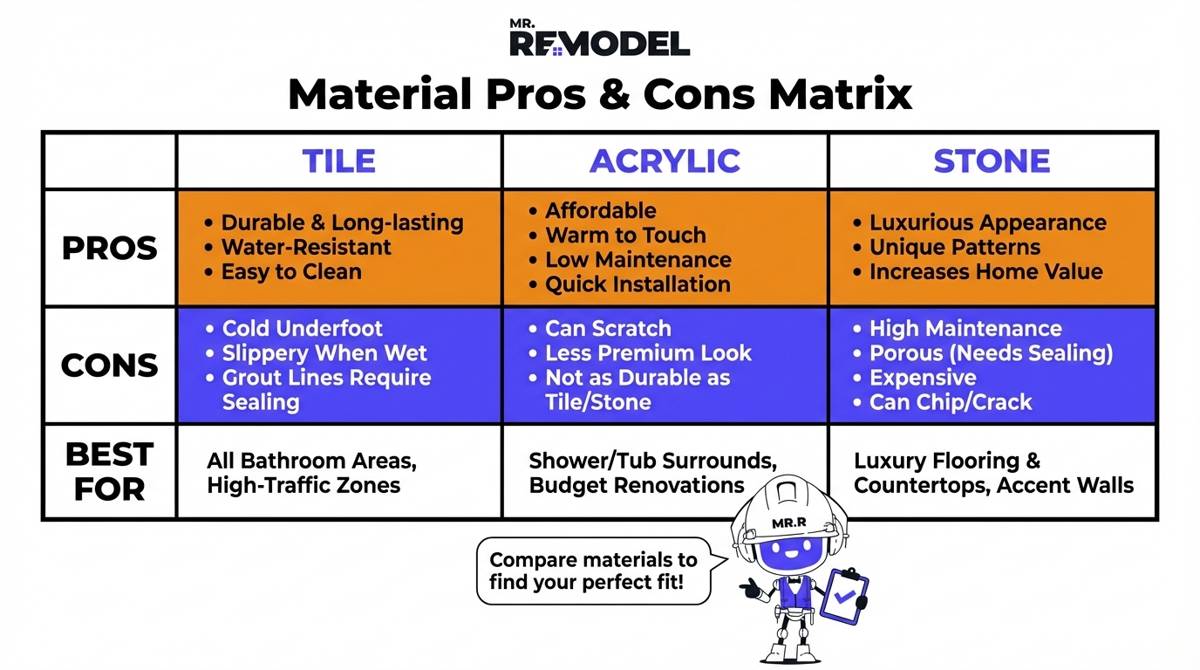
Tile (The Traditional Choice)
- Pros: Infinite design options, premium look, high resale value.
- Cons: Grout lines require scrubbing and sealing. Grout can crack, leading to leaks. Expensive installation.
Acrylic/Composite (The Modern Choice)
- Pros: Non-porous (easy to clean), no grout lines to mold, flexible (won't crack with house settling), fast installation.
- Cons: Can look "plasticky" if low-grade. Limited design patterns compared to tile.
Engineered Stone
- Pros: Looks like real marble or granite but is non-porous and requires no sealing.
- Cons: Heavy and expensive.
Hiring a Professional vs. DIY
In the age of YouTube, many homeowners are tempted to tackle bathroom remodeling themselves. While painting and vanity swapping are safe DIY projects, the wet area is different.
The Plumbing Risk
Bathroom remodeling involves supply lines (pressure) and waste lines (sewer gas). A mistake here is not just messy; it is dangerous and expensive. Improperly waterproofing a DIY shower pan can lead to slow leaks that rot out floor joists over the years, causing structural failure.
The Code Factor
Professional contractors understand local code requirements regarding drain slope, vent distance, and tempered glass safety. For a project involving water containment, the warranty that comes with a pro installation is often worth the labor cost.
Frequently Asked Questions
What is the difference between a full and partial bathroom remodel?
A Full Remodel typically involves demolition down to the studs, changing the layout (moving toilets or sinks), and replacing flooring and lighting. A Partial Remodel focuses on replacing just the bathtub or shower and the vanity. This option offers a new look for significantly less mess and downtime.
Why does a tub-to-shower conversion cost more than a standard remodel?
Mr. Remodel data shows Tub-to-Shower conversions average roughly $18,310, which is often higher than cosmetic updates. This is because converting a tub to a shower is a structural plumbing project. It requires digging into the subfloor to expand the drain pipe size from 1.5 inches to 2 inches to meet code, waterproofing the new footprint, and often installing heavy glass enclosures.
Does replacing a tub with a shower hurt resale value?
Generally, no, as long as there is at least one bathtub remaining in the home. The National Kitchen & Bath Association reports that large, walk-in showers are the number one requested bathroom feature. For most buyers, a modern luxury shower adds more value than an unused, outdated fiberglass tub.
Do I need a permit for a bathroom remodel?
If you are changing plumbing or electrical systems, the answer is almost always yes. A simple "remove and replace" of a fixture in the same spot sometimes does not require a permit, but converting a tub to a shower (which changes the drain) definitely does. A reputable contractor will handle the permitting process for you.
Bathroom Remodeling Options: Choosing Your Path
The best bathroom remodeling method is the one that solves your specific pain points.
- If you need accessibility or hate stepping over a tub wall: Choose a Tub-to-Shower Conversion.
- If you want a modern look without a month of dust: Choose a Partial Remodel or One-Day System.
- If you are gutting a rot-filled room or moving walls: Commit to a Full Remodel.
Don't let the options overwhelm you. Use the data to make a well-informed decision that balances your budget with your long-term needs. If you’re concerned about finding the right contractor for your bathroom remodeling project, let Mr. Remodel connect you with trusted, local contractors who can help you create your dream bathroom.
Ready to get specific quotes for your chosen method?
Get Your Free, No-Obligation Bathroom Remodeling Quote Today